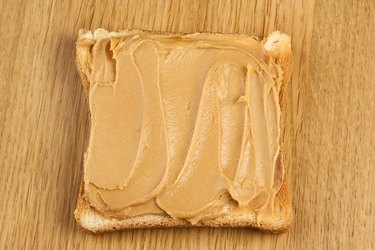
If you prefer Jif peanut butter, you can feel confident that it's as healthy as most other brands. The macronutrients in Jif are nearly identical to the amount in generic peanut butter reported in the U.S. Department of Agriculture's National Nutrient Database. Even though Jif has different varieties, most of them share the same nutritional profile. Just be aware: Some that sound healthy aren't always the best choice.
Control Calories by Limiting Portions
Video of the Day
You'll get the same amount of macronutrients from most of the regular varieties of Jif peanut butter, such as the creamy, crunchy and natural types. The first two ingredients in the regular varieties are peanuts and sugar, followed by 2 percent or less of molasses, fully hydrogenated vegetable oil, sugar and emulsifiers. These Jif varieties have 190 calories, 8 grams of total carbohydrates and 3 grams of sugar in a 2-tablespoon serving. One exception -- Simply Jiff -- consists primarily of peanuts and has sugar listed with the minor ingredients. It has 180 calories, 7 grams of carbs and 2 grams of sugar per serving.
Video of the Day
Boost of Protein
The Academy of Nutrition and Dietetics recommends peanut butter sandwiches on its list of healthy snacks to help repair and rebuild muscles after endurance activities. But you don't have to be an athlete to benefit from the protein in Jif peanut butter products. A 2-tablespoon serving contains 7 grams of protein. This amount provides 15 percent of women's and 12.5 percent of men's recommended dietary allowance.
Healthy Fats for Heart Health
The different types of regular Jif peanut butter contain 16 grams of total fat in a 2-tablespoon serving. You won't get any cholesterol, and at least 80 percent of the total fat consists of unsaturated fats, which help lower cholesterol. Peanut butter doesn't naturally contain the omega-3 fatty acids commonly called fish oil: eicosapentaenoic acid and docosahexaenoic acid. Jif produces a special omega-3 peanut butter by fortifying it with anchovy and sardine oil. It has the same amount of total and unsaturated fats as other varieties.
Antioxidant Vitamin E, But Sodium Too
Some Jif products are fortified with vitamin C, but most contain the same nutrients. They're all good sources of vitamin E and niacin and provide smaller amounts of iron and riboflavin. Check the label for sodium content, because it varies. Jif creamy peanut butter has 140 milligrams per serving, or about 9 percent of your recommended daily intake. Simply Jif only has 65 milligrams of sodium, while its natural peanut butter has 80 milligrams.
Reduced Fat and Other Varieties
Jif's reduced fat peanut butter eliminates 4 grams of fat, but it has nearly double the amount of carbohydrates. As a result, the total calories stay the same. You'll also get significantly more sodium: 220 milligrams in a 2-tablespoon serving. If you buy peanut butter with honey, chocolate or other flavors, you'll get more carbs and double the sugar as in the regular varieties. Jiff also has a line of whipped peanut butter. They have fewer calories but also less protein and nutrients and diverse amounts of sugar and carbs.
- Harvard School of Public Health: Fats and Cholesterol: Out With the Bad, In With the Good
- Academy of Nutrition and Dietetics: Top Snacks for Runners
- Institute of Medicine: Dietary Reference Intakes
- Jif Regular Peanut Butter: Creamy Peanut Butter
- Jif Regular Peanut Butter: Extra Crunchy Peanut Butter
- Jif Natural Peanut Butter Spread: Creamy Peanut Butter Spread, Contains 90 Percent Peanuts
- Jif: Simply Jif Peanut Butter: Creamy Peanut Butter
- Jif Omega-3 Peanut Butter: Creamy Peanut Butter With Omega-3 DHA and EPA
- Jif: Reduced Fat Creamy Peanut Butter Spread (60 Percent Peanuts)
- Jif Whipped Peanut Butter Spreads: Whipped Peanut Butter and Chocolate Flavored Spread
- USDA National Nutrient Database: Peanut Butter, Smooth Style, With Salt