Protein is an essential nutrient, and it's found in food sources, such as chicken breast, meat, seafood, black beans and tofu. It's often called the building blocks of life because it's found in every human cell.
Cells rely heavily on protein to function. They're able to build protein to perform specific functions, but this wouldn't be possible without a process called protein synthesis. For this process to be carried out, biomolecules that carry information and make up your genetic material (aka nucleic acids) get involved.
Video of the Day
Video of the Day
Here's how it works and how protein and nucleic acids like DNA and RNA are closely related.
What Are Nucleic Acids?
There are two key players when it comes to genetic material — deoxyribonucleic acid (DNA) and ribonucleic acid (RNA). These are the two main types of nucleic acids. They make up your genetics, but they do more than that.
Nucleic acids play essential roles in all cells and viruses, such as storing genomic information and creating new proteins, according to the National Human Genome Research Institute. One of the major roles of nucleic acids is a process called protein synthesis.
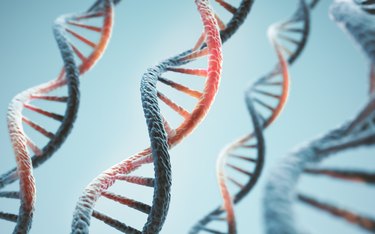
DNA molecules, which take on the famous double helix form, carry information. Each molecule consists of four chemical bases — adenine, guanine, cytosine and thymine — and the sequence determines the information, according to the U.S. National Library of Medicine. There are billions of sequences.
While DNA molecules famously have two strands, RNA molecules only have one. However, RNA molecules are just as important. In fact, RNA contains information copied from DNA. It's also the genetic material of some viruses.
Are Nucleic Acids Proteins?
No, nucleic acids aren’t proteins.
The two main types of nucleic acids are DNA and RNA. They are molecules that carry information.
There is a close relationship between nucleic acids and protein, but they are not the same. DNA and RNA are required to create proteins through the process of protein synthesis.
So, what do DNA and RNA have to do with protein? A lot. Protein couldn't exist without nucleic acids. Their main common ground is protein synthesis.
What Is Protein Synthesis?
Protein synthesis is the process where new proteins are formed in cells. Cells can then build those proteins to carry out the necessary functions. Every cell relies on proteins, so this process is very important, and it wouldn't be possible without nucleic acids.
Creating new proteins via protein synthesis is a two-step process, including transcription and translation.
It starts with DNA. First, a strand of DNA is transcribed to create RNA. This is a specific type of RNA called messenger RNA (mRNA), and it's like a middleman.
Information carried by the single-stranded mRNA molecule is then translated into chains of amino acids, according to the University of Utah. This is helped by ribosomes, which are molecular machines that read mRNA sequences and help form proteins out of the resulting amino acids. Short strings of amino acids form peptides and longer strings become proteins. So, DNA becomes RNA, which becomes new protein.