
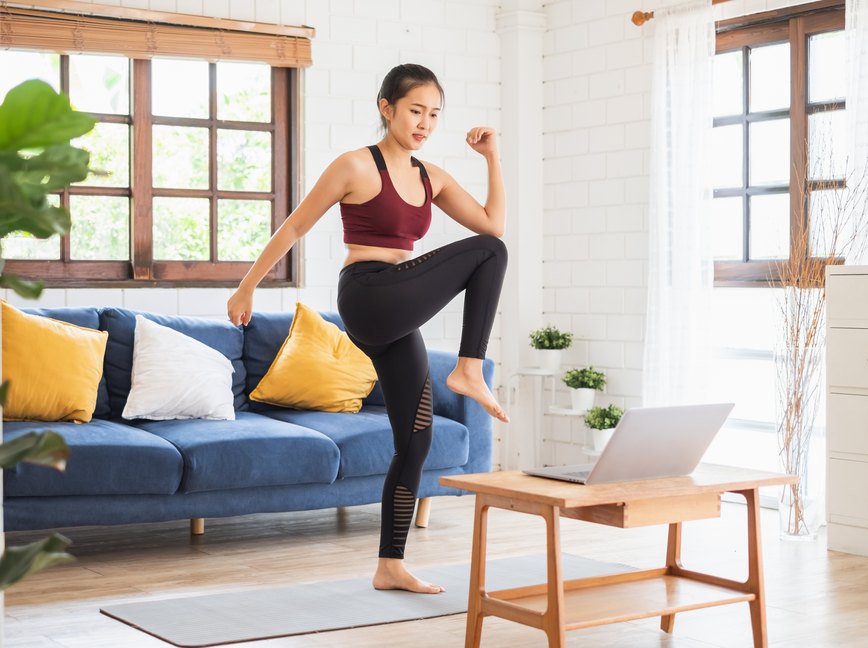
Circuit training workouts without equipment can provide both cardiovascular and strength training benefits, at home or in the gym, for any fitness level. And just because you're not using any equipment doesn't mean your workout will is any less effective.
To get an excellent strength and cardio workout, all you need is a circuit or two of several exercises (plus a few feet of free space). Learn more about circuit training and try your own equipment-free workout right at home.
Video of the Day
Video of the Day
What Is Circuit Training?
Circuit workouts are an efficient way to exercise. Typically, little rest is taken between sets as you perform one exercise right after another. Depending on your fitness level, the amount of rest you choose determines how extreme your workout is and what type of cardio you'll be performing.
There are several different types of circuit training, depending on your fitness goals and preference. You can design high-intensity workouts, aerobic workouts or advanced Tabata-style workouts (all of these are technically circuit training) by merely adjusting your rest and work periods.
For an advanced gym-goer, performing 60 seconds of work with 15 seconds of rest could be a reasonably standard high-intensity interval training (HIIT) circuit. Circuit training for beginners may include 30 seconds of high-intensity work with a 60-second break.
The good news is that you can easily design your own circuit training workouts without equipment and adjust them to your individual goals and fitness level. First, let's take a deeper look at some typical work and rest period times, and then explore some of the best circuit training exercises without weights.
What Is a 3-Exercise Circuit?
You don't need a ton of exercises or a gym and coach to enjoy circuit training benefits. You can create a circuit with even just three moves right at home. Just choose three exercises (like a squat, push-up and plank) and do each move for a certain time (like 30 seconds), followed by a minute of rest.
Designing Your Circuit Workout
The American Council on Exercise provides a table for determining the type of workout you are doing based on specific work and rest intervals. The intensity of your work interval will also come into play.
With anaerobic intervals, working out at an intense level — about 7 to 8 on a scale of 10 — will be required to get results. With aerobic training, the intensity will be lower, around 3 or 4 on the scale. Below is a Ratings of Perceived Exertion Scale, used by the American Council on Exercise and the Cleveland Clinic, among other institutions.
- 0 – No effort
- 1 – Very easy
- 2 – Somewhat easy
- 3 – Moderate effort
- 4 – Slightly hard
- 5 – Hard
- 6
- 7 – Very hard
- 8
- 9
- 10 – Very, very hard
Below are some examples of how to time your work and rest periods (or active recovery, AR) based on the desired workout type and intensity, as provided by the American Council on Exercise.
Tip
Remember to start slowly and work your way up. Do not attempt more advanced workouts without being physically ready. As always, speak to your healthcare provider before embarking on a new exercise program.
- Cardiovascular conditioning (aerobic): 1 to 5 minutes of work and 1 to 5 minutes of rest/AR (1:1)
- Metabolic conditioning (anaerobic HIIT): 15 to 45 seconds of work and 30 to 120 seconds of rest/AR (1:2-3)
- Tabata: 20 seconds of work and 10 seconds rest/AR (2:1)
Tabata, for example, requires working out at high intensity for 20 seconds followed by 10 seconds of rest or active recovery. Repeat this cycle for four minutes. That's a set, or round. Perform up to four rounds per session.
If, say, you prefer to exercise outdoors, you can sprint for 20 seconds, walk for 10 seconds and repeat. Continue for four minutes, take a short break and start all over.
Researchers behind a May-June 2013 study in ACSM's Health and Fitness Journal recommend selecting exercises that hit all of the major muscle groups. Furthermore, it's important to work large muscle groups to create the intensity and resistance necessary for an effective workout. With this approach, you'll burn more calories as your body requires more energy to use them.
Can You Do Circuit Training Without Equipment?
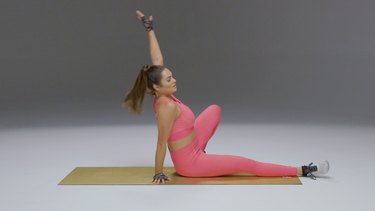
You don't need elaborate equipment, a big gym or a coach to create an effective circuit workout at home. And choosing exercises easy for transitions can also help reduce rest times. That's where body-weight exercises come in. A few recommended exercises include:
Should You Train Full-Body or One Area Per Workout?
Unfortunately, there's no perfect answer here — it depends on your personal goals. On busy weeks when you don't anticipate making it to the gym too many times, doing full-body workouts each day can help ensure you're training all your major muscle groups. But on weeks you anticipate hitting the gym several days, focusing on one area of the body can give that section a little more strength-building benefit.
Circuit Training Workouts Without Equipment
Depending on your schedule and fitness level, you can perform more than one circuit during a 20- or 30-minute workout. Remember to listen to your body and never sacrifice form for speed. Set a timer for 10 to 15 minutes and repeat this circuit until time is up, taking rest as needed.
Squats and Push-Ups Circuit
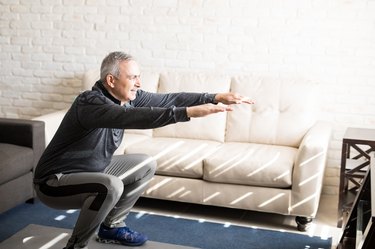
1. Body-Weight Squats
- Stand tall with your feet hip-width apart and brace your core. Focus on keeping your feet rooted into the ground and your core tight the entire time.
- Extend your arms out in front of you and slowly bend your knees as you push your hips back to lower toward the floor. Focus on lowering your body as if you were going to sit on a chair.
- Lower down as far as comfortable, or until your thighs are parallel with the floor.
- Pause for a moment at the bottom of your squat.
- On an exhale, reverse the motion by pressing through your heels to return to standing. As you stand, lower your arms back to your sides.
2. Push-Up
- Come into a high plank and extend your legs behind you so your head, hips and heels are aligned.
- Brace your core. Then, bend at your elbows to lower your torso to the floor. Make sure your elbows are no more than 45 degrees from your body.
- Push your hands into the ground to extend your arms and return to a high plank. Your body should come back to a plank in a straight line.
Tip
For a modified version, you can do incline push-ups, placing your hands on a box or bench instead of the floor.
3. Squat Jumps
- Stand with your feet shoulder-width apart and your toes facing forward or slightly outward.
- Keeping your feet flat on the floor and back straight, brace your core and push your hips back and down until your thighs are parallel to the floor (or as low as you can comfortably go).
- From the bottom of your squat, push through your feet to jump explosively off the ground. (You can extend your arms down along your sides as you do.)
- Land safely with your knees slightly bent.
After your squat jumps, rest for 1 to 5 minutes before you repeat the circuit. And if you get too tired during this exercise, substitute for quick-paced body-weight squats.
Why Choose Circuit Training
An April 2017 analysis published in Ageing Research Reviews showed that circuit training for three sessions per week for an average of 41 minutes per session resulted in greater upper and lower body strength.
This workout method increased adherence to strength training programs due to the shorter duration of circuit training workouts versus traditional models of straight sets and repetitions. Increasing workout adherence can mitigate the typical loss in muscle mass experienced by the majority of aging adults.
When it comes to measures of blood pressure and cholesterol, a small study published in Lipids in Health and Disease in September 2013 notes that high-intensity circuit training seems more effective than low-intensity circuit training.
The study found that although all groups displayed improved body weight measures, the high-intensity circuit training group had more significant reductions in several areas. These include fat mass, diastolic blood pressure, total cholesterol, low-density lipoprotein cholesterol and triglycerides, as well as an increase in healthy high-density lipoprotein cholesterol.
Researchers concluded that high-intensity circuit training was more effective at improving blood pressure and blood lipids than lower-intensity circuit training or endurance training alone.
It is clear that whether you opt for a lower-intensity or higher-intensity form of circuit training, the benefits are worth it. Choose a type of workout with your specific health concerns and goals in mind. You can also mix the two to get the best of both worlds.
- American Council on Exercise: "How to Create an Effective Circuit Workout"
- Cleveland Clinic: "Rated Perceived Exertion (RPE) Scale"
- American College of Sports Medicine's Health and Fitness Journal:"High-Intensity Circuit Training Using Body Weight: Maximum Results With Minimal Investment"
- Lipids in Health and Disease: "Effects of High-Intensity Circuit Training, Low-Intensity Circuit Training and Endurance Training on Blood Pressure and Lipoproteins in Middle-Aged Overweight Men"
- Ageing Research Reviews: "Circuit Resistance Training Is an Effective Means to Enhance Muscle Strength in Older Adults: A Systematic Review and Meta-Analysis"