
10 Types of Shooting in Basketball
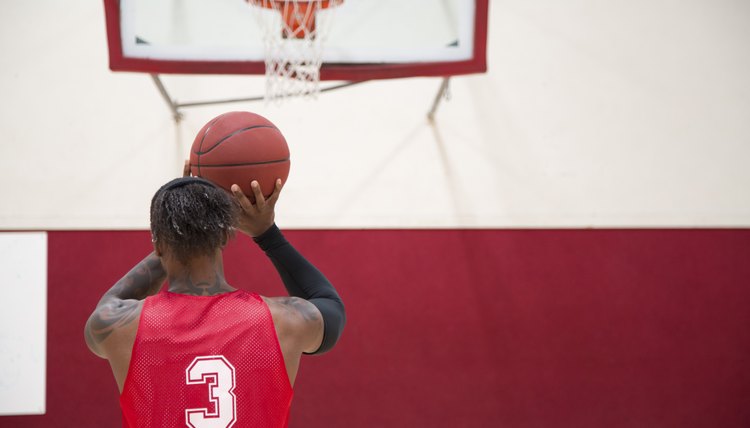
The object of basketball is to shoot the basketball through the slightly larger hoop. Shooting, like rebounding and passing, is one of the most basic skills in basketball, and one new players are typically eager to learn. While some players specialize in certain types of shots, all-around players learn as many as possible to maximize their basketball shooting options. Here are the types of shots all players should know from the NBA all the way down to beginners.
What are the fundamentals of shooting a basketball?
Most basketball players rely on the same basic shooting technique to hit different types of basketball shots. Square your shoulders to the basket, place the fingers of your shooting hand under the ball, tuck your elbow close to your body and balance the ball lightly with your non-shooting hand. Extend your shooting arm toward the hoop and flick your wrist to release the shot. Shoot with your fingers and generate most of the power with your wrist, not your arm. Follow through directly toward the target with your shooting hand. You’ll typically aim for a spot above the middle of the rim. From close range, aim for a spot on the backboard. This is the basic shot that the all-time great shooters use and basketball coaches coach in basketball drills.
How to shoot a Mid-range jump Shot
The jumper is used often for shots that reside in the middle range of the basketball court. Use your footwork to get separation and be prepared to quickly go through your shooting motion, Jump straight up and use the basic shooting form. Release the ball at the peak of your jump. This is the easy way to get a two point field goal, besides a slam dunk of course.
How to shoot a Three point jump shot
Most NBA players are being forced to add this shot to their repertoire thanks to the way Steph Curry and Klay Thompson have changed the game of basketball. Stephen Curry has made three-point shots a way of art but shooting them can be easy as long as you stay behind the three-point line. Curry keeps his body aligned with the basket while having his feet face slightly to the left. Curry also dips the ball to build momentum before he comes up and brings the ball to where his right eye is with his arm and torso making a ninety degree angle. He then transfers the weight of the ball from his palm to his fingertips and lets it fly for a three pointer. This is how Curry shoots his long range shots as one of the best shooters of all time.
How to shoot a Free throw
The two-handed set shot was once the common way to shoot from the perimeter. Today it’s typically only used by young players who lack the strength to shoot with one hand. A free throw, however, is basically a type of set shot, although it’s almost always performed with one hand. Use the standard shooting form, but don’t jump. A free throw occurs when an offensive player is fouled by a defensive player.
How to shoot a Bank shot
A bank shot is a shot that banks off the backboard and into the hoop. It’s a hard shot to hit due to the angles but many mid-range shots can be banked in. Just aim for the square behind the hoop if dead on with the basket, but off center shots need to be angled in.
How to shoot a Fadeaway
The fadeaway is a very difficult shot to consistently hit. The fadeaway is a shot used when needing to shoot over a defender. You will start by dribbling and gathering the ball. Then you have to go through the shot motion while falling backward in order to angle your shot over the defender. Often the fadeaway shot can be started with your back to the basket.
How to shoot a Layup
You’ll typically shoot layups from very close range after dribbling to the basket, or taking a pass near the hoop. Typical layup form involves grasping the ball with two hands, raising it in front of your face and banking it off the backboard, which all occurs while you’re in motion. A putback of a missed shot is also technically a layup. If you can jump well enough you may also raise the ball as high as possible and flip it straight through the rim.
How to shoot Post Shots
Centers and power forwards who typically operate near the basket often use short shots. A turn-around jumper begins with your back to the basket. You then jump away from the hoop while leaning back and simultaneously pivoting about 180 degrees to face the basket before you shoot. For a hook shot, stride into the lane with your back to the hoop while keeping your torso between the basket and the ball. Turn your non-shooting shoulder toward the hoop, jump, raise the ball straight up and flip your wrist to take the shot.
How to Dunk
The dunk, basketball’s most spectacular shot, relies more on jumping ability than shooting skill. If you can jump high enough, and hands large enough to control the ball, leap, lift the ball above the rim and push or throw it through the net.
References
Writer Bio
M.L. Rose has worked as a print and online journalist for more than 20 years. He has contributed to a variety of national and local publications, specializing in sports writing. Rose holds a B.A. in communications.