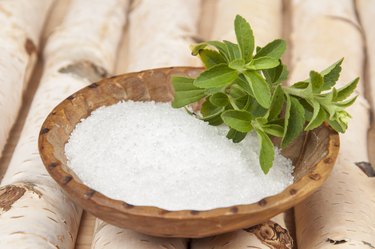
The glycemic index is a scale that indicates how quickly your blood sugar is likely to rise after you eat a certain food. Sugar alcohols, which are digested slowly, have a very low glycemic index. Other sugar substitutes, such as aspartame, saccharin and stevia, do not contain carbohydrates and rank very low on the glycemic index. Sucralose is not digested and has a low glycemic index. Selecting a sugar substitute can prevent large fluctuations in blood sugar.
The Glycemic Index
Video of the Day
The glycemic index ranks food on a scale from 0 to 100. The closer to 100, the higher the glycemic index. Glucose, a unit of carbohydrate broken down into its simplest form, has a glycemic index of 100. Foods below 55 have a low glycemic index, foods between 56 and 69 have a medium glycemic index and foods above 70 have a high glycemic index. To determine a food's glycemic index, volunteers eat 50 grams of carbohydrate. Participants' blood sugar levels are measured for the next two hours and compared to the changes in their blood sugar levels after eating 50 grams of glucose, which is the reference food of the glycemic index.
Video of the Day
Sugar Alcohols
Although they taste like sugar, sugar alcohols are digested in the body much slower than regular sugar. They also have fewer calories. For example, a teaspoon of sugar has 4 calories, but a teaspoon of the sugar alcohol erythritol has only 0.2 calorie, and a teaspoon of xylitol has 2.4 calories. Xylitol's glycemic index is 12, while erythritol's glycemic index is 1. Some people may experience stomach cramps and diarrhea if they eat too many sugar alcohols, although the manufacturers of erythritol state that it is better absorbed and less likely to cause abdominal distress than other sugar alcohols.
Aspartame, Saccharin and Sucralose
Aspartame, saccharin and sucralose all have a glycemic index of 0. More than 6,000 food products contain aspartame, the first low-calorie sweetener to be approved by the U.S. Food and Drug Administration. When you digest aspartame, which contains no carbohydrates, it breaks down into two amino acids and a small amount of methanol. Saccharin also provides a sweet flavor without calories or carbohydrates. Sucralose is manufactured from sugar. It is very sweet but has no calories because it passes through the body without being digested.
Stevia
Several brand-name sweeteners use stevia, or rebaudioside A, which comes from a plant in South America. The sweet parts of the plant, known as steviol glycosides, are isolated and purified from the leaves. Stevia is metabolized in the stomach to steviol, which is excreted in the urine. Sweeteners that contain stevia have zero calories or carbohydrates. Stevia has a glycemic index of 0.