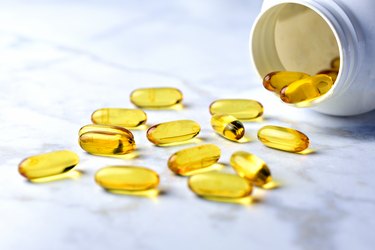
Because fish oil pills contain fat, it's logical to wonder if they cause weight gain. Research shows no evidence of this effect.
Fish oil has 41 calories in 1 teaspoon and 123 calories in 1 tablespoon, reports the United States Department of Agriculture. Despite the caloric content, a few preliminary studies suggest the oil may actually lead to a reduction in waist circumference rather than weight gain.
Video of the Day
Video of the Day
Tip
Taking fish oil supplements doesn't lead to weight gain.
Omega-3 Fatty Acids
The two omega-3 fatty acids in fish oil are docosahexaenoic acid (DHA) and eicosapentaenoic acid (EPA). Food sources of these nutrients include fatty fish, such as salmon, tuna, mackerel and herring, states the National Institutes of Health.
An additional omega-3 fatty acid called alpha-linolenic acid (ALA) is found in the plant foods of chia, flaxseed and walnuts. The body converts only a small amount of ALA to EPA and DHA, so it's important to get these nutrients from both fish and plant sources.
Omega-3 fats have multiple uses. They provide calories for energy and are a vital part of the membrane that encircles every cell in the body. DHA levels are particularly high in the brain, sperm cells and retina of the eye. These healthy fats also play a role in the functioning of the immune system, lungs, endocrine system, heart and blood vessels, notes the NIH.
Benefits of Eating Fatty Fish
The American Heart Association (AHA) states that eating omega-3 fish lowers the risk of abnormal heart rhythms that can lead to sudden death. It also slows the development of hardening of the arteries and reduces triglyceride levels.
People should eat fish, especially fatty fish, twice a week, recommends the AHA. Each serving should be 3.5 ounces or approximately 3/4 cup. The USDA's ChooseMyPlate offers the following serving guidelines: a salmon steak is 4 to 6 ounces, a can of tuna is 3 to 4 ounces and a small trout is 3 ounces.
Some varieties of fish have mercury and other contaminants, warns the AHA. In spite of this problem, the benefits outweigh the risks for postmenopausal women and men who are middle aged and older.
Unquestionably, eating fatty fish is beneficial for health, yet the advantages of taking the pills is less clear. Sometimes food-derived nutrients have effects that differ from supplement-delivered nutrients. When you eat fish, you ingest all the vitamins, minerals and other beneficial components in addition to the fatty acids, but when you take the pills, you ingest only the fatty acids, explains Harvard Health.
Likewise, taking many supplements is no substitute for eating nutrient-dense foods like fruits, vegetables and whole grains. The immense value of a healthy diet doesn't translate to supplements.
Fish Oil Benefits
Animal experiments investigating the effect of fish oil on weight suggest a benefit, but human experiments show inconsistent results. For this reason, a November 2015 study published in PLOS One undertook a review of clinical trials to determine if the oil promotes weight loss.
The PLOS One review says current findings didn't support an anti-obesity advantage, but the oil appeared to reduce waist circumference. A decrease in abdominal fat could help people with obesity, especially if they engage in lifestyle modifications, the authors concluded. Large-scale studies are needed to draw definite conclusions.
Improved heart health is a possible benefit of fish oil, states the Mayo Clinic. Studies indicate that taking fish oil supplements for at least six months lowers the risk of heart-related events and death in people at high risk.
Multiple investigations note modest decreases in blood pressure in people taking the supplements. The positive effect may be more pronounced in people with moderate-to-high blood pressure than in those with mildly elevated blood pressure, says Mayo Clinic.
According to the Arthritis Foundation, DHA and EPA have anti-inflammatory properties that have value for arthritis. Preliminary evidence indicates fish oil pills may reduce joint tenderness and stiffness in rheumatoid arthritis and osteoarthritis.
Reviews of scientific literature suggest fish oil reduces depression when taken with antidepressants, notes the Arthritis Foundation. The oil also decreases symptoms of Raynaud's disease, a condition that restricts circulation to the skin.
Fish Oil Side Effects
The concentrated oil in supplements isn't risk-free. Harvard Health says that anyone middle-aged or older shouldn't take fish oil pills without consulting a doctor.
When the pills are taken as directed, they're generally considered safe. However, side effects include bad breath, loose stools, indigestion, nausea, rash and a fishy aftertaste.
Fish oil pills have a side effect associated with one of their benefits. While they may reduce the risk of blood clots, taking too much may raise the likelihood of bleeding, states Harvard Health. If the dose is high enough, the increased risk of bleeding may cause a stroke, says Mayo Clinic. High doses of fish oil can also suppress immunity.
It isn't known if people with seafood allergies can take fish oil capsules safely. Signs of an allergic response include hives, itching, skin rash and swelling of the tongue, lips or face, notes the Cleveland Clinic. Symptoms may also include breathing problems. If you experience these effects, report them to your doctor as soon as possible.
Unlike medications, no oversight agency regulates the quality, source or quantity of ingredients in supplements. In some brands of fish oil, research has found trace amounts of polychlorinated biphenyls, which are chemicals linked to cancer. Other studies show the amounts of omega-3 fatty acids posted on product labels are inaccurate in some products.
Fish Oil Drug Interactions
Fish oil interacts negatively with some medications. Exercise care in taking it with anti-clotting drugs like warfarin or aspirin; it might raise the risk of bleeding.
Don't take fish oil with orlistat, because the drug will reduce the absorption of the beneficial fat. Instead, take the supplement and medication two hours apart. Contraceptive drugs may suppress the positive effect of the oil on triglycerides. Fish oil may also decrease vitamin E levels, notes the Mayo Clinic.
- National Institutes of Health: "Omega-3 Fatty Acids"
- American Heart Association: "Fish and Omega-3 Fatty Acids"
- USDA: ChooseMyPlate.gov: "10 Tips: Eat Seafood Twice a Week"
- Harvard Health Publishing: "Fish Oil: Friend or Foe?"
- USDA National Nutrient Database: "Fish Oil, Cod Liver"
- PLOS One: "Does Fish Oil Have an Anti-Obesity Effect in Overweight/Obese Adults?"
- Mayo Clinic: "Fish Oil"
- Arthritis Foundation: "Fish Oil"
- Harvard Health Publishing: "Should You Consider Taking a Fish Oil Supplement?"
- Cleveland Clinic: "Fish Oil, Omega-3 Fatty Acids Capsules (OTC)"