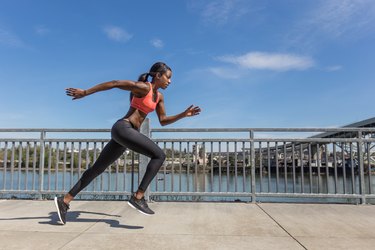
Sprinting seems like a simple enough action, but if speed is what you're after, knowing how to angle your body and position your legs and feet correctly will really separate the hares from the tortoises.
The good news is that you don't need to train like an Olympic athlete to reach your true sprinting potential, although sprinting phenom Michael Johnson in an article for the BBC does provide a few priceless tips.
Video of the Day
Video of the Day
He believes that visualizing the race in your head and having a race strategy makes all the difference. A few simple tweaks here and there and a little applied knowledge will help you run faster than you've ever run before.
Stay Low to the Ground
Maintain a straight line from the back of your ankle to your head. Keep your body at a 45-degree angle to the ground. Stay low to the ground but don't force yourself to bend forward. Angle your body forward but take care not to stick your butt out as this might cause you to become unbalanced.
Read more: 20 Essential Checks to Help You Run Faster
Stay Loose and Relaxed
Stay relaxed as you run. Let your muscles work and drive you forward without straining or tensing. Use signs like clenched fists, tight facial muscles and elevated shoulders to tell you if you're not relaxed enough.
Keep your arms at a 90-degree angle from the elbow. Don't lock your arms, as this will restrict your range of motion and cause tightness. Relax your fingers and keep your palms up. Keep your eyes focused on the end of your lane. In other words manifest tunnel vision, says Brian Mac Sports Coach.
Take Shorter Steps
Take more steps by shortening your stride. This will ensure that your feet spend more time on the ground than in the air. Shorter steps mean faster sprints. Try to hit the ground with the front part of your foot so that you work with your center of gravity. Don't bounce when you run; keep your movement horizontal, not vertical.
Use Your Hamstrings
After each foot strikes the ground, pull your heel up toward your butt. This tight contraction of the hamstring gives you a shorter leg arch, meaning that your legs get back into position quickly and efficiently for your next step.
Don't push off with your toes and allow the hamstring contraction to save you precious energy. Make sure that your feet fall under you as you run, not in front of you, as this will ensure that you have balance and leverage.
Read more: Does Running Give You Muscular Legs?
Outside the Box
Now that you're loaded up with the technical stuff and what not to do with this and what to do with that, you can start thinking about different training methods to become a faster sprinter. You've probably heard about HIIT or high-intensity interval training. But have you heard about Fartleks?
That's a Swedish word for "speed play." It's basically sprinting as fast as you can toward a designated spot in the distance — 50, 100 or 200 meters — and then slowing down to a walk until your heart rate normalizes. And then do it all over again. Use a stopwatch and see if you can beat your own time. Apart from having skill and speed, there's nothing like a little motivation.