
What is the Best Material For a Basketball Hoop Background?
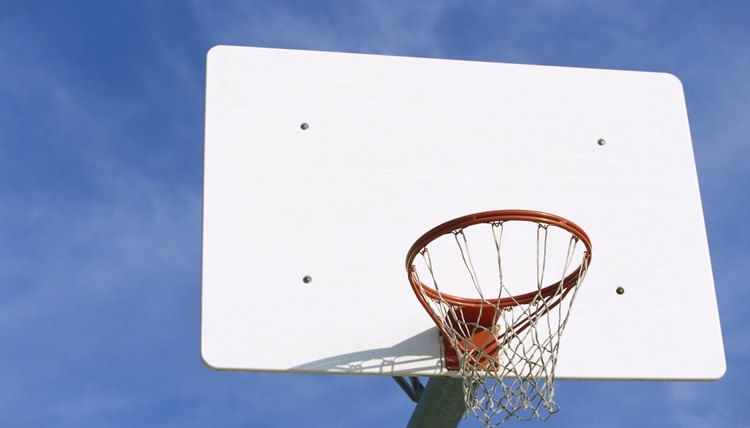
Basketball backgrounds, called backboards, can be constructed of many types of material. The best construction materials for your hoop background depend upon the intended use of your backboard, and different standards exist for professional and amateur courts. Once you have assessed your needs, the choice of backboard material will become much simpler.
Purpose Of Backboard
Backboards used for official games have different requirements than backboards used for casual home play. Cost also becomes a factor because simple backboard material such as wood will be far cheaper than a custom fiberglass.
Transparent Backboards
Top basketball organizations, such as the NBA, NCAA, WNBA, are required to have transparent backboards. This is because official games are usually either televised or have seating with views of the court that would be obscured by an opaque backboard. Transparent backboards are usually constructed of tempered glass or fiberglass. High school leagues and gyms might not use transparent backboards, based on their seating layout.
Transparent Backboard Rules
The NBA outlines certain regulations for transparent backboards. Specifically, the backboard must have a 2-inch thick white outline of a rectangle placed at the center of the board, behind the ring. The rectangle's dimensions must be 24 inches wide by 18 inches tall.
Opaque Backboards
Simple wood is an inexpensive choice for a nontransparent backboard. Plywood can be cut, shaped, and worked with relative ease in order to fit specifications. Keep in mind that while plywood is cheap, it can be relatively flimsy if left as a single sheet. You can increase the integrity of the backboard by doubling the thickness: Simply attach a second sheet of plywood cut to the same parameters.
Sizing and Measurements
When creating a basketball backboard, keep in mind that precise specifications are required for the dimensions of both the backboard and the hoop. Backboards are generally shaped to be a rectangle measuring 6 feet wide by 3.5 feet tall. The rim is required to be 18 inches in diameter, measured from the inside edge of the rim. Official hoops are 10 feet high, measuring from the bottom of the rim to the ground. Unofficial hoops can easily be tailored to the needs of the court.
Backyard Backboard Materials
If you're building a backyard court for outdoor play, suitable backboard options include plywood and acrylic. Marine plywood is particularly durable, resisting warping and weather damage. If you go the acrylic route, the best choices are heavy-duty varieties such as Plexiglass or Lucite.
Writer Bio
Marcus Scott has been writing on international politics, local news and culture since 2004. He has written articles, op-eds, columns and edited for student organization presses and blogs, including the Roosevelt Institution Defense and Diplomacy blog. In 2005 and 2006 Scott attended the Journalism Education Association national conferences. He earned his Bachelor of Arts in international relations from the University of California, Davis.