
How Far Is It From Home Plate to Second Base on a High School Baseball Field?
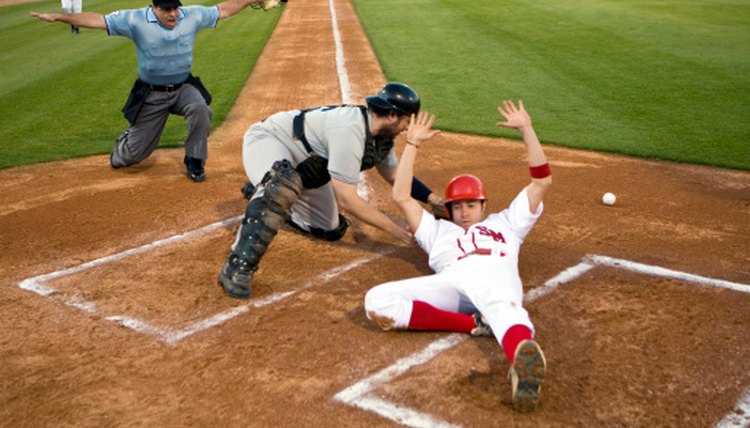
Whether you play ball in high school, college, the Babe Ruth League or the major leagues, you’ll cover the same distance when you make a trip around the bases. All regulation infields conform to the same measurements at that level of play, but you’ll find differences in the outfields. Baseball diamonds are smaller for players in Little League and Pony League games, where the traditional 90-foot baselines are reduced to 60 and 75 feet.
Baseball Diamonds
On a standard high school baseball diamond, there are 90 feet between the bases; a base runner taking the standard route from home to second covers 180 feet. The distance across the infield from the back tip of home plate to second base is 127 feet, 3 3/8 inches. That’s also the distance across the infield from first base to third. The center of the pitcher’s mound sits 60 feet, 6 inches from home, and the mound consists of a raised 18-foot circle. A regulation mound is 10 1/2 inches high, compared to the surface level of home plate.
Outfields
There’s variety when it comes to outfield dimensions, which is one reason some ballparks are known as home run parks and others pose more of a challenge for power hitters. The outfield is defined as the space between the two foul poles or lines. Foul lines must extend at least 325 feet from home plate to the pole marker, but they can be longer.
Other Measurements
There are rules governing the size of the plates on the field, too. Home plate measures 17 inches across while the pitcher’s rubber measures 24 inches by 6 inches. The NFSHS recommends that the on-deck circle be located to the side and away from home plate by 37 feet, if space allows. It recommends a distance of 60 feet from the foul line to the nearest obstruction or dugout.
Rules
Though high school players play on the same size infield as major leaguers, they don’t play by all the same rules. The NFSHS sets rules governing high school play, as well as standards for equipment, facilities and uniforms. The organization publishes a list of approved bats and outlines differences between baseball and softball rules. The NFSHS website provides information for coaches and officials, as well as high school players.
References
Writer Bio
Carol Ochs is an award-winning writer in the Washington, D.C. area. During 17 years with The Associated Press she covered health, medical and sports stories as a writer, editor and producer. She has written for the health section of "The Washington Post," a Fairfax County stewardship publication and a biopharmaceutical newsletter. Ochs has a Bachelor of Science in journalism from Ohio University, Athens.