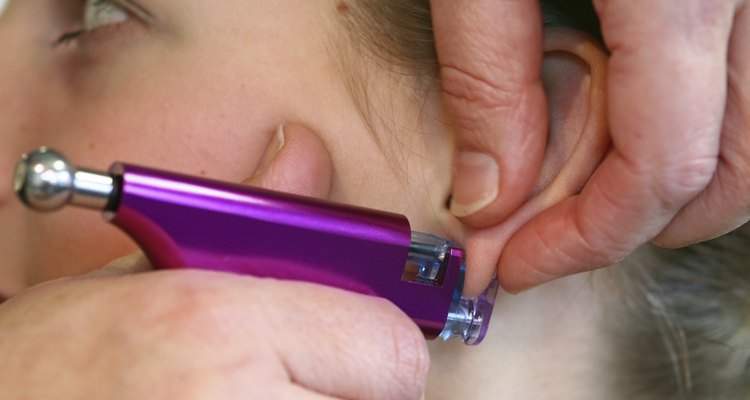
Jaap Uilhoorn/iStock/Getty Images
One of the most common complications of ear piercing is infection. According to a college sample of students conducted at Pace University, 17 percent of individuals with piercings experienced medical complications, including bacterial infections, bleeding and trauma to the tissue. Swimming before your piercing heals increases your chance of infection. Public pools and bodies of water are breeding grounds for bacteria. Additionally, water treated with chemicals can damage your jewelry.
Skip the Swimming Pool
Safety regulations advise you not to swim, sit in a hot tub or take hot baths until your piercing has healed. According to the Oregon Health Licensing Agency, piercings in the ear lobe takes six to eight weeks to heal, while ear cartilage piercings take four months to one year to heal completely. Piercings heal on the outside first and follow with healing on the inside. A piercing may look healed externally when it is not. Swimming surrounds the head with bacteria which can cause infection by entering the smallest openings in your skin.
Don't Take a Dip
Individuals may assume swimming in a pool will not cause a bacterial infection to enter their newly pierced ear due to chlorination. According to the Centers for Disease Control, chlorine does not kill bacteria and germs immediately. In fact, germs can survive in a chlorinated pool for minutes to days. Contaminated water can enter the body causing ear, eye, skin and wound infections. Additionally, one in eight public pool inspections found code violations and noncompliance with chlorination procedures causing pools to close, as reported by a 2010 study conducted by the Centers for Disease Control and Prevention.
What Lies Beneath the Lake
Swimming in stagnant water, such as a lake, contributes to contracting infectious agents. Pseudomonas is a bacterial species living in these bodies of water. This bacterium can enter the piercing, causing a threatening infection and cultivating sensitivity to the ear, pain, swelling, redness, pus drainage, swollen lymph nodes and fever. In a 2006 case study reported by the “Canadian Family Physician,” a 21-year-old woman pierced her cartilage and swam in an open body of water one week after piercing. She developed pseudomonas and was treated with antibiotics and a surgical splint, causing mild deformation to her ear.
Caustic Chlorine
Chlorinated water can ruin your earrings and other jewelry. Gold or silver jewelry should never come in contact with bleach products, such as chlorine. The chlorine scratches, chips and causes dullness to the surface of your earrings. According to Susan Aber, a gemologist and geologist at Emporia State University, you should never wear jewelry in a swimming pool due to the damage chlorine causes to metals.
Related Articles

Symptoms of Food Poisoning With Oysters
How to Soothe an Irritated Piercing

How to Drain a Cheek Piercing

Rules for Navel Piercings
How to Wash Out an Ear With Warm Water

How Long Do Shucked Oysters Stay Fresh?

Why Does the Hair Fall Off of Your ...

How to Take Out a Lip Ring Stud

What Is the Function of the Amniotic ...

Swollen Lymph Nodes in Horses

Ear Piercing & Sports
How to Clean Smiley Piercings
Complications of Nipple Piercing

Taking Care of Gauged Ears
How to Clean Your New (Conch) Ear ...

How to Remove Acne Scars With Water

Problems With Nose Piercings

How to Swim With Belly Button Ring
What Is Bio-Flex Made of for Piercings?

How Long Should I Wait to Get My Nose ...
References
Writer Bio
Suzanne Allen has been writing since 2004, with work published in "Eating for Longevity" and "Journal of Health Psychology." She is a certified group wellness instructor and personal trainer. Allen holds a Bachelor of Arts in communication and information sciences, a Bachelor of Arts in psychology and a Master of Arts in clinical psychology.
Photo Credits
Jaap Uilhoorn/iStock/Getty Images