
Gymnastic Bar Strength Training
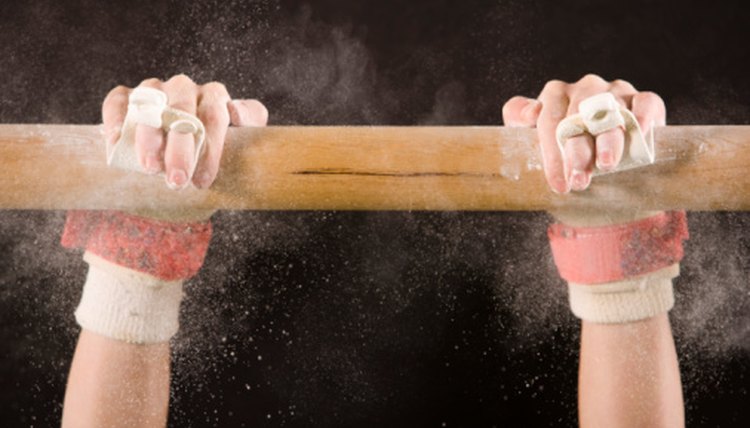
Gymnastics is a sport that requires an extreme amount of upper body and core strength. The best way to train for bars is by increasing strength, power and muscular endurance. Proper training also helps reduce the risk of injury which can be high in gymnastics. The National Strength and Conditioning Association recommends for optimal power and strength training, train within a six to eight repetition range, so that you are fatigued by the eighth repetition. Gymnasts, however, also need endurance to complete a bar routine effectively, in which case the repetition range is about 15 to 20.
Core Exercises
According to Sports Fitness Advisor, a strong core will reduce risk of injury, keep your body stable, and improve movement efficiency. Hang on the high bar and do bent or straight leg lifts to the bar. Do three sets of 15 to 20. To do hip lifts, get up on the bar so you are in a front support position. Slowly lean your shoulders over the bars and lift your hips up as high as you can, thighs moving upward along the bar and your feet pointed toward the ground. Slowly return to front support. Do three sets of 15 to 20.
Back Exercises
Your back is largely involved in casting, handstands and giants on bars. Pullups are the best exercise for gymnasts to increase strength in their upper body. Do three variations of pullups, wide grip, narrow grip and reverse grip chin-ups. Beginners attempt as many as you can, but experienced gymnasts do sets of 15 to 20. To help improve muscular endurance, lie on the floor with arms extended overhead and do superman lifts, or back extensions. Keep your arms and feet together the whole time and do three sets of about 20 repetitions.
Shoulder Exercises
You need strong shoulders to hold handstands and aid with dynamic swings on the bar. Practice doing handstand pushups on the floor, or on a floor bar against a wall if it is available. Beginners, do pushups in a pike body position to emphasize the shoulder muscles. Also incorporate bar dips. Start in front support on the bar, and bend your elbows and lower your upper body down to try to touch your ribcage to the bar. Press back up, keeping your abs tight so you stay in correct position.
Glute Exercises
Even though legs are rarely used in a bar routine, except for bar transitions and landings, the glutes are a part of the core and act as a stabilizer between the upper and lower body. Without strong glutes, the lower body would be flailing about without control. Hang on the bar and arch your back, but squeeze your glutes primarily. Try to hold that position for three to five seconds before releasing. Using only the floor, lie on your back and perform a single leg glute bridge, lifting your hips up as high as you can for three to five seconds. Do about 15 on each leg.
Writer Bio
Riana Rohmann has been working for the Marine Corps doing physical training and writing fitness articles since 2008. She holds personal trainer and advanced health and fitness specialist certifications from the American Council on Exercise and a Bachelor of Science in kinesiology and exercise physiology from California State University-San Marcos.