
How Do Men and Women Differ Athletically?

Athletic differences between men and women have much to do with innate characteristics determined by genetics and hormones. These include height, weight, muscle mass, body fat and aerobic capacity. As a group, women do not run, jump or swim as fast as men. Women are also more prone to certain types of athletic injuries than men.
Estrogen

David De Lossy/Photodisc/Getty Images
Due to higher estrogen levels, women have more body fat than men. The leanest female athletes, such as top marathon runners, have body fat of approximately 8 percent, compared with 4 percent for their male counterparts. In addition, women's bodies are less muscular, but their joints are more flexible, which gives them greater range of motion -- an advantage in sports such as gymnastics. The wider female pelvis also affects the alignment and movement of the extremities. Men have higher levels of testosterone, which gives them a performance advantage in other ways.
Testosterone

David De Lossy/Photodisc/Getty Images
Testosterone enables men to develop larger skeletal muscles as well as larger hearts. Men also have a larger proportion of Type 2 muscle fibers, which generate power, strength and speed. Testosterone also increases the production of red blood cells, which absorb oxygen, giving men an even greater aerobic advantage, reports "New York Times" writer Gina Kolata, in an interview with Dr. Mark Tarnopolsky, an exercise researcher at McMaster University in Ontario.
Injuries

David De Lossy/Photodisc/Getty Images
Women are more prone to injuring joints such as the shoulders and knees. Weaker shoulder muscles and looser supporting tissues mean the joint is less stable than in men, reports writer Michael Lasalandra, in an interview with Beth Israel Deaconess Medical Center sports medicine physician Bridget Quinn. Also, the injury rate to the anterior cruciate ligament, or ACL, a major knee ligament, is significantly higher in female than in male athletes. By proper training and strengthening of supporting muscles, women can prevent such injuries.
Sports Records
David De Lossy/Photodisc/Getty Images
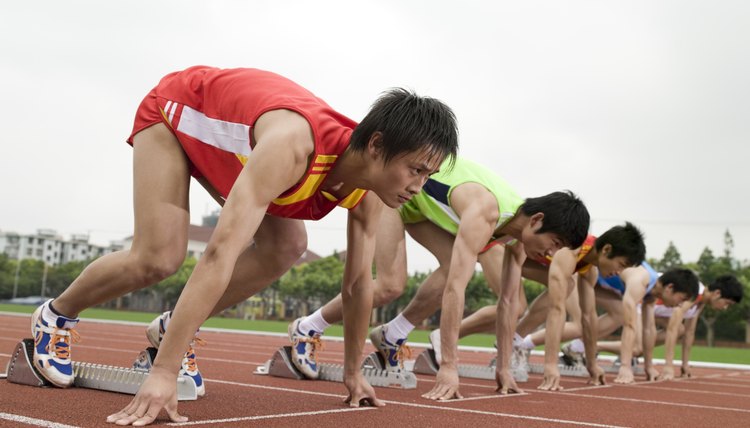
The gender gap in athletic performance, as shown in records from Olympic competition, has remained stable since 1983. The mean difference has been about 10 percent between men and women for all events. The mean gap is 10.7 percent for running, 8.9 percent for swimming and 17.5 percent for jumping. When performances improve, the improvements are proportional for each gender. Still, in sports such as running, a woman who is fit and well-trained can outperform a man who is not. In shooting and equestrian competition, where physical balance and mental concentration are essential, women can compete on a par with men.
References
- Journal of Sports Science and Medicine: Women and Men in Sport Performance: The Gender Gap Has Not Evolved Since 1983
- Beth Israel Deaconess Medical Center: Women and Sports Injuries: Why It's a Different Game
- The New York Times: Men, Women and Speed. 2 Words: Got Testosterone?
- The Wall Street Journal: Taking Aim at an Old Debate
Writer Bio
Lexa W. Lee is a New Orleans-based writer with more than 20 years of experience. She has contributed to "Central Nervous System News" and the "Journal of Naturopathic Medicine," as well as several online publications. Lee holds a Bachelor of Science in biology from Reed College, a naturopathic medical degree from the National College of Naturopathic Medicine and served as a postdoctoral researcher in immunology.