
Vitamin K might not be the first nutrient on your wellness radar, but it plays a crucial role in many of your body's functions, including blood clotting and maintaining bone strength.
The good news? It's not that challenging to meet your daily vitamin K needs through your diet. But both how you prepare foods and the medications you take matter when it comes to your vitamin K status.
Video of the Day
Video of the Day
Below, we explain the health benefits of vitamin K, where to find it in food and what can happen if you get too much or too little of the nutrient.
So, What Is Vitamin K?
Vitamin K is an umbrella term for a group of compounds that share a similar chemical makeup, according to the National Institutes of Health (NIH). The primary members of the vitamin K club are:
- Vitamin K1: Also called phylloquinone, this is found in plants.
- Vitamin K2: Also known as menaquinone, this is produced by bacteria that live in the intestinal tracts of humans and animals.
One of the four fat-soluble vitamins (along with vitamins A, D and E), vitamin K is best known for its essential role in producing proteins that promote blood clotting. But the nutrient and its byproducts are also involved in maintaining bone health and supporting cell proliferation in the body, according to research in Blood.
How Much Vitamin K You Need Each Day
Unlike other vitamins that come with a recommended dietary allowance, or RDA, the NIH recommends an adequate intake, or AI, when it comes to vitamin K. AIs are applied when there isn't enough data for an RDA to be established.
You can think of AIs and RDAs pretty interchangeably. In both cases, the recommended intake is the amount that is either proven or estimated to be adequate to meet most healthy people's daily needs for a particular nutrient.
Here's how much vitamin K you should get daily, per the NIH.
Average Daily Recommended Amounts
Age | Male | Female | Pregnancy | Lactation |
|---|---|---|---|---|
0 to 6 months | 2 mcg | 2 mcg | ||
7 to 12 months | 2.5 mcg | 2.5 mcg | ||
1 to 2 years | 30 mcg | 30 mcg | ||
4 to 8 years | 55 mcg | 55 mcg | ||
9 to 13 years | 60 mcg | 60 mcg | ||
14 to 18 years | 75 mcg | 75 mcg | 75 mcg | 75 mcg |
19+ years | 120 mcg | 90 mcg | 90 mcg | 90 mcg |
Foods High in Vitamin K
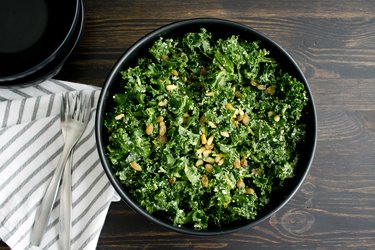
When you think of vitamin K, think leafy greens. These vegetables are the primary dietary sources of phylloquinone, though the nutrient also occurs in foods like soybeans and pine nuts. Here are some of the top food sources of vitamin K, per the NIH and an April 2012 review in Food & Nutrition Research:
- Natto (a fermented soy product): 850 mcg, 708% DV in 3 ounces
- Collard greens: 530 mcg, 442% DV in 1/2 cup (boiled)
- Turnip greens: 426 mcg, 355% DV in ½ cup (boiled)
- Spinach: 145 mcg, 121% DV in 1 cup (raw)
- Kale: 113 mcg, 94% DV in 1 cup (raw)
- Broccoli: 110 mcg, 92% DV in ½ cup (boiled)
- Soybeans: 42 mcg, 36% DV in ½ cup (roasted)
- Cabbage: 163.1 mcg, 136% DV in 1 cup (cooked)
Other foods that contain vitamin K include canned pumpkin, okra and blueberries. For a healthy dose of vitamin K, toss a homemade kale salad with edamame for a hit of plant-based protein and a sprinkle of blueberries for natural sweetness.
Endogenous production of vitamin K (i.e. synthesis of the menaquinone form of the nutrient by bacteria in our colon) can also contribute to one's vitamin K status, per Harvard's T.H. Chan School of Public Health.
Tip
Because vitamin K is a fat-soluble vitamin, it’s more readily absorbed by the body when consumed along with a source of fat. Go ahead and sauté your kale in a healthy glug of olive oil, drizzle avocado oil over your spinach salad or mash some soybeans into homemade guacamole. Also interesting: “Leaner cuts of animal foods contain less K2 [or menaquinone] than higher fat animal foods and full-fat dairy,” says Wendy Bazilian, DrPH, RD, a registered dietitian and author of the Eat Clean, Stay Lean series.
The Benefits of Vitamin K
1. Aids in Blood Clotting
Vitamin K is best known for its function in blood clotting. That's because the nutrient is necessary for the production of clotting proteins like prothrombin, a component of the blood that becomes activated during coagulation, according to the U.S. National Library of Medicine.
You might be wondering: Isn't blood clotting a bad thing? When it comes to clotting, the key is a happy medium. That is, insufficient clotting can result in significant blood loss, which we don't want. On the other hand, excessive clotting may lead to adverse health outcomes, such as stroke.
Vitamin K is therefore essential, as it helps to regulate clotting.
2. Contributes to Bone Health
Vitamin K is also required for the synthesis of proteins needed for strong bones, like osteocalcin, the vitamin K-dependent protein that's responsible for maintaining bone strength, per Harvard's T.H. Chan School of Public Health.
"Healthy bone mineralizes and turns over throughout life, so all the 'players' [including vitamin K] are needed in adequate amounts to help build, maintain, turn over and repair [bones] in order to preserve bone strength," Bazilian says. "Vitamin K is critical to this ongoing process, since the enzyme that plays a role in forming proteins for bone depends on its presence."
Research supports the connection between vitamin K and healthy bones. People with the highest intakes of vitamin K were found to have a 22 percent lower risk of fractures compared to people with the lowest intakes, according to an April 2017 meta-analysis in Medicine.
3. May Help Prevent Heart Disease
The jury is still out on the exact role vitamin K plays in heart health, but the link likely has to do with a compound called matrix gla protein, or MGP.
MGP is yet another vitamin K-dependent protein that inhibits calcification (aka the buildup of calcium) in the blood, soft tissues and bones. That's important, because vascular calcification is a key risk factor for cardiovascular disease, per 2020 research in Current Medicinal Chemistry.
Though more research is needed on this topic, some theorize that without sufficient vitamin K, MGP will not prevent calcification as normal, which may in turn hike up heart disease risk.
What About Vitamin K for Easy Bruising?
A severe vitamin K deficiency may cause symptoms related to increased bleeding, including nosebleeds or bleeding into the skin, causing bruising, according to Merck Manuals. Properly prescribed vitamin K supplements may help decrease bruising if you have a true vitamin K deficiency. However, vitamin K deficiency is rare, and if your bruising is caused by anything else, increased vitamin K intake is unlikely to help your condition.
A few small studies have indicated that vitamin K creams may help with healing bruises, but more research needs to be done in this area.
Vitamin K Deficiency

Unlike some other vitamins, vitamin K is broken down and then released from the body in short order, meaning stores are limited.
Still, it's rare for U.S. adults to be deficient in vitamin K unless they have a medical condition that hinders nutrient absorption or take antibiotics for an extended period of time, per Harvard's T.H. Chan School of Public Health. Plain and simple: Low dietary vitamin K isn't often the cause of deficiency.
Infants are at a higher risk of vitamin K deficiency as vitamin K doesn't pass through the placenta easily and breast milk is a poor source of the nutrient, per Oregon State University. Because low vitamin K levels increase the risk of excessive bleeding, newborns are given a vitamin K supplement (via injection) at birth to ensure they're equipped with adequate clotting proteins for the first few weeks of life.
Vitamin K deficiency, according to Harvard's T.H. Chan School of Public Health, can include:
- Extended prothrombin time, meaning it takes longer for the blood to clot
- Excessive bleeding or hemorrhage
- Decreased bone mineral density, resulting in osteopenia or osteoporosis
What if You Get Too Much Vitamin K?
“Vitamin K toxicity is unlikely and pretty rare,” Leah Kaufman, RD, a New York-based registered dietitian, tells LIVESTRONG.com. What’s more, the NIH states that no adverse health outcomes have been reported, either from dietary or supplemental vitamin K.
Drug Interactions and Risks
Here's what to know about vitamin K if you're taking certain medications:
1. Warfarin
Given vitamin K's involvement in blood clotting, it makes sense that the nutrient can interact with anticoagulant (or anti-clotting) medications like warfarin.
"Warfarin prevents the production of clotting factors so that blood clotting occurs more slowly," Dr. Bazilian explains. Basically, warfarin and vitamin K have opposite jobs, which means they can interact in negative ways.
People taking anticoagulant meds don't need to cut vitamin K from their diet, though. "The key to maintaining a healthy level of blood clotting — in effect, making sure the medication is not over- or under-working — is keeping vitamin K intake consistent," Dr. Bazilian says.
Eating a ton of leafy greens one week might cause the blood to clot quicker, while skipping vitamin K-rich foods altogether might 'thin' the blood too much, increasing the risk of excessive bleeding.
"In general, a doctor (perhaps in collaboration with a dietitian) will assess a person's usual intake of vitamin K-rich foods and advise them to stay at that level of intake or adjust it to a certain amount for good nutrition, then continue to eat similarly each day so that the warfarin dose can be established and monitored for its intended effects," Dr. Bazilian says.
Vitamin K supplements are not recommended for those taking anticoagulant medications.
2. Antiobitics
Some antibiotics can also interfere with vitamin K status due to their effects on vitamin K-generating gut microbes.
3. Weight-Loss Meds
And because vitamin K is a fat-soluble vitamin, weight-loss meds like Orlistat (or Alli) — which prevent the body from absorbing dietary fats as a means of reducing caloric intake — can also mess with absorption of the nutrient, per the U.S. National Library of Medicine.
Vitamin K Supplements

Vitamin K supplements can contain various forms of the nutrient, including phylloquinone, phytonadione or menaquinone, per the NIH. Phylloquinone (vitamin K1) is a vegan source of the nutrient.
"Menaquinone, or vitamin K2, is primarily synthesized in our own gut. In a supplement, it could be of animal origin," Dr. Bazilian says.
It's not uncommon to find vitamin K included in vitamin D supplements.
"Vitamins D and K are both fat-soluble vitamins that work together to regulate calcium levels," Kaufman explains. "It's been shown that vitamin D promotes the production of vitamin K-dependent proteins, therefore the two nutrients are often combined in supplements to improve functionality."
Because vitamin K is easy to obtain from food, healthy people have little reason to add the supplement to their medicine cabinet. Talk to your health care provider before adding a vitamin K supplement to your routine. Consuming a supplement without a noted deficiency is likely unnecessary for both you and your wallet.
Best Vitamin K Supplements
- Pure Encapsulations Synergy K ($59.50; Amazon)
- Now Foods MK-7 and Vitamin K-2 ($11.89; Amazon)
- Thorne Research Basic Bone Nutrients ($38; Amazon)
- Office of Dietary Supplements: “Vitamin K Health Professional Fact Sheet”
- Harvard T.H. Chan School of Public Health: “Vitamin K”
- Oregon State University: “Vitamin K”
- Blood: “Functional Study of the Vitamin K Cycle in Mammalian Cells”
- U.S. National Library of Medicine: “Prothrombin Time Test and INR (PT/INR)”
- Medicine: “Vitamin K Intake and the Risk of Fractures”
- Current Medicinal Research: “The Role of Matrix Gla Protein (MGP) in Vascular Calcification”
- U.S. National Library of Medicine: “Orlistat”
- Merck Manuals: "Vitamin K Deficiency"
- Food & Nutrition Research: "Vitamin K: food composition and dietary intakes"