When IBS symptoms range from cramping, bloating and abdominal pain to gas and diarrhea, some people find that conventional medications just aren't enough and wish for something else. Others may be interested in trying more natural approaches rather than drugs.
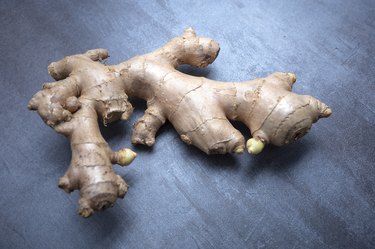
Complementary and alternative remedies are popular for a variety of ailments, and ginger is a common go-to option, used for thousands of years in Asian medicine, according to the National Center for Complementary and Integrative Health (NCCIH). Ginger itself is a rhizome, a type of flowering plant. While you might know it as a cooking ingredient in a variety of Asian dishes, it has many applications for digestive issues, which could explain why it's a source of interest as an IBS aid.
Video of the Day
Video of the Day
Read more: Your Ultimate Guide to Living Well With IBS
Ginger and Digestion
When it comes to natural remedies, ginger has been near the top of many lists for a long time. The British Dietetic Association notes that ginger has a long history of use as a method treating nausea during pregnancy, for example. According to the NCCIH, it's also been used successfully to relieve nausea from chemotherapy treatment and might be useful in relieving motion sickness and nausea after surgery. People also take it for relief from both osteoarthritis and rheumatoid arthritis.
As for why ginger seems to help with nausea symptoms, there are a few different theories. One theory, according to the association, is that it enhances the movement of the gastrointestinal tract, but in a manner that doesn't disrupt its rhythm. Because of this, it also may be useful in reducing the abdominal pain related to IBS.
"Ginger can act to relax the smooth muscle of the GI tract, and it relaxes the nausea centers in the brain," says Lisa Ganjhu, DO, a clinical associate professor and internist in the Division of Gastroenterology and Hepatology for NYU Langone Health in New York City.
What the Research Shows
The question remains, though, about whether it can be proven that ginger helps with IBS symptoms.
According to the International Foundation for Gastrointestinal Disorders (IFFGD), many practitioners of traditional Chinese medicine suggest ginger to their patients, but there hasn't been much conventional research using trials to investigate the value of ginger for IBS. One study, done at the University of North Carolina, involving a group of 45 people with IBS, was inconclusive.
For the study, published in January 2014 in the journal Complementary Therapies in Medicine, participants were randomly assigned to receive 1 gram of ginger, 2 grams of ginger or a placebo each day. An identical number of people reported experiencing relief from taking the placebo or taking the single gram of ginger (53 percent of each group), while fewer people found relief with the higher ginger dose.
The researchers concluded that more and larger studies are needed before any definitive conclusions can be drawn about ginger and irritable bowel syndrome.
A Supportive Voice
Though the jury is still out on the clinical effectiveness of ginger for IBS symptoms, that doesn't mean that it won't provide you with some relief. In fact, it's a readily accessible, inexpensive home remedy that can offer you some potential benefit with very few side effects or risks to your overall well-being, says Marta Ferraz Valles, RD, LD, an outpatient dietitian with the Institute for Digestive Health and Liver Disease at Mercy Medical Center in Baltimore.
"We need more research, but so far we know that ginger can reduce IBS symptoms," Valles says. "Although it works just as well as a placebo does, ginger offers relief 53 percent of the time."
"Plus, since a half-teaspoon of powdered ginger daily is safe and cheap," she says, "it is definitely something that people with IBS can try."
Read more: How Do I Make Ginger Tea With Ground Ginger?
- British Dietetic Association: “Is Ginger Useful for Treating IBS?”
- International Foundation for Gastrointestinal Disorders: “Complementary and Alternative Treatments”
- Lisa Ganjhu, DO, clinical associate professor, internist, Division of Gastroenterology and Hepatology, NYU Langone Health, New York City
- Complementary Therapies in Medicine: “Is Ginger Effective for the Treatment of Irritable Bowel Syndrome? A Double Blind Randomized Controlled Pilot Trial”
- Marta Ferraz Valles, RD, LD, outpatient dietitian, Institute for Digestive Health and Liver Disease, Mercy Medical Center, Baltimore
- National Center for Complementary and Integrative Medicine: “Ginger”
Is this an emergency? If you are experiencing serious medical symptoms, please see the National Library of Medicine’s list of signs you need emergency medical attention or call 911.