What does fact checked mean?
At Healthfully, we strive to deliver objective content that is accurate and up-to-date. Our team periodically reviews articles in order to ensure content quality. The sources cited below consist of evidence from peer-reviewed journals, prominent medical organizations, academic associations, and government data.
The information contained on this site is for informational purposes only, and should not be used as a substitute for the advice of a professional health care provider. Please check with the appropriate physician regarding health questions and concerns. Although we strive to deliver accurate and up-to-date information, no guarantee to that effect is made.
Herbal Treatment for Liver Cirrhosis
Herbs have been used for hundreds of years to help improve liver health and function. The National Digestive Disease Information Clearinghouse states that cirrhosis is a liver-related condition involving degeneration and dysfunction of your liver tissue. If you have liver cirrhosis, your healthy liver tissue is being replaced by scar tissue, which impairs blood flow through your liver. If you are considering using herbs to help treat your liver cirrhosis, first consult with your physician about the potential benefits and drawbacks of herbal therapy.
If you are experiencing serious medical symptoms, seek emergency treatment immediately.
Liver Cirrhosis
The University of Maryland Medical Center states that cirrhosis is commonly caused by alcohol abuse 1. In fact, in the U.S., excessive alcohol consumption is the leading cause of liver scarring. Other possible causes of cirrhosis include hepatitis B and C, cystic fibrosis, certain autoimmune conditions, blocked bile ducts and iron- and copper-related metabolic disorders. Signs and symptoms of liver cirrhosis include:
- jaundice
- fatigue
- decreased appetite
- swelling
- vomiting
- nausea
- weight loss
- abdominal pain
- The University of Maryland Medical Center states that cirrhosis is commonly caused by alcohol abuse 1.
Herbs for Liver Health
Herbs for Liver & Spleen Support
Learn More
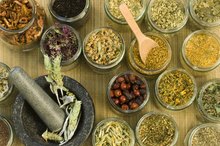
Some herbs may possess the ability to protect and restore the health and function of your liver. Celandine, milk thistle and bupleurum are other useful herbs for liver problems.
Most Popular Herb
Milk thistle is one of the most popular herbs for the treatment of liver cirrhosis. Milk thistle is a plant indigenous to the Mediterranean region but now grows around the world. The leaves of the milk thistle plant produce a milky fluid when crushed. Silymarin is the active ingredient in milk thistle that helps protect your liver and treat liver conditions such as cirrhosis, hepatitis and fatty liver. Silymarin, a combination of flavonoids, helps liver cells damaged by alcohol and other toxins regenerate.
- Milk thistle is one of the most popular herbs for the treatment of liver cirrhosis.
Warning
Herbal Treatments for Gangrene
Learn More
Certain herbs may help treat your liver cirrhosis, although there is no guarantee of a cure. You should understand the risks associated with herbal remedies before using them to treat your liver dysfunction. A health care professional with advanced training in botanical medicine can tell you what herbs are safe for you, how to use these herbs most effectively and what side effects you might experience. Herbal remedies contain active ingredients that can cause significant physiological effects. Always talk with your doctor before taking herbs.
- Certain herbs may help treat your liver cirrhosis, although there is no guarantee of a cure.
- A health care professional with advanced training in botanical medicine can tell you what herbs are safe for you, how to use these herbs most effectively and what side effects you might experience.
Related Articles
Herbs for Liver & Spleen Support
Learn More
Herbal Treatments for Gangrene
Learn More

What Are the Benefits of Water on Liver Detoxification?
Learn More
Herbs to Support My Liver After Gallbladder Removal
Learn More
Can You Take Alpha Lipoic Acid & Milk Thistle at the Same Time?
Learn More
Vitamins and Supplements for Cirrhosis
Learn More
Dandelion vs. Milk Thistle
Learn More
Ashwagandha Liver Side Effects Contraindications
Learn More
Herbs to Help Stop Drinking Alcohol
Learn More
Herbs That Remove Ascites in the Abdomen
Learn More
References
- University of Maryland Medical Center: Cirrhosis
- "Plant Medicine in Practice"; William A. Mitchell Jr., N.D.; 2003
- FastStats - Chronic Liver Disease or Cirrhosis. Centers for Disease Control and Prevention. May 30, 2013.
- Guss D, Sherigar J, Mohanty SR. Missed Diagnosis of Liver Cirrhosis Leads to Disparities in Care for Older Patients. Gastroenterology Res. 2018;11(5):333-339. doi:10.14740/gr1074w
- Symptoms & Causes of Cirrhosis. National Institute of Diabetes and Digestive and Kidney Diseases. Mar 1, 2018.
- Cirrhosis: MedlinePlus Medical Encyclopedia. MedlinePlus. Sept 11, 2019.
- Cirrhosis: MedlinePlus Medical Encyclopedia. MedlinePlus. Sept 11, 2019.
- Nderitu P, Bosco C, Garmo H, et al. The association between individual metabolic syndrome components, primary liver cancer and cirrhosis: A study in the Swedish AMORIS cohort. Int J Cancer. 2017;141(6):1148-1160. doi:10.1002/ijc.30818
- Hung TH, Liang CM, Hsu CN, et al. Association between complicated liver cirrhosis and the risk of hepatocellular carcinoma in Taiwan. PLoS ONE. 2017;12(7):e0181858. doi:10.1371/journal.pone.0181858
- Cirrhosis of the Liver Prevention. Cleveland Clinic. Jan 11, 2019.
- Centers for Disease Control and Prevention (CDC). National Vital Statistics Report, Volume 67, Number 5. https://www.cdc.gov/nchs/data/nvsr/nvsr67/nvsr67_05.pdf. Published July 26, 2018.
- National Institute of Diabetes and Digestive and Kidney Diseases. Cirrhosis. https://www.niddk.nih.gov/health-information/liver-disease/cirrhosis#signs
Writer Bio
Robyn Hughes has been writing since 2008 about health, nutrition, fitness and botanical medicine. She is a naturopathic physician and freelance writer based in Durham, N.C. She holds a Bachelor of Arts in cognitive science from Indiana University and a doctoral degree from the National College of Natural Medicine in Portland, Ore.