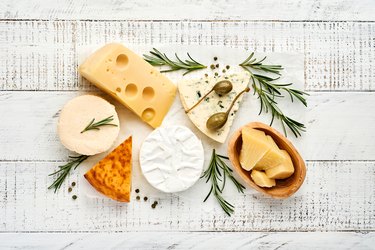
As a creamy cooking ingredient, grab-and-go snack or pairing with wine, cheese is a staple for many.
But it turns out most adults' dairy intake falls short of the recommended 3 cups per day, according to the Dietary Guidelines for Americans. A 1 1/2-ounce portion of cheese is one serving (considered one cup equivalent).
Video of the Day
Video of the Day
While most cheeses are high in fat and calories — and many are high in sodium — cheese can make the cut as part of a healthy diet thanks to its high calcium and protein, per the Harvard T.H. Chan School of Public Health.
But you'll still want to enjoy it in moderation. Some studies suggest full-fat dairy may be a better bet than low-fat options for lowering the risk of heart disease and type 2 diabetes. It's hypothesized that certain nutrients in cheese, like calcium, may protect the heart or that saturated fatty acids in cheese differ from those in red meat, the Harvard T.H. Chan School of Public Health explains.
Before buying cheese, read the nutrition facts label on the package. There, you'll find the percent Daily Value (DV), which tells you how much of any nutrient a given food offers, according to the U.S. Food and Drug Administration (FDA).
Use the following guide to curate a selection of cheeses for your nutritional needs.
Cheese Nutrition Comparison Chart
Cheese | Serving Size | Calories | Total Fat | Protein | Sodium | Calcium |
|---|---|---|---|---|---|---|
Brie | 1 oz. | 95 | 7.9 g | 5.9 g | 7% DV | 4% DV |
Cheddar | 1 oz. | 114 | 9.5 g | 6.5 g | 8% DV | 16% DV |
Feta | 1 oz. | 75 | 6.1 g | 4 g | 14% DV | 11% DV |
Gorgonzola | 1 oz. | 100 | 8 g | 6 g | 5% DV | 12% DV |
Gouda | 1 oz. | 101 | 7.8 g | 7.1 g | 10% DV | 15% DV |
Jarlsberg | 1 oz. | 100 | 8 g | 8 g | 5% DV | 15% DV |
Mascarpone | 1 Tbsp | 120 | 12 g | 1 g | 1% DV | 3% DV |
Monterey Jack | 1 oz. | 106 | 8.6 g | 7 g | 7% DV | 16% DV |
Mozzarella | 1 oz. | 72 | 4.5 g | 6.9 g | 7% DV | 17% DV |
Philly Cream Cheese | 1 oz. | 100 | 9 g | 2 g | 5% DV | 0% DV |
Pecorino Romano (Sheep Cheese) | 1 oz. | 110 | 9 g | 8 g | 20% DV | 15% DV |
Swiss | 1 oz. | 112 | 8.8 g | 7.7 g | 2% DV | 19% DV |
Vegan Cheese | 1 oz. | 80 | 6 g | 0 g | 10% DV | 0% DV |
Babybel | 3/4 oz. | 70 | 6 g | 5 g | 7% DV | 12% DV |
Cheese Curds | 1 oz. | 110 | 8 g | 7 g | 8% DV | 15% DV |
1. Brie
Brie cheese, nicknamed the "Queen of Cheeses," is a soft cheese made from cow's milk. The majority of Brie available in grocery stores is pasteurized, although raw milk varieties are available from specialty cheese shops and online.
According to the USDA, a 1-ounce serving of Brie contains:
- Calories: 95
- Total fat: 7.9 g, 10% DV
- Saturated fat: 4.9 g, 25% DV
- Cholesterol: 28.4 mg, 9% DV
- Sodium: 178 mg, 7% DV
- Total carbs: 0.1 g, 0% DV
- Dietary fiber: 0 g, 0%DV
- Sugar: 0.1 g, 0% DV
- Protein: 5.9 g, 12% DV
- Vitamin B12: 0.5 mcg, 20% DV
- Selenium: 4.1 mcg, 7% DV
When it comes to Brie cheese nutrition, 1 ounce provides nearly 6 percent of the selenium that your body needs every day. This trace mineral plays a role in reproduction, thyroid gland function and DNA production, per the National Institutes of Health (NIH). Selenium's antioxidant properties protect against cell damage, per the Harvard School of Public Health.
Brie also contains a small amount of phosphorus, a mineral found in bones and teeth and every cell in the body, per the NIH. And it's high in vitamin B12, which is vital for healthy nerves and blood cells, according to NIH.
What's more, most of the calories in Brie cheese come from fat, which means it'll help keep you full for longer. Brie cheese is healthy in moderation.
2. Cheddar
With 114 calories per ounce, cheddar is more caloric than many other common cheeses. It also has a bit more fat, and more than half of the fat in cheddar cheese is saturated — the type that the American Heart Association (AHA) says people with high cholesterol should limit in their diet.
Just 1 ounce of cheddar has:
- Calories: 114
- Total fat: 9.5 g, 12% DV
- Saturated fat: 5.4 g, 27% DV
- Cholesterol: 28.1 mg, 9% DV
- Sodium: 185.5 mg, 8% DV
- Total carbs: 1 g, 0% DV
- Dietary fiber: 0 g, 0% DV
- Sugar: 0.1 g, 0% DV
- Protein: 6.5 g, 13% DV
- Vitamin B12: 0.3 mcg, 13% DV
- Calcium: 201.6 mg, 16% DV
3. Feta
Feta is a Greek cheese traditionally made with sheep's or goat's milk. Many of the commercial variations available in the U.S. are made with cow's milk, which produces firmer cheese.
The white cheese is cured and stored in a liquid known as whey brine. Feta has a soft, crumbly texture and a salty, tangy flavor.
One ounce of feta cheese has:
- Calories: 75
- Total fat: 6.1 g, 8% DV
- Saturated fat: 3.8 g, 19% DV
- Cholesterol: 25.3 mg, 8% DV
- Sodium: 323.5 mg, 13% DV
- Total carbs: 1.1 g, 0%DV
- Dietary fiber: 1 g, 4% DV
- Sugar: 0 g, 0%
- Protein: 4 g, 8% DV
- Vitamin A: 119.8 IU, 4% DV
- Calcium: 140 mg, 11% DV
Feta has a strong flavor, so a little goes a long way. Feta cheese is a healthy addition to your diet, but it is high in sodium, so enjoy it in moderation.
4. Gorgonzola
Gorgonzola is a type of Italian blue cheese that is easy to crumble. It's often added to salads and comes from either cow's milk or goat's milk.
Per the USDA, 1 ounce of gorgonzola contains:
- Calories: 114
- Total fat: 9.5 g, 12% DV
- Saturated fat: 5.4 g, 27% DV
- Cholesterol: 28.1 mg, 9% DV
- Sodium: 185.5 mg, 8% DV
- Total carbs: 1 g, 0% DV
- Dietary fiber: 0 g, 0% DV
- Sugar: 0.1 g, 0% DV
- Protein: 6.5 g, 13% DV
- Vitamin B12: 0.3 mcg, 13% DV
- Calcium: 201.6 mg, 16% DV
Gorgonzola cheese nutrition shows that it's high in sodium. Sodium is an important electrolyte, a mineral that regulates fluid balance in the body and supports proper muscle and nerve function, per the National Library of Medicine (NLM). But excess sodium in your diet pulls water into your blood vessels, the AHA explains, and that can raise your blood pressure and heighten your risk for heart disease.
Sodium content can vary by brand, so your best bet is to shop around or select a lower-sodium cheese.
What's more, gorgonzola cheese calories come mostly from fat, and blue cheese carb content is low, which means cheese is keto-friendly.
5. Gouda
Gouda originated in the Netherlands and remains one of Holland's top exports, according to the Netherlands Board of Tourism & Conventions. When it comes to calories, Gouda is on par with Monterey Jack.
Per the USDA, 1 ounce of gouda contains:
- Calories: 101
- Total fat: 7.8 g, 10% DV
- Saturated fat: 5 g, 25% DV
- Cholesterol: 32.4 mg, 11% DV
- Sodium: 232.6 mg, 10% DV
- Total carbs: 0.6 g, 0% DV
- Dietary fiber: 0 g, 0% DV
- Sugar: 0.6 g, 1% DV
- Protein: 7.1 g, 14% DV
- Vitamin B12: 0.4 mcg, 18% DV
- Calcium: 199 mg, 15% DV
Yes, Gouda is good for you and delivers about the same amount of calcium and protein as Monterey Jack. One big difference: Gouda has more sodium than Monterey Jack: 232.6 milligrams per ounce versus 170.4 milligrams.
6. Jarlsberg
Dotted with holes, Jarlsberg resembles Swiss cheese but actually hails from Norway. It's known for its mild, distinctively nutty flavor. One ounce of part-skim Jarlsburg contains:
- Calories: 100
- Total fat: 8 g, 10% DV
- Saturated fat: 5 g, 25% DV
- Cholesterol: 19.9 mg, 7% DV
- Sodium: 129.9 mg, 5% DV
- Total carbs: 1 g, 0%DV
- Dietary fiber: 0 g, 0% DV
- Sugar: 0 g, 0%
- Protein: 8 g, 16% DV
- Vitamin A: 199.9 IU, 7% DV
- Calcium: 199.9 mg, 15% DV
Jarlsberg nutrition facts show that the cheese, like other types, delivers calcium: Just 1 ounce satisfies 15 percent of your daily calcium needs.
If you have lactose intolerance, you may be able to enjoy a slice of Jarlsberg. The brand boasts that its product is naturally lactose-free, with less than 0.01 grams of lactose per 100 grams of cheese.
7. Mascarpone
Mascarpone's creamy texture is perfect for stuffed crepes, baked desserts and even pasta filling. But for those watching their weight and heart health, it's something to enjoy sparingly.
Just 1 tablespoon of mascarpone cheese provides:
- Calories: 120
- Total fat: 12 g, 15% DV
- Saturated fat: 9 g, 45% DV
- Cholesterol: 35 mg, 12% DV
- Sodium: 15.1 mg, 1% DV
- Total carbs: 1 g, 0% DV
- Dietary fiber: 0 g, 0% DV
- Sugar: 1 g, 2% DV
- Added sugar: no data
- Protein: 1 g, 2% DV
- Vitamin A: 500.1 IU, 17% DV
- Calcium: 40 mg, 3% DV
Mascarpone nutrition facts show that the cheese's sodium content is much lower than other cheeses.
However, over two-thirds of the fat in mascarpone is saturated, the type that can raise your "bad" LDL cholesterol and build up in your blood vessels, per the NLM. The Dietary Guidelines for Americans call for limiting saturated fat to less than 10 percent of calories per day.
8. Monterey Jack
Sun, surf — and a slice of Jack? California is the nation's top producer of Monterey Jack, per the California Milk Advisory Board. This semi-hard cow's milk cheese delivers just over 100 calories per ounce and far less sodium than some other cheeses.
A 1-ounce serving of Monterey Jack contains:
- Calories: 106
- Total fat: 8.6 g, 11% DV
- Saturated fat: 5.4 g, 27% DV
- Cholesterol: 25.3 mg, 8% DV
- Sodium: 170.4 mg, 7% DV
- Total carbs: 0.2 g, 0% DV
- Dietary fiber: 0 g, 0%
- Sugar: 0.1 g, 0% DV
- Protein: 7 g, 14% DV
- Vitamin B12: 0.2 mcg, 10% DV
- Calcium: 211.9 mg, 16% DV
Is pepper jack cheese healthy? Pepper jack is Monterey Jack infused with jalapeño, Serrano or red bell peppers, per the USDA. The spicy version, depending on the brand you buy, has roughly the same number of calories and grams of fat, according to the USDA.
And is colby jack cheese healthy? It's made by combining colby cheese and Monterey Jack, according to the Dairy Farmers of Wisconsin. Nutritionally, it has a little less sodium (168.6 milligrams) and about the same amount of fat (8.7 grams) and calories (108) as Monterey Jack, per the USDA.
Monterey Jack vs. Cheddar
The nutritionals for Monterey Jack vs. cheddar are pretty similar. However, cheddar (which originated in England, according to the American Cheese Society) has more fat and sodium than Monterey Jack. So if you're watching your salt and fat intake, you may want to choose Monterey Jack.
The good news is cheddar has just as much calcium as Monterey Jack and just about the same amount of protein.
9. Mozzarella
Stringy and gooey when baked, mozzarella originated in and around Naples, Italy, from the milk of the water buffalo. These days it's made mostly with cow's milk, according to a December 2017 review in Food Biophysics. Although, you could find buffalo mozzarella cheese made with buffalo milk.
Choosing mozzarella made with low-fat rather than whole milk slims down the calorie and fat content. One ounce of part-skim mozzarella (made with cow's milk) contains:
- Calories: 72
- Total fat: 4.5 g, 6% DV
- Saturated fat: 2.9 g, 14% DV
- Cholesterol: 18.2 mg, 6% DV
- Sodium: 175.8 mg, 7% DV
- Total carbs: 0.8 g, 0% DV
- Dietary fiber: 0 g, 0% DV
- Sugar: 0.3 g, 1% DV
- Protein: 6.9 g, 14% DV
- Vitamin B12: 0.2 mcg, 10% DV
- Calcium: 222.1 mg, 17% DV
If you crave this pizza topper but wonder whether mozzarella cheese is good for you, know this: It's an excellent source of bone-building calcium. Just 1 ounce of part-skim mozzarella delivers about one-fifth of your daily calcium requirement.
Some more mozzarella cheese benefits: One serving of the low-fat version supplies 7 percent of your daily need for B2, also known as riboflavin, and 10 percent of the DV for B12. These water-soluble B vitamins are necessary for the production of healthy red blood cells, per Colorado State University Extension.
Because buffalo mozzarella is full-fat, it contains more calories and fat — specifically, 85 calories and 7.4 grams of fat, per the USDA.
10. Philly Cream Cheese
A schmear on your bagel? Cream cheese is ubiquitous in delis and dairy cases, but it's still widely known as Philadelphia or "Philly" Cream Cheese, the 1880s brand now owned by the Kraft Heinz Company.
One ounce of Philadelphia Original Cream Cheese provides:
- Calories: 100
- Total fat: 9 g, 14% DV
- Saturated fat: 6 g, 29% DV
- Cholesterol: 30 mg, 9% DV
- Sodium: 110 mg, 5% DV
- Total carbs: 1 g, 0% DV
- Dietary fiber: 0 g, 0% DV
- Sugar: 1 g, 0% DV
- Protein: 2 g, 4% DV
- Calcium: 0% DV
Philadelphia cream cheese nutritional facts show that the bagel topper tips the fat scale with 9 grams per 1-ounce serving. That includes 6 grams of saturated fat. But there are lighter versions on the market.
Philadelphia Reduced Fat Cream Cheese cuts total fat to 5 grams, including 3.5 grams of saturated fat. But that lighter version is somewhat higher in sodium and sugar: 120 milligrams and 2 grams, respectively, versus 110 milligrams and 2 grams in the Original.
The Whipped variety is lighter and fluffier, and a 2-tablespoon serving gives you just 50 calories and 4 grams of fat.
What Is Neufchatel Cheese?
Neufchatel cheese comes from the French region of Haute-Normandie. Its flavor and texture are very similar to cream cheese's, but it has a third less fat (with 6.5 grams per ounce). When it comes to Neufchatel vs. cream cheese, Neufchatel has fewer calories (74 calories).
11. Sheep Cheese
Sheep's milk is sweeter than cow's milk and produces a cheese that contains more fat, protein and calcium per serving than cheese prepared from cow's milk. The most popular type of sheep's milk cheese in the United States is Pecorino Romano, a hard cheese made in Italy.
According to the USDA, 1 ounce of Pecorino contains:
- Calories: 110
- Total fat: 9 g, 12% DV
- Saturated fat: 6 g, 30% DV
- Cholesterol: 24.9 mg, 8% DV
- Sodium: 479.9 mg, 20% DV
- Total carbs: 1 g, 0% DV
- Dietary fiber: 0 g, 0% DV
- Sugar: 0 g, 0% DV
- Protein: 8 g, 16% DV
- Vitamin A: 199.9 IU, 7% DV
- Calcium: 199.9 mg, 15% DV
Pecorino Romano is a popular cheese for grating over pasta and veggies. Sheep's milk cheeses are known for their mild, nutty flavor, while goat's milk cheese is tangy, notes the Harvard School of Public Health.
When it comes to sheep cheese vs. cow cheese, Pecorino Romano contains about 480 milligrams of sodium, making it much saltier than many cow's milk cheeses. The AHA recommends that people get no more than 2,300 milligrams of sodium a day. In general, foods that deliver 20 percent or more of the DV for sodium are considered high in sodium, per the FDA.
Most of Pecorino cheese calories come from fat. An April 2020 study in Food Research International found that sheep's milk fat is more easily digested than cow's milk fat.
12. Swiss Cheese
For people watching their salt intake, Swiss cheese boasts an advantage over other cheeses, including Jarlsberg. Per the USDA, an ounce of Swiss provides:
- Calories: 112
- Total fat: 8.8 g, 11% DV
- Saturated fat: 5.2 g, 26% DV
- Cholesterol: 26.4 mg, 9% DV
- Sodium: 53.1 mg, 2% DV
- Total carbs: 0.4 g, 0% DV
- Dietary fiber: 0 g, 0%
- Sugar: 0 g, 0%
- Protein: 7.7 g, 15% DV
- Vitamin B12: 0.9 mcg, 36% DV
- Calcium: 253 mg, 19% DV
What Is Baby Swiss?
Baby Swiss, an American product, ripens for a shorter period of time than traditional Swiss, according to the Dairy Farmers of Wisconsin. As a result, baby Swiss has smaller holes, or "eyes." Nutritionally, depending on the brand, it's similar to the classic version, per USDA.
13. Vegan Cheese
Vegan cheese is a cheese product made without milk or milk products. It's usually derived from soy, rice or oat milks, with gums, starches or tapioca added for texture. Vegan cheeses differ nutritionally depending on the type and brand.
One ounce of Whole Foods' 365 Everyday Value Plant-Based Mozzarella Cheese Alternative has:
- Calories: 80
- Total fat: 6 g, 8% DV
- Saturated fat: 6 g, 30% DV
- Cholesterol: 0 g, 0% DV
- Sodium: 220 mg, 10% DV
- Total carbs: 6 g, 2% DV
- Dietary fiber: 0 g, 0% DV
- Sugar: 0 g, 0% DV
- Protein: 0 g, 0% DV
- Vitamin D: 0 mcg, 0% DV
- Calcium: 0 mg, 0% DV
Yes, it's dairy-free, but is vegan cheese healthy? Because these non-dairy cheeses lack animal fat, they tend to be cholesterol-free and a bit lower in fat than dairy cheese (with many having 5 to 6 grams per serving, according to the USDA), per the non-profit Vegetarian Resource Group.
However, vegan cheese's protein content is low, so if you're trying to eat more protein, you'll have to get the macro from other sources.
Tip
Some cheese alternatives include casein, a protein obtained from cow's milk, so beware: Not all cheese alternatives are truly vegan products, per the Academy of Nutrition and Dietetics. Remember to check the ingredient list to ensure your cheese is fully vegan.
14. Babybel
The Bel Group's cheesemaking tradition began more than 150 years ago in the Jura region of France. Today, its U.S.-based operations tout seven brands, including the iconic Mini Babybel cow's milk cheese, famously sealed in red wax.
There are multiple varieties, like Cheddar, Gouda and Light, but this is how one 21-gram Original Mini Babybel (3/4 ounce) stacks up:
- Calories: 70
- Total fat: 6 g, 8% DV
- Saturated fat: 4 g, 20% DV
- Cholesterol: 20 mg, 7% DV
- Sodium: 160 mg, 7% DV
- Total carbs: 0 g, 0% DV
- Dietary fiber: 0 g, 0% DV
- Sugar: 0 g, 0 % DV
- Protein: 5 g, 10%
- Vitamin A: 199.9 IU, 7% DV
- Calcium: 150 mg, 12% DV
You may be wondering, is Babybel cheese healthy? Babybel's mini rounds of cheese make for a convenient, portion-controlled and portable, protein-packed snack. However, 4 of its 6 grams of fat are the saturated type.
The Light version has just 3 grams of total fat, including 2 grams of saturated fat. No matter the variety, Babybel is 98 percent milk and 100 percent real cheese.
15. Cheese Curds
Cheese curds are the unaged byproduct of the cheddar cheesemaking process, per the Dairy Farmers of Wisconsin. As whey is drained from the vats during the creation of cheddar, cheese curds remain as an end product.
A 1-ounce portion of cheese curds provides:
- Calories: 110
- Total fat: 8 g, 10% DV
- Saturated fat: 5 g, 25% DV
- Cholesterol: 30 mg, 10% DV
- Sodium: 199.9 mg, 8% DV
- Total carbs: 1 g, 0% DV
- Dietary fiber: 0 g, 0% DV
- Sugar: 0 g, 0% DV
- Protein: 7 g, 14% DV
- Vitamin A: 400.1 IU, 13% DV
- Calcium: 200 mg, 15% DV
Cheese curds might be tasty, but they're not the heart-healthiest option around. Most of the calories in fried cheese curds come from fat: One serving of these little morsels provides 8 grams of fat, about 5 grams of which are saturated, the type of fat that can raise bad cholesterol levels.
- Harvard T.H. Chan School of Public Health: "Cheese"
- U.S. Department of Agriculture and U.S. Department of Health and Human Services: "Dietary Guidelines for Americans, 2020-2025"
- U.S. Food and Drug Administration: "Daily Value on the New Nutrition and Supplement Facts Labels"
- USDA: "Brie Cheese"
- Office of Dietary Supplements: "Selenium - Fact sheet for Consumers"
- Harvard School of Public Health: "Selenium"
- ODS: "Phosphorus - Fact Sheet for Consumers"
- ODS: "B12 - Fact Sheet for Consumers"
- Food Biophysics: "Mozzarella Cheese – A Review of the Structural Development During Processing"
- USDA: "Mozzarella (Lowfat)"
- Colorado State University Extension: "Water-Soluble Vitamins: B-Complex and Vitamin C - 9.312"
- California Milk Advisory Board: "Real California Cheese Facts"
- USDA: "Monterey Cheese"
- USDA: "USDA Commodity Requirements Natural Pepper Jack Cheese (Monterey Jack Cheese With Peppers)"
- USDA: "Nutrition Facts Comparison Tool"
- Dairy Farmers of Wisconsin: "Slice of History"
- USDA: "Cheese Colby Jack"
- Netherlands Board of Tourism & Conventions: "Gouda Cheese Market"
- USDA: "Gouda Cheese"
- American Heart Association: "The Skinny on Fats"
- American Cheese Society: "Cheese Definitions and Categories"
- USDA: "Ahold USA Inc. - Natural Gorgonzola Cheese"
- National Library of Medicine: "Fluid and Electrolyte Balance"
- AHA: "Get the Scoop on Sodium and Salt"
- USDA: "Nutrition Comparison of Raley's - Crumbled Gorgonzola Cheese"
- USDA: "Mila - Mascarpone Cheese"
- National Library of Medicine: "Facts About Saturated Fats"
- Jarslberg: "Our Production"
- USDA: "Jarlsberg - Swiss Cheese"
- Jarlsberg: "Q&A - Jarlsberg"
- USDA: "Swiss Cheese"
- Dairy Farmers of Wisconsin: "Baby Swiss"
- USDA: "Nutrition Comparison of Swiss Cheese vs Penn Cheese Corporation Baby Swiss"
- Bel Group:"150 Years of Dairy Goodness"
- Bel Group: "A History of Quality and Innovation"
- Babybel: "Mini Babybel - Products and Nutrition"