Are Pretzels OK for Dieting?
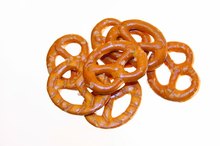
Lititz, Pennsylvania holds the distinction of being home to the very first commercial bakery to produce pretzels, according to Bethanne Patrick, author of “An Uncommon History of Common Things.” Initially, all pretzels were soft and doughy, but in the mid-1800s, the Pennsylvania factory began producing the crisp, crunchy pretzels common today. When losing weight, including pretzels in your diet may help you satisfy your urge to snack and still keep your calories to a minimum.
Dietary Requirements
When you lose weight through dieting, you need to determine the number of calories you will get from carbohydrates, proteins and fats before deciding whether pretzels fit into your dietary requirements. If you are focusing on a high-protein diet to lose weight, you will want to limit both soft and hard pretzels, as they contain 79.8 grams and 23.02 grams of carbohydrates, respectively. If you are eating about half your calories from carbohydrates, whole-grain pretzels will help you meet your carbohydrate requirement, and serve as a whole-grain food.
Calories
How Many Calories Are in a Bran Muffin?
Learn More
A medium, soft pretzel has 389 calories, and a 1-ounce serving of whole-wheat, crunchy pretzels has 103 calories. If you are eating at a 1,600-calorie level, one soft pretzel is 24 percent of your daily caloric intake, while the serving of hard pretzels is just 6 percent. The small size of hard, crunchy pretzels makes it easy to eat more than 1 ounce at a time. Count the number of pretzels you eat, or use a food scale to measure 1 ounce at a time.
Nutrients
Soft pretzels and crunchy, whole-grain pretzels have 32 calories and 6.3 calories from fat, respectively. The fats in both types of pretzels are mainly monounsaturated and polyunsaturated, with both pretzels containing less than 1 g of unhealthy saturated fats. The 2 grams of fiber in both pretzel types will help you eat at least 25 grams of fiber a day if you are female, and 38 grams if you are male. Fiber consumption may help you lose weight by keeping you feeling full after eating. Unfortunately, salted pretzels are high in sodium, with soft and hard pretzels having 926 milligrams and 486 milligrams of sodium per serving, respectively. All Americans should limit their sodium to a maximum of 1,500 milligrams per day, advises the American Heart Association. Other nutrients in pretzels included small amounts of iron and 25 micrograms of folic acid per 1-ounce of hard pretzel.
Strategies
Nutritional Value of Fritos
Learn More
If you choose to include pretzels in your diet, select low-sodium or salt-free pretzels to avoid eating most of your sodium requirement in one food type. Eat your low-salt pretzels with a healthy food, such as raw vegetables, hummus or fat-free yogurt. Portion your hard pretzels in snack-sized plastic bags to take to the office or to keep in the car as a snack. If you eat soft, baked pretzels, eat only half to conserve calories and give the other half to a friend.
Related Articles

How Many Calories Are in a Bran Muffin?
Learn More
Nutritional Value of Fritos
Learn More
Are Whole-Wheat Tortillas Healthy?
Learn More

Graham Cracker Nutrition Information
Learn More
Kraft Macaroni & Cheese Nutrition Information
Learn More

List of Roughage Foods
Learn More

Nutritional Values of Waffles vs. Pancakes
Learn More

Popcorn and Weight Loss
Learn More
Low Cholesterol Cookies & Snacks
Learn More

How to Lose 45 Pounds in 2 Months
Learn More
References
- “An Uncommon History of Common Things”; Bethanne Patrick, et al.; 2009
- MedlinePlus: Fiber
- American Heart Association; Sodium (Salt or Sodium Chloride); February 2011
Writer Bio
Diane Lynn began writing in 1998 as a guest columnist for the "Tallahassee Democrat." After losing 158 pounds, she wrote her own weight-loss curriculum and now teaches classes on diet and fitness. Lynn also writes for The Oz Blog and her own blog, Fit to the Finish. She has a Bachelor of Science in finance from Florida State University.