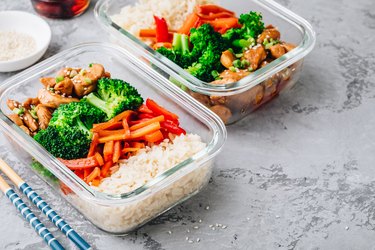
Diet programs like Nutrisystem promise to help you lose weight, but they can be rigid and expensive to follow. Get a little more flexibility by creating your own Nutrisystem meals at home. All you need is a little planning and meal prep work on the weekend to start losing weight on your own.
About the Nutrisystem Program
Video of the Day
Nutrisystem is a weight-loss program that offers meal plans with prepackaged meals and guidance as to how to slowly work in your own freshly-prepared food that you love. The Nutrisystem program is entirely prescribed, so you get anywhere from five to seven breakfasts, lunches and dinners each week, plus snacks, that are all pre-portioned. You sign up for a 5-day per week or 7-day per week plan; a completely personalized plan is also available.
Video of the Day
At most meals, you don't have to weigh and measure anything yourself, or eyeball portion sizes — it's all done for you with prepackaged meals. Nutrisystem prides itself on creating healthier versions of your favorite foods that include the right mix of nutrients. Their meals contain the right mix of high-quality, lean protein and high-fiber, low-glycemic carbohydrates, with no artificial sweeteners or flavor.
During the first week, meals are designed to help kickstart weight loss and "reboot" your body. You're given a list of meals to choose from, according to your personal goals. These meals are delivered to your door.
After week one, you continue to lose weight by using Nutrisystem meals and snacks. The program guides you as to how you can add fresh foods and be flexible with homemade or restaurant meals.
The Nutrisystem site notes that the program is a safe, effective and scientifically-backed weight-loss plan supported by the distinguished United States Science Advisory Board and strong clinical studies. The Nutrisystem program allows subscribers to align their goal of weight loss with the diet recommended by the USDA Dietary Guidelines.
Losing Weight on Nutrisystem
The Nutrisystem program promises to help you lose up to 13 pounds and 7 inches overall in your first month. It is a low-calorie eating plan, but because the meals are pre-portioned, you don't have to count calories yourself. Unlike other programs, you don't have to calculate points or macronutrients.
The plan doesn't focus on a specific gimmick, such as overemphasizing any one macronutrient, and it doesn't ban foods. It is in line with national guidelines for total fat, saturated fat, trans fats, carbohydrates, protein, fiber, sodium and added sugar.
The program also includes use of the free NuMi weight-loss app, which is specially designed for your Nutrisystem plan. It helps you track your food, activity and progress. The app keeps you motivated with challenges, offers discounts and freebies and provides easy recipes and grocery shopping tools. All along the way you get expert tips, articles and research to support your plan.
Nutrisystem Menu Items
The menu items on the Nutrisystem plan are varied, and meant to meet a variety of tastes. For breakfast, you might enjoy a cinnamon bun or apple strudel bar, cinnamon roll, chocolate muffin or turkey, sausage and egg muffin. Lunch offerings include a hamburger, pepperoni pizza melt or chicken, broccoli and rice. For dinner, enjoy pizza, artichoke-and-spinach-stuffed chicken breast or a meatloaf sandwich. Snacks include ice cream sandwiches, chocolate-covered pretzels and a lemon zest cake.
New items are often added. The prepackaged foods contain no artificial flavors or sweeteners, no artificial colors, no high-fructose corn syrup and no partially-hydrogenated oils. You choose your menu items according to your plan, and they're delivered frozen or vacuum-sealed.
The Nutrisystem program has you eating smaller, balanced meals throughout the day to promote weight loss and the maintenance of a healthy size. You eat about six times each day, or every two to three hours. The program also helps you fit in fresh grocery foods and other flexible meals, so you get plenty of balance and variety.
Benefits of Nutrisystem
The program includes "Flex" meals that mean you can add two non-packaged breakfasts, lunches, dinners and snacks each week, so you continue to enjoy your life. You can get out and enjoy a happy hour with friends, or a home-cooked meal with your kids.
No matter what plan you follow, you get comprehensive support and counseling options from trained professionals, such as weight-loss coaches, registered dietitians and certified diabetes educators. If you have a special dietary need, Nutrisystem can also accommodate in most cases — especially for diabetics.
Nutrisystem plan options are also available once you've lost weight and want to maintain your results. Select products are available at retail. All delivered meals are easy to store and reheat, so you can enjoy your meals and lose weight without a lot of preparation and hassle.
Nutrisystem is also effective for weight loss, some research shows. A meta-analysis published in the Annals of Internal Medicine in April 2016 found that Nutrisystem has the potential to help people achieve notable weight-loss results, but more research is needed to evaluate its long-term outcomes.
Nutrisystem meals are supportive of glycemic control in diabetics, too. Research published in Obesity Review in August 2016 showed that Nutrisystem, along with a few other commercial weight-loss programs, show promise in lowering glycemic (or blood sugar) levels in Type 2 diabetics.
Homemade Version of Nutrisystem
Your first step in making a homemade version of Nutrisystem is to determine how many calories you need to eat to support weight loss. Nutrisystem makes this determination for you, but when you're creating your own Nutrisystem meals, you have to do the calculations yourself.
Read more: The Ultimate Guide to Fat Loss
Your calorie needs are dependent on a number of factors, including your size, activity level, gender and age. A simple way to roughly estimate your daily calorie maintenance needs, explains Harvard Health Publications, is to multiply your current weight by 15.
Then, to determine the number of calories you should consume to lose 1 to 2 pounds per week — a safe level according to Johns Hopkins Medicine — subtract 500 to 1,000 calories from your maintenance number. Calorie intake, however, should not fall below 1,200 per day in women, or 1,500 per day for men. Eating too few calories makes it hard for you to get optimal nutrition.
To determine the calories you should have at each meal, take the number of calories you need to lose weight, and divide it up into three large meals and three smaller snacks. For example, if you currently weigh 160 pounds, this equation determines you need 2,400 calories per day to maintain your weight (15 x 160).
To lose weight, subtract 500 to 1,000 from 2,400 and you find your weight-loss goals is to consume 1,400 to 1,900 calories per day to lose 1 to 2 pounds per week. If you aim for an average of 1,600 calories per day, you could enjoy three large meals of about 400 calories per day (to equal 1,200 calories) and three snacks of about 125 to 130 calories each to replicate the Nutrisystem way of eating.
Meal Prepping for Nutrisystem
Your DIY Nutrisystem plan will require some work and calorie counting. You'll need to spend one or two days per week (the weekend is often a good time) shopping and meal prepping to create your homemade version of Nutrisystem.
Meal plan using a calorie resource such as a book or other nutrition guide, recognizing that each meal should contain lean protein, healthy high-fiber carbohydrates and a healthy source of fat. Snacks are generally made up of healthy foods, but may contain an occasional treat such as a low-calorie ice cream bar or low-fat cookie.
For the most part, focus on buying whole, unprocessed foods to adhere to Nutrisystem's commitment to avoiding artificial colors, added sugars, artificial sweeteners and trans fats.
Foods that will dominate your shopping list include:
- Lean chicken, fish, beef, turkey and pork
- Fresh leafy green vegetables, such as spinach, beans, broccoli and asparagus
- Whole grains, such as brown rice, quinoa and whole-wheat bread
- Healthy fats, such as nuts, avocados and olive oil
- Low-fat dairy, including frozen yogurt, skim milk and almond milk
A kitchen scale and set of measuring cups help you weigh out your menu items according to your calorie needs. Nutrition labels of prepackaged foods assist you in learning portion sizes and calorie amounts; you may also get assistance from websites such as Food Data Central. To replicate the Nutrisystem plan, you'll be reading lots of labels so you don't eat in excess of your calorie limits.
Pre-portion servings of protein, carbohydrates and vegetables into small containers to freeze or grab from the refrigerator. You may also look at cookbooks and healthy cooking websites for full meals, such as soups or stir-frys, that are easily cooked in advance for enjoyment later in the week. This meal prep creates the same ease that's so enticing with the Nutrisystem program.
Read more: How to Lose Weight Fast, the Healthy Way
You'll also need a week's worth of pre-portioned snacks. Have fresh fruit on hand, measure out baggies that contain an ounce or two of nuts, and purchase natural energy bars or healthy muffins.
The Nutrisystem app is free, so you may get ideas for recipes you can prepare in advance and store to support your DIY Nutrisystem plan. Create a meal plan for each day of the week and prepare as much of the food in advance as possible. Be smart when storing prepared food, too. Follow guidelines for safe food handling and don't keep pre-made meals longer than 3 to 5 days.
- Obesity Review: "A Systematic Review of Commercial Weight-loss Programs’ Effect on Glycemic Outcomes Among Adults with or at Increased Risk for Type 2 Diabetes Mellitus"
- Annals of Internal Medicine: "Efficacy of Commercial Weight Loss Programs: An Updated Systematic Review"
- Nutrisystem: "About Nutrisystem"
- Harvard Health Publishing: "Calorie Counting Made Easy"
- Johns Hopkins Medicine: "Maintaining Weight Loss"
- State Food Safety Resources: "When to Throw It Out"
- USDA: Dietary Guidelines 2015-2020
- USDA: Food Data Central