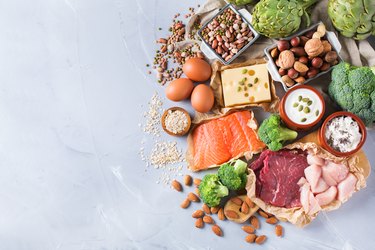
Reducing caloric intake and increasing calorie expenditure creates the calorie deficit necessary for weight loss. Reducing your carbohydrate intake can also help you reach your goal, says a study published in 2018 in the British Medical Journal — and so can increasing your protein intake, which provides extra satiety. Eating too few calories, however, such as 1,000 calories a day, can leave you feeling fatigued, which will interfere with your ability to exercise — the other important piece of the weight-loss puzzle.
1,000 Calorie Diet
Video of the Day
Consuming only 1,000 calories a day isn't enough for male or female adults. The only time an adult should go that low is under medical supervision. In some cases, doctors prescribe very low-calorie diets for people with obesity whose excess weight poses a health danger.
Video of the Day
Your calorie needs are determined by your age, weight and gender. The average moderately active female needs about 2,000 calories per day, and the average moderately active male needs approximately 2,400 to 2,600 calories each day. These are good estimates for people who want to maintain their weight and who get a moderate amount of exercise equivalent to walking 1.5 to 3 miles per day at a brisk pace.
People who are more active need more calories, and people who are sedentary need fewer. Whatever activity category you fall into, reducing your current daily calorie intake by about 500 calories is a good place to start. That means about 1,500 calories for a moderately active woman, and an average of 2,000 calories for a moderately active male.
If that's not working for you, you can drop your calorie intake further, but not much. According to the National Institutes of Health, meal plans that include 1,200 to 1,500 calories per day are suitable for most women who want to lose weight, and most men and more active women can lose weight on 1,500 to 1,800 calories per day.
Read more: Negative Side Effects of a Low-Carb Diet
Low-Carb, High-Protein Counts
Eating low-carb can mean a lot of things. For men, who have higher calorie needs, it might mean eating fewer than 100 grams of carbs per day, and for women it might include anything less than 50 grams per day. If you're following the popular keto diet, you may be getting less than 4 percent of your calories from carbs.
The Dietary Guidelines for Americans recommends getting 45 to 65 percent of your daily calories from carbohydrates. On a 1,200-calorie diet, if you stick to the low end of the range, you still need 135 grams of carbs per day — 170 for a 1,500-calorie diet. That's far more than many low-carb diets propose, but it's the lowest amount the mainstream medical community considers adequate for good health. Going below the generally recommended carb intake — to 100, 50 or 30 grams of carbs per day — is OK for a short period of time, but check with your doctor first, especially if you have a pre-existing health condition.
When you cut the carbs, you have to replace them with something. The keto diet prescribes an increase in fat intake, while other low-carb diets recommend increasing your protein intake. Too much fat will raise your caloric intake significantly, since fat has more than double the calories of carbs and protein per gram. Too much fat can also be bad for your health, increasing your risk of high cholesterol and heart disease.
The Dietary Guidelines recommends up to 35 percent of calories from protein, which adds up to 105 grams of protein daily for a 1,200-calorie diet and 131 grams daily for 1,500 calories. But, even that may be too much. According to Harvard Medical School, unless you're an athlete, getting more than 2 grams of protein per kilogram of body weight per day — 136 grams for a 150-pound person — isn't recommended. It may be fine for a brief time, but too much protein long-term can lead to kidney problems, high cholesterol and increased cancer risk.
Low-Carb, High-Protein Choices
When significantly restricting carbs, it's important to get enough of the right carbs — namely those that are high in fiber. Taking in too little dietary fiber is a common pitfall for low-carb diets and one that can cause constipation and bloating.
The recommended intake for fiber is 25 grams per day for women and 38 grams per day for men. To meet those targets, low-carb, high-fiber nonstarchy vegetables are your best choices. Some examples include:
- Broccoli: 6 grams carbs, 2.5 grams fiber per cup, chopped
- Cauliflower: 5 grams carbs, 2 grams fiber per cup, chopped
- Carrots: 6 grams carbs, 2 grams fiber per medium carrot
- Red bell peppers: 7 grams carbs, 2.5 grams fiber per medium pepper
Most fruits are higher in carbs because of their sweetness, and they don't offer drastically different nutrients than vegetables. Raspberries and blackberries are your lowest-carb and calorie choices with about 30 calories, 7 grams of carbs and 4 grams of fiber per half-cup.
Your protein choices need to be lean in order to maximize protein intake while staying within your daily calorie budget. Some examples of low-calorie, high-protein foods include:
- Chicken breast: 26 grams protein, 140 calories per 3 ounces
- Tilapia: 22 grams protein, 109 calories per 3 ounces
- Egg whites: 3.6 grams protein, 17 calories per large egg
- Nonfat plain cottage cheese: 15 grams protein, 104 calories per cup
You have lots of options for low-carb, high-protein meals that fit within a 1,200- to 1,500-calorie daily diet. Make lists of your favorite foods in each category, as well as how many carbs and calories and how much protein each has per serving. Then, rotate through your choices throughout the week so your meals never get boring.
Read more: Healthy Low-Carb Eating Plan
- The BMJ: Effects of a Low-Carbohydrate Diet on Energy Expenditure During Weight-Loss Maintenance
- Chris Kesser: Are You An Under-Eater? 8 Signs You’re Not Eating Enough
- Dietary Guidelines for Americans: Estimated Calorie Needs per Day, by Age, Sex, and Physical Activity Level
- Diet Doctor: How Low-Carb Is Keto?
- Harvard Medical School: When It Comes to Protein, How Much Is Too Much?
- Robb Wolf: Keto Constipation Hacks: How to De-Bloat & Improve Poo on a High Fat Diet
- National Academy of Medicine: Dietary Reference Intakes: Macronutrients
- USDA: National Nutrient Database: Broccoli, Raw
- USDA: National Nutrient Database: Carrots, Raw
- USDA: National Nutrient Database: Cauliflower, Raw
- USDA: National Nutrient Database: Peppers, Sweet, Red, Raw
- USDA: National Nutrient Database: Chicken, Broilers or Fryers, Breast, Meat Only, Cooked, Roasted
- USDA: National Nutrient Database: Blackberries, Raw
- USDA: National Nutrient Database: Raspberries, Raw
- USDA: National Nutrient Database: Cheese, Cottage, Nonfat, Uncreamed, Dry, Large or Small Curd
- USDA: National Nutrient Database: Egg, White, Raw, Fresh
- USDA: National Nutrient Database: Fish, Tilapia, Cooked, Dry Heat
- Cleveland Clinic: Fat and Calories