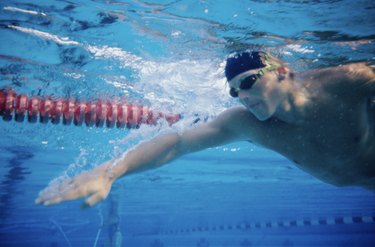
The swimming pool is generally a safe environment when it comes to knee injuries, because most strokes cause minimal impact on the bones and joints. However, certain strokes can cause knee injuries if performed repetitively or improperly. The knees are the second most frequently injured body part in swimmers, after the shoulders. Competitive swimmers are most likely to incur knee injuries, but recreational breast stroke swimmers may also experience knee ailments and associated pain.
Risk Factors
Video of the Day
Several factors are related to an increased risk of knee pain in swimmers. A condition called breast stroker's knee may result from the whiplike kicking motion used in breast stroke swimming. Risk factors for developing breast stroker's knee include overtraining, poor technique, inadequate warmups and limited flexibility of the hip, among others. Competitive swimmers with good breast stroke technique, on the other hand, are at lower risk for developing knee pain.
Video of the Day
Injury Symptoms
Knee injuries related to swimming primarily cause pain and, in some cases, swelling. But few clinical research studies have documented whether these symptoms occur most commonly in one or both knees, according to a September 2011 report published in the "British Medical Bulletin." The authors note, however, that the inner aspect of the knee is most commonly affected. This area corresponds to a ligament known as the medial collateral ligament. Videotaping swimmers has documented a connection between knee injuries and the angle of the hip at the beginning and the completion of the kick.
Injury Treatment
Knee injuries in swimmers are typically treated with rest, ice and elevation, but no clinical studies have determined the ideal rest period. During recovery, swimmers are generally advised to slow down, reduce the force of kicking, warm up carefully and avoid overusing the affected knee. In some cases, antiinflammatory medications or cortisone injections may be used to reduce knee pain. A knee brace is helpful for some swimmers.
Prevention
Warming up and stretching before a swimming workout can help prevent knee injuries and pain for both recreational or competitive athletes. Perfecting kicking and stroke techniques to avoid wide and unnecessarily forceful kicks is also useful. Forcefully pushing off the pool wall can increase the risk for knee injury. Strengthening the muscles of the thigh and hip helps prevent knee injuries related to poor body alignment and weak muscles.
- Clinical Kinesiology: Understanding Trends and Risk Factors of Swimming -- Related Injuries in Varsity Swimmers
- FINA Sports Medicine: Knee Problems in Aquatics
- Sports Health: Epidemiology of Injuries and Prevention Strategies in Competitive Swimmers
- British Medical Bulletin: Soothing Suffering Swimmers -- A Systematic Review of the Epidemiology, Diagnosis, Treatment and Rehabilitation of Musculoskeletal Injuries in Competitive Swimmers
- The Encyclopaedia of Sports Medicine; An IOC Medical Commission Publication; Dennis J. Caine, Peter Harmer, Melissa Schiff (eds.)
Is this an emergency? If you are experiencing serious medical symptoms, please see the National Library of Medicine’s list of signs you need emergency medical attention or call 911.