If you have pain on the outside of the lower leg, above the ankle, you might have a calf strain. Whenever you lift your heel to step forward or walk on your tip-toes, the calves flex. Because of this, the calves become well-developed if an exercise routine contains lots of walking and running, even if there aren't any particular calf exercises being performed.
However, the outside calf muscles could become uncomfortably tight if more time is spent working these muscles than stretching them. This might cause pain in a broad range of areas, including the knees, feet and heel. If the outer calf — the gastrocnemius muscle — feels particularly tight, stretching this area could provide relief.
Video of the Day
Video of the Day
Stretch for Calf Muscle Pain
The outside calf muscles are exercised whenever someone stands on tip-toe, walks or runs, and the constant muscle contractions could make calf muscles stiff. Devoting a couple of days per week to stretching the calves may not be enough to make up for the constant stress on these muscles. You use your calves every day — you should also stretch them every day to stay flexible.
Read more: Stiff Calf After Doing Calf Raises
Stretches for Outside Calf Pain
A good opportunity to stretch for outside calf pain is after an exercise session, when the calves are warm and receptive to being stretched. Although, anyone with especially tight calves may want to stretch cautiously even after warming up with a walk or run.
If the outside of the calf is so tight that normal movement is difficult; then it will take some experimentation to find the best stretches to do without discomfort.
1. Standing Wall Calf Stretch
This stretch is an effective way to increase the flexibility of the outer calf muscles.
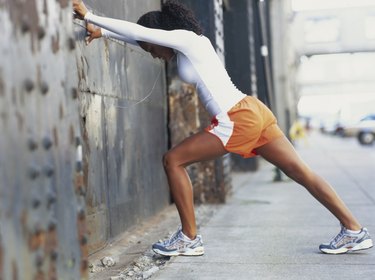
HOW TO DO IT: Turn toward a sturdy wall with the body maintained upright. Place the right foot on the wall with, toes slightly higher than the heel, keeping the right heel on the floor. Turn the right foot slightly so that the toes point inward to stretch the outside of the calf. Maintain balance by placing the left hand on the wall for support.
Lean the right hip and right leg forward until the right leg outer calf feels stretched. Stay in the stretched position for about 15 to 30 seconds, and then repeat this stretch for the left foot. If performing multiple sets, take up to a one-minute rest period before moving on to the opposite calf.
Read more: My Calf Muscle is Sore After Cramping
2. Towel Calf Stretch
This stretch for the outside of the calf is performed seated and only requires a regular bath towel to do properly.
HOW TO DO IT: Sit on the floor, keep the upper body upright and hold the ends of a towel in each hand. Bend the left leg, placing the left foot down on the floor; then extend the right leg, placing the right ankle on the floor.
Place the middle of the towel over the top of your right foot while turning the right foot inwards slightly to emphasize the outside of the calf. Gently pull on the towel to move the right foot back until there is a feeling that the right, outside calf is being stretched.
Stay in the stretched position for 15 to 30 seconds and then repeat the stretch for the other foot. If performing multiple sets, take up to a one-minute rest period before moving on to the opposite calf.