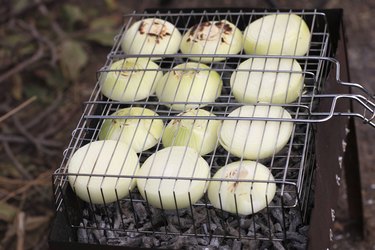
Onions have a good dose of vitamin C and healthful phytochemicals that help your body fight inflammation and blood sugar spikes. One way to make onions tastier is by grilling them. Watch the type of oil you use and your cooking methods, however, if you want your grilled onions to stay diet friendly. Also remember to add the higher calorie number and fat grams into your daily allotment if you are counting these.
Calories and Fat
Video of the Day
Raw onions have 46 calories per cup, most of which come from carbohydrates, and are virtually fat free, according to the U.S. Department of Agriculture's Nutrient Database. Onions grilled or sautéed with oil have 115 calories per cup, with the difference in calories supplied by fat calories. If you are limiting your fat intake, you must factor in the 9.4 grams of fat that the cooked onions have.
Video of the Day
Many diets, such as the heart-healthy diet recommended by the American Heart Association, require you to watch the type of fat you consume. Eating onions that are grilled in a partially hydrogenated vegetable oil will raise your trans fat intake and raise your risk for high cholesterol. Instead, choose onions grilled in a more heart-healthy mono- or polyunsaturated fat like safflower, olive, canola or macadamia nut oil. When you grill onions yourself, brush thickly sliced onions only lightly with your oil to reduce calories and fat, recommend Fred Pescatore and Jeff Harter, authors of "The Hamptons Diet Cookbook."
Blood Sugar Effects
Raw onions are a diet friendly food because they have blood sugar-lowering effects thanks to their allyl propyl disulfide, or APDS, content as well as their allicin content. However, while it may be possible that onions help keep your blood sugar low and even help you manage diabetes, more research is needed to determine this effect, according to the World Health Organization. You may counteract the effects of allicin if you grill your onions too soon. That's because allicin is formed from the enzyme alliinase when an onion is cut or crushed. This enzyme can be inactivated by heat. To partially conserve the allicin-producing alliinase, let your onions "stand" for about 10 minutes before exposing them to heat.
Glycemic Load
Onions have a low glycemic index, just like most other vegetables. The glycemic index of a food is an indication of how quickly that particular food raises your blood sugar when compared to pure glucose. A glycemic index of 100 is bad, as it is the same of pure sugar, and anything under 50 would be considered low, or good, according to Harvard Health Publications. Onions actually measure up with a GI of 10, according to Carbs--Information.com. Raw vegetables have a lower glycemic load than grilled veggies. However, you are only converting your onion from a low-glycemic food to a low-moderate glycemic food. Thus, if you are following a plan that calls for avoiding high-glycemic foods, you are still okay, note Meri Raffetto and Rosanne Rust, authors of the "Glycemic Index Cookbook for Dummies."
Fiber for Weight Loss
One thing that lowers a food's glycemic index is fiber. Both raw and grilled onions supply dietary fiber. Raw onions give you 2 grams of fiber per cup, while grilled have 1.5 grams of fiber per cup, notes the USDA. Fiber is also essential for overall health. Consuming fiber in your diet reduces your risk of diabetes, heart disease, obesity, stroke, high blood pressure, and intestinal ailments, according to a review 2009 issue of "Nutrition Reviews." Other significant benefits of fiber include a reduction in cholesterol levels as well as a lower risk of ulcers, hemorrhoids and constipation. Researchers report that prebiotic fibers -- specialized fibers from plants -- may even boost the immune system. The recommended daily intake of fiber is 25 grams for women and 38 grams for men.
- U.S. Department of Agriculture: Nutrient Database: Onions, Raw, and Onions, Yellow, Sauteed)
- American Heart Association: Fat
- The Hamptons Diet Cookbook; Fred Pescatore, et al
- Harvard Health Publications: Glycemic Index and Glycemic Load
- World Health Organization: Bulbus Allii Cepae Monograph
- Linus Pauling Institute: Garlic and Organosulfur Compounds
- Institute of Medicine: Dietary Reference Intakes: Macronutrients
- Glycemic Index Cookbook for Dummies; Meri Raffetto and Rosanne Rust
- Linus Pauling Institute: Glycemic Index and Glycemic Load
- Nutrition Reviews: Health Benefits of Dietary Fibers
- University of Sydney: About Glycemic Index
- Carbs--Information.com: Glycemic Index Food Chart