
What Is the Crown of a Football Field?
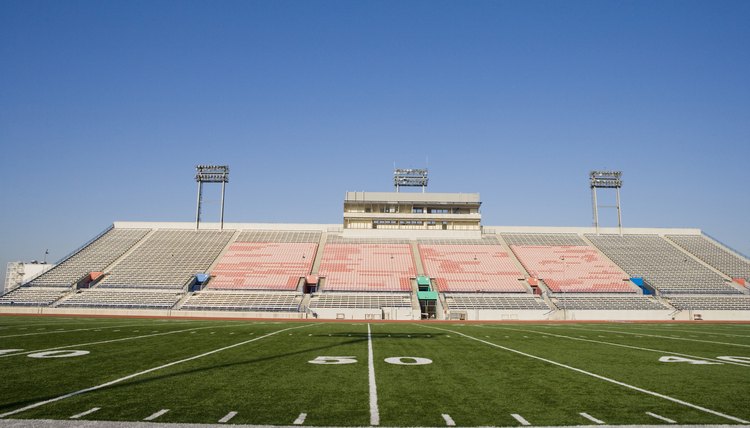
A properly designed grass American football field does not lie perfectly flat. The surface of the field often arcs a foot or more from the sidelines to the midfield to allow excess water to drain off. Without a crown, as the raised area is called, a grass football field can become a soupy, dangerous mess. Many NFL fields and high school athletic fields in America utilize this surface drainage strategy.
Avoiding Ponding
moodboard/moodboard/Getty Images
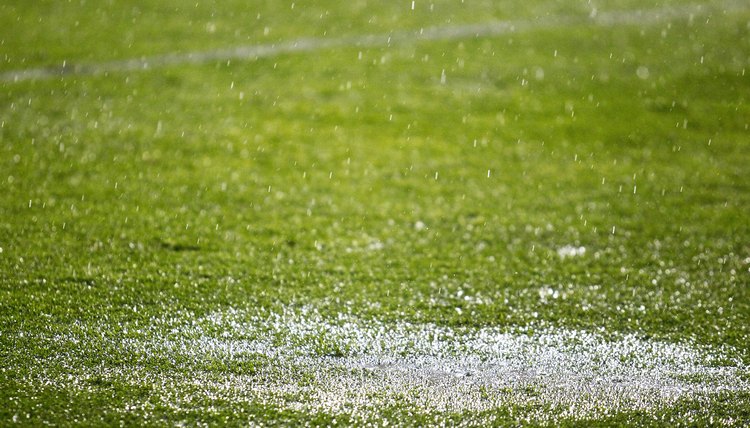
When rain falls on a natural grass football field, it can either soak into the soil or run off. The crown is designed to allow rain to run off toward the sidelines, away from the center of the field, where most of the action takes place. Jim McAfee of Texas A&M University, an expert on sports field design and maintenance, notes that on a field without a crown -- or with an inadequate crown -- water will quickly pond, forming pools.
In addition to creating unsafe playing conditions, ponding causes the soil in grass fields to compact more tightly, which only makes the problem worse. Stadiums that do not have an open roof, like the Dallas Cowboys’ Cowboys Stadium, do not have to deal with this problem.
What is The Proper Slope for a football field?

moodboard/moodboard/Getty Images
Crowning a football field starts well before the grass is laid. The underlying soil is sculpted so that the crown runs down the middle of the field, roughly from one goalpost to the other. The area from the crown to each sideline is then graded so that there is a smooth, even slope down each side of the field. The slope is barely perceptible -- perhaps 1 foot of drop over 75 feet, or about a 1 percent to 1.5 percent grade. If one were to lie down facing the hash marks you can barely make out a slope in between the opposing field markings but the set up has little to no effect on a National Football League game or games of other levels.
How does Soil Type affect a football field?
moodboard/moodboard/Getty Images
How high the crown should be depends on factors that include the type of soil underlying the field; the amount of rainfall the field can expect to receive; and any drainage system installed in the field. The most important of these is the soil. The firmer and less absorbent the soil, the sooner it becomes saturated and susceptible to ponding, so the higher the crown should be from endzone to endzone.
Looser, more absorbent soils can have a lower crown because the soil can soak up more water before ponding begins. McAfee recommends a 12- to 18-inch crown, with the shorter heights used for loamy or sandy soils and the taller crowns for soils with a lot of clay. Paul E. Rieke, a pioneering soil and turf specialist and horticulture expert at Michigan State University, has suggested going as high as 24 inches for extra-firm soils with poor drainage.
The Soccer Factor
Once the crown has done its job and gotten water off the field, a football facility must have an adequate drainage system to move the water away from the sideline as well. Otherwise, it can just pool there and, if it's rainy enough, back up onto the field. McAfee notes that many football fields are used for other sports, particularly as soccer fields, which have a wider playing surface. Designers must take all uses of the field into account when determining crown height and field slope, lest they build a field on which football players stay dry but soccer players find themselves in ankle-deep puddles in spots. This is why some pro football stadiums must do renovations before hosting FIFA world cup games in 2026.
Do synthetic turf fields have crowns?
moodboard/moodboard/Getty Images
While bluegrass or bermuda grass fields need a crown, artificial turf fields don’t necessarily need them. This is because turf fields usually have built in irrigation and can easily absorb water. However turf fields have some downsides so deciding a playing surface for a new stadium can be tough.
References
Writer Bio
Cam Merritt is a writer and editor specializing in business, personal finance and home design. He has contributed to USA Today, The Des Moines Register and Better Homes and Gardens"publications. Merritt has a journalism degree from Drake University and is pursuing an MBA from the University of Iowa.