
If you weigh 135 pounds and want to lose a few pounds, it's important to consult your doctor first to ensure you're not about to do something unhealthy. If she gives you the OK, expect your progress to be slower than someone who has an excess amount of weight to lose.
Step 1

Enter your information into a calorie estimator, such as the American Council on Exercise's "Daily Caloric Needs Estimator," to determine how many calories your body needs based on your gender, height, weight and activity level. (See link in Resources) The resulting number will be how many you should consume to maintain your weight; you'll need to consume fewer than that to lose weight.
Video of the Day
Step 2

Track your daily calorie intake by using an online "calories in foods" calculator, or an app you can download to your mobile phone. Apps and websites including FitDay and FreeDieting help you calculate your caloric needs and estimate the number of calories that are in the foods you eat. They can also estimate the number of calories you've burned through exercise. (See links in Resources)
Step 3

Alter your diet to incorporate more healthy foods and fewer high-fat, high-calorie items. Tracking your intake with an app or an online tool over a period of time will help you notice any eating patterns that may hinder your weight loss. Then, you'll be able to determine where you might be able to cut down. The usual culprits include alcohol, sodas and sweet drinks, late-night snacks, desserts and overly-large portions.
Step 4

Perform cardiovascular exercise on a regular basis. Do three to four days of steady-state exercise in which you do activities such as walking, running, cycling, aerobics, dance fitness or swimming for 30 to 60 minutes. Do high-intensity interval training, or "HIIT," two days a week. During HIIT workouts, warm up for about five minutes at a slow pace, and then do your preferred form of cardio at about 80 to 90 percent of your maximum speed for 30 seconds. Slow down to 50 percent of your maximum speed for another 30 seconds. Cycle between the two speeds for six to eight rounds. This will help you increase your aerobic fitness, burn subcutaneous abdominal fat and increase your metabolism for the rest of the day.
Step 5
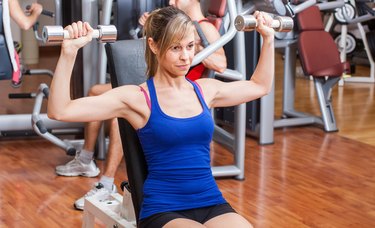
Incorporate strength training into your routine two days a week. Building muscle will help you burn more calories. Your routine should work all the major muscle groups, including the legs, back, arms, chest, shoulders and abdominals.
Tip
Don't get discouraged if you don't make progress as quickly as you'd hoped. At your weight, your weight loss is going to be very gradual, and it may be difficult to see changes for several weeks -- or even months.
Video of the Day