
How to Stretch the Psoas Muscle
The psoas muscle connects the lower middle spine to the top of the leg, making it one of the most important muscles in your body. You may not give this muscle much thought, as it's deeply embedded within your body; but when it's tight or injured, you experience a range of discomforts and injuries, including low back pain, sciatica, disc problems, hip degeneration, knee pain and pelvic pain.
A tight psoas can also compromise the range of motion you have in your low back, shoulders and hips. Stretching this hip flexor muscle is simple and necessary if you participate in activities that regularly shorten it, such as sitting for long periods or sports including running and cycling.
Function of the Muscle
Running, walking and sitting all engage the psoas muscle. When you raise your knee, the psoas contracts. When the leg swings back, as during a running stride, it lengthens the muscle. Sitting for hours at a time leaves the psoas in a contracted position -- habituating it into tightness. When it's tight, you suffer posturally from an arched lower back, anterior pelvic tilt and hunched-forward shoulders. These postural abnormalities can lead to compression of the lumbar discs of the spine.
The psoas doesn't work alone. It joins the iliacus at the hip, which travels from the hip to the thigh; the iliacus and psoas together are often referred to as the iliopsoas. Stretch this region daily or aim for at least three days per week on non-consecutive days. Stretching is especially necessary after psoas-tightening activities such as running.
Simplest Stretch
A way to determine if a psoas muscle is extremely tight is to lie on the floor with both legs extended in front of you. Hug one knee into the chest and, if the other leg lifts off the floor, chances are that the psoas of the extended leg is overly tight. Try this on both sides, as one side may be tighter than the other.
Stretch after doing this analysis. While on the floor, bring both legs to a 90-degree angle; ensure your tailbone stays on the floor. Draw the extended right leg toward your chest using your hands and place the left foot on the floor, knee bent. Slowly inch your foot along the floor, extending the left leg, to stretch the psoas. Go just to the point of mild sensation -- not pain. Hold for 20 seconds or longer and repeat on the other side.
Warrior I
The yoga pose of Warrior I, when you focus on not tilting the pelvis anteriorly, provides a solid stretch for the psoas. Stand in a lunge position, feet 3 to 4 feet apart, with the front knee bent deeply and the back foot set down at a 45-degree angle. The front heel aligns with the inner arch of the back foot. Lift your arms overhead and lean back slightly to feel the hip flexors push forward.
Yoga International suggests doing the pose in a doorjamb or against a pillar, with the right leg behind you and the left leg forward. Your hands reach up to hold the doorjamb or pillar and help pull your chest toward the wall and the naval and pelvis away. Working against the wall helps you tilt the pelvis posteriorly to effectively stretch the psoas.
In either version of the pose, hold for about five deep inhales and exhales, or approximately 30 seconds.
Low Lunge
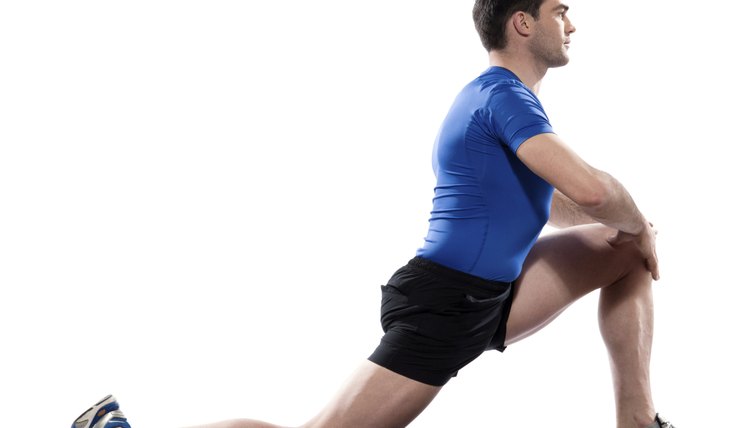
A simple kneeling lunge also stretches the psoas. Kneel on the floor or a mat and bring one foot forward so that the ankle is under the knee and the leg forms a 90-degree angle. Tuck your pelvis as you lean your body forward into the lunge. Avoid arching your lower back. If you feel comfortable doing so, raise your arms up and overhead, leaning back more. Treat the lunge as a dynamic stretch and press into it for 2 to 3 seconds at a time for 20 repetitions on each side.
References
- Runner's World:Runner's Guide to the Psoas
- Yoga International: How to Stretch and Strengthen the Psoas
- Rauseo C. The rehabilitation of a runner with Iliopsoas tendinopathy using an eccentric-biased exercise – a case report. Int J Sports Phys Ther. 2017;12(7):1150-1162. doi:10.26603%2Fijspt20171150
- Clevland Clinic. Psoas Syndrome. Updated November 12, 2018.
- Calais-Germain B. Anatomy of Movement. Seattle: Eastland Press; 2014.
Writer Bio
Andrea Cespedes is a professionally trained chef who has focused studies in nutrition. With more than 20 years of experience in the fitness industry, she coaches cycling and running and teaches Pilates and yoga. She is an American Council on Exercise-certified personal trainer, RYT-200 and has degrees from Princeton and Columbia University.