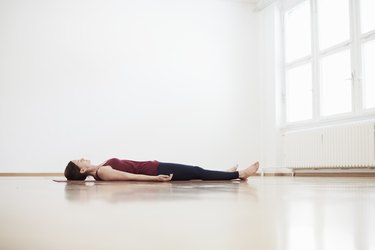
A cervical disc bulge can cause neck pain, as well as tingling and numbness down your arm. These C5-C6 disc protrusion exercises may help improve your symptoms. In addition to pain relief, they promote good posture and may restore your mobility.
Cervical Disc Bulge vs. Herniation
Video of the Day
If you have been told you have a cervical disc bulge, you may be wondering how that differs from a disc herniation. The discs act as cushions between the vertebrae in your spine. They are often compared to jelly doughnuts as they have a tough outer layer of cartilage and a soft inner layer.
Video of the Day
As you age, these discs can stiffen and cause the outer layer of the disc to bulge out, says the Mayo Clinic. This is a cervical disc bulge.
A herniated disc is the result of the disc cracking, causing the soft inner cartilage to protrude. This condition is more likely to cause pain than a bulging disc because it can irritate the nerve roots.
A cervical disc bulge is largely due to degenerative changes, while a disc herniation often occurs abruptly from an acute injury, says the University of Pennsylvania. While they do differ, both benefit from treatment that includes anti-inflammatory medications and exercise. Physical therapy for a C5-C6 herniated disc or bulging disc will focus on pain relief as well as range of motion (ROM) and postural exercises.
Symptoms of Cervical Disc Bulge
The symptoms of a cervical disc bulge can vary from mild to intense. The degeneration of the disc material can eventually result in the disc material rupturing and turning from a bulge into a herniation, says the University of Virginia.
A cervical disc bulge and herniation may cause neck and arm pain that radiates down to the hand. You may also experience tingling and numbness — like your hand is asleep. The pain may increase when turning your head or performing certain motions. Eventually, you may also notice some weakness in your arm.
The specific place where you feel these symptoms depends on the nerve that is being affected. With a C5-C6 disc bulge or herniation, you may experience symptoms down your lateral arm, forearm, thumb and index finger, says the University of Florida Department of Neurosurgery. With this specific nerve being affected, you may eventually have biceps weakness.
Physical therapy for a C5-C6 herniated disc or bulging disc can often help in relieving pain and improving motion.
C5-C6 Disc Bulge Exercise
The goal of these C5-C6 disc protrusion exercises is to move the bulging disc back and away from the nerve. The symptoms should start to move out of your arm or shoulder so you feel them more localized in your neck, says the North American Spine Society. The neck pain should then start to decrease and eventually subside completely.
This is called "centralization," and it means you are improving and making important steps to having less neck pain. Beware that numbness and tingling may take longer to subside than the pain.
If your symptoms worsen during exercise, stop the activity and focus on those that improve the pain. Talk with your doctor before starting any exercise program.
Move #1: Supine Retraction
- While lying on your back, place your fingers on your chin and push down so your chin tucks.
- You will feel a stretch in the back of your neck.
- Repeat eight to 10 times.
Move #2: Sitting or Standing Neck Retraction
- Sit up straight and place your fingers on your chin and push your head backward as far as it will go while continuing to look straight ahead.
- Hold for one to two seconds and then release back to neutral.
- Repeat eight to 10 times, three to four times per day, especially if it helps with the pain.
- Continue to do this C5-C6 disc bulge exercise for another two weeks even after the pain has subsided to prevent its reoccurrence.
Move #3: Isometric Strengthening
- Sit in a chair with good posture.
- Place your hand on your forehead and push your head and neck forward against your hand.
- Push as hard as you can without pain. Hold 10 seconds and repeat three times.
- Place your hand against the back of your head three times, as well as both sides of your head to strengthen in all positions.
Move #4: Prone Head Lifts
- While lying face down, prop up on your elbows and let your head hang down.
- Lift your head to a neutral position and then continue to move it up until you are looking up.
- Hold for five seconds and slowly return to the starting position.
- Repeat five times.
Move #5: Supine Head Lifts
- While lying on your back, raise your head off of the surface and bring your chin to your chest.
- Hold for five seconds and then rest.
- Repeat eight to 10 times.
Read more: Gym Exercises You Can Do With a Slipped Disc
Maintain your range of motion by slowly turning your head all the way to the left and to the right, at least twice a day. Progress to more advanced postural strengthening exercises, such as seated rows.
- Mayo Clinic: "Bulging Disk vs. Herniated Disk: What's the Difference?"
- University of Pennsylvania: "Bulging Disc vs. Herniated Disc: What’s the Difference?"
- University of Virginia: "Cervical Disc Disease, Herniation, and Degeneration"
- University of Florida Department of Neurosurgery: "Herniated Disc – Cervical"
- The North American Spine Society: "Cervical Exercise: The Backbone of Spine Treatment"
Is this an emergency? If you are experiencing serious medical symptoms, please see the National Library of Medicine’s list of signs you need emergency medical attention or call 911.