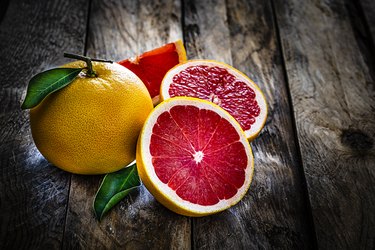
Your lipids test wasn't ideal? If so, your doctor may have prescribed a statin medication to help lower your LDL cholesterol. But there's a catch. Statins, like many medications, can interact with certain foods. In this case, it's primarily grapefruit. Here's how to protect yourself.
Read more: The Effects of Eating Too Much Grapefruit
Video of the Day
Video of the Day
What to Know About Statins
Optimally, your total cholesterol level should be below 200 milligrams per deciliter, according to the Mayo Clinic. Your LDL cholesterol level in particular should be below 130 milligrams per deciliter, or 100 if you've had a heart attack and even lower if your heart attack or stroke risk is very high.
If your cholesterol is beyond the healthy zone, you might start with lifestyle changes like quitting smoking, eating a diet rich in fruits, vegetables and fiber and getting the recommended 150 minutes of exercise every week, says the National Heart, Lung, and Blood Institute.
But if taking all those steps isn't enough to improve your blood test results, your doctor will likely prescribe a statin. Statins help to not only lower your LDL cholesterol, but also minimize the risk of blood vessel disease. If you've already had a heart attack, statins can help you avoid having another one, according to the Cleveland Clinic.
But as critical care specialist Matthew Tomey, MD, an assistant professor of medicine and cardiology at the Icahn School of Medicine at Mount Sinai in New York City, states, "The number one thing people shouldn't forget is that, even with statin therapy, lifestyle optimization, including diet optimization, remains important."
Food Interactions With Statins
"There are different ways that the body processes medicine in general — the liver and the kidneys are the two major organs that help us to break down and eliminate medicines and their byproducts," says Dr. Tomey.
In the liver, a set of enzymes works to break down statins. "One of them, cytochrome P3A4, is responsible for degrading a number of the most commonly used statin drugs," he explains.
However, a number of things — like other medications you take, foods you eat and exposures in the environment — can affect these enzymes. Some make them work better, some make them work less. Furanocoumarin, a substance found in grapefruit, can affect that enzyme by inactivating it, says Harvard Health Publishing. In turn, the statin you take becomes more potent in lowering cholesterol, but it also exposes you to a greater risk of toxicity from the drug, notes Harvard Health.
The question, though, is how much grapefruit is considered too much for you to eat or drink? In truth, it takes a lot. "You need to consume the equivalent of six large grapefruits to increase the potency of the tested statin by over 13 fold," explains Dr. Tomey. "Now for most of us, we might have a 6- to 8-ounce glass of grapefruit juice on any given day, which will increase the potency by about threefold."
Other fruits that contain the same compound as grapefruit include pomelos (an Asian fruit hybrid that looks like an oversized grapefruit), Seville oranges and limes, but research has been limited and it's unknown whether they produce the same amount of risk as grapefruit, according to UC San Diego Health.
The most adverse side effect of consuming grapefruit while taking statins is rhabdomyolysis, a breakdown of muscle tissue that can be dangerous for kidneys and cause kidney failure or even death, but it is extremely rare, according to a study published in January 2016 in the American Journal of Medicine — so rare that not eating grapefruit wouldn't reduce the risk by much.
That study, which also includes pomegranates and celery on the list of foods with furanocoumarin, concluded that moderate amounts of grapefruit won't interfere significantly with statins.
Importantly, grapefruit affects certain statins more than others, as Harvard Health Publishing points out. It has a big impact on atorvastatin (Lipitor), lovastatin (Mevacor) and simvastatin (Zocor), but little or no effect on fluvastatin (Lescol), pitavastatin (Livalo), pravastatin (Pravachol) and rosuvastatin (Crestor).
Still, you might want to take a more cautious approach. "I think it is totally reasonable to part with grapefruit juice if you can part with it, but it's not the end of the world if, once in a blue moon, you have a small glass of grapefruit juice," suggests Dr. Tomey.
Read more: Foods to Avoid When Taking Antibiotics
- Mayo Clinic: “Statins: Are These Cholesterol-Lowering Drugs Right for You?”
- Cleveland Clinic: “Do Your Statins and Grapefruit Safely Mix?”
- Matthew I. Tomey, MD, critical care specialist, Mount Sinai Medical Center; assistant professor, medicine and cardiology, Icahn School of Medicine at Mount Sinai, New York City
- UC San Diego Health: “Food for Naught”
- American Journal of Medicine: “Grapefruit Juice and Statins”
- National Heart, Lung, and Blood Institute: " High Blood Cholesterol"
- Harvard Health Publishing: "Grapefruit Juice and Statins"