
How Should Zone Defense Be Played in 7-on-7 Flag Football?
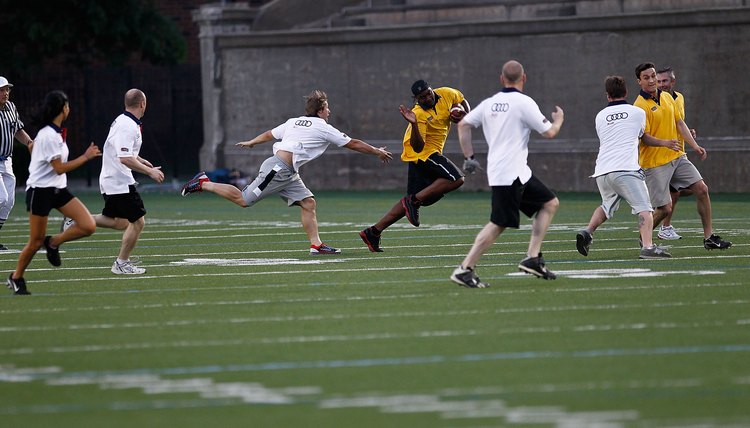
Playing zone defense in football requires players to patrol a certain area of the field and cover any offensive player that comes into that zone. In terms of playing zone defense for 7-on-7 flag football, it's possible to successfully apply several schemes from standard, 11-man football. For example, depending on how many people are allowed to rush the quarterback under the rules, the same type of defense can be played in flag football that many NFL teams employ.
The Cover 2 Defense for 7-on-7
The cover 2 defense in the NFL requires four defensive linemen to rush the quarterback while the other seven defensive players play zone coverage. For 7-on-7 flag football, apply the same principles if you wish to play a safe zone and not rush the quarterback. With seven players in the cover 2 defense, five defenders should each have a zone that covers throws within 5 to 15 yards of the line of scrimmage. Two players should cover the zone near the sidelines while the other three cover zones across the middle of the field.
The Safeties' Responsibility
The two deep defenders in cover 2 defenses should cover large zones that are deeper than the five front defenders. Essentially, the safety’s job should be to cut the field in half, with one safety playing a large zone on the deep right side of the field and the other safety covering the entire deep left side of the field. If the offensive team sends more than two players deep, the middle linebacker from the front five defenders should follow the middle receiver deep and allow the safeties to cover the other two players.
The Goal of the Cover 2 Zone
With all seven defenders in coverage, the opposing quarterback must be extremely accurate in order to find holes in the zone coverage and make a completion. The cover 2 defense suffocates the intermediate passing game and forces the quarterback to make low-percentage throws deep or short passes toward the sideline. Therefore, the goal of the zone defense should be to force the players into the middle of the field where other defenders can help.
Blitzing with Zone Defenses
Depending on the rules in your flag football league, you might have to blitz some of the five players covering the short part of the field. Use two deep cover players for the deep part of the field, with three defenders playing in three zones short and two players rushing the quarterback. This strategy forces the quarterback to throw the ball deep, which is difficult because of the two pass rushers.
References
Writer Bio
Kenneth D. Hartline is a Doctor of Psychology student at Pepperdine University in Los Angeles, California. He is also the founder and CEO of Hartline Enterprises LLC, a mental performance consulting agency. In 2009 he graduated from the University of Oregon with dual bachelor's degrees in journalism and psychology and has been writing professionally since 2007.