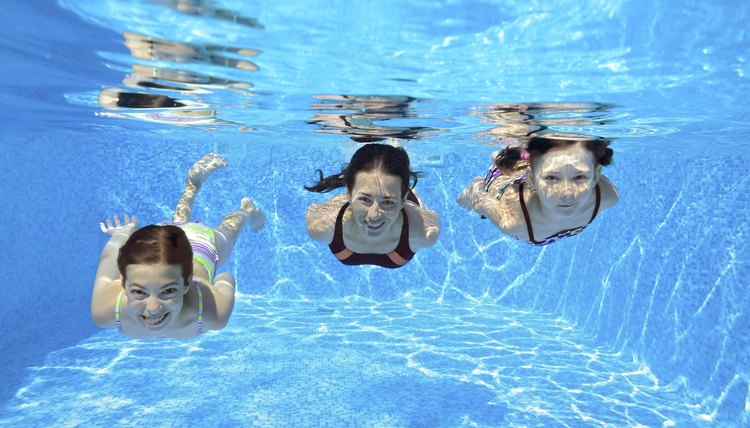
Trying to conceive can make for a very trying time in a woman's life, with many concerns and fears. While most activities are safe during the conception period and early pregnancy, there are those that should be avoided. Swimming in pregnancy has been touted as great exercise, but not much focus has been paid to the period of ovulation.
Symptoms of Ovulation
Most women do not understand how complex the menstrual cycle really is. There are many aspects that must interplay just right in order for ovulation to occur. There are signals to and from the brain and to and from the ovary that signal a very specific set of conditions that must occur. The function of a woman's menstrual cycle is to provide a reproductive window when pregnancy can take place and to prime the uterus for a possible pregnancy cycle. The signs and symptoms of both a menstrual flow and ovulation are varied and differ with each patient. Some women complain of very mild period symptoms, while some have debilitating pain requiring medical intervention. Similarly, ovulation can go by unnoticed by some, while other women have what physicians term "Mittelschmerz," which is midcycle abdominal pain or pelvic pain associated with ovulation. The activities that women can perform can be severely limited by both the physical and emotional effects of the process.
Length of the Menstrual Cycle
The average length of an adult menstrual cycle is usually defined as 25 to 35 days, as measured from the start of a menstrual bleed until the beginning of the following bleed cycle. When a woman is born, the ovaries possess approximately 1 to 2 million immature eggs. Through a process of elimination, by the time menstruation begins the number has been reduced to less than 400,000, according to J.O. Schorge, et al., in "Williams Gynecology." The process of ovulation along with natural cell death will deplete these immature eggs until the eggs are gone at the time of menopause.
Hormones and Ovulation
The first part of the menstrual cycle is the follicular phase. The body secretes follicle-stimulating hormone, which guides the maturation of the follicle until it is ready for ovulation. There is also a gradual buildup of leutinizing hormone (LH) until a "surge" of this hormone signals a cascade of processes that help the immature egg resume its maturation, culminating in the release of the egg from the ovary. Once released, the egg is picked up by fingerlike projections on the fallopian tubes called "fimbria," and it is transported to the uterus for possible fertilization and implantation. The LH surge typically will last about 48 hours, with ovulation after 36 to 40 hours. In addition to the Mittelschmertz described above, ovulation may also be accompanied by "moliminal symptoms," which may include breast tenderness, acne, food cravings and mood changes. If pregnancy does not occur, then lack of hormone signals will starve the innermost layers of the uterus, which will cause a breakdown of the tissue, leading to menstrual flow. If fertilization takes place, the egg implants within the uterus and ovulation will be stopped until the pregnancy comes to fruition.
Swimming and Menstruation
A review of current literature in PubMed and Euclid with search terms "swimming and ovulation" and "fertility and swimming" did not yield any adverse results. The American Congress of Obstetricians and Gynecologists (ACOG) recommends regular exercise, including swimming, except for women at risk of preterm labor, those with vaginal bleeding and those with ruptured membranes. A literature review did not show any adverse effects of swimming during ovulation; however, every patient is unique, and before a determination can be made a consultation with a physician is advisable since there are medical conditions that can contraindicate exercise and medications that adversely react to sunlight.
References
- "Williams Gynecology"; J.O. Schorge, et al.; 2008
- American Congress of Obstetricians and Gynocologists: Exercise During Pregnancy


Member Comments