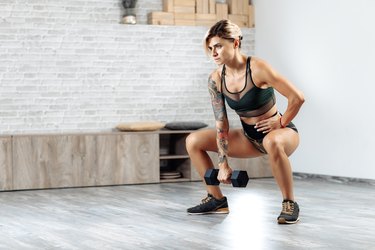
Dumbbell exercises are an excellent way to lose body fat, including on your stomach. While you can't spot reduce abdominal fat, losing weight all over your body eventually helps you lose belly fat.
Aside from essential healthy habits such as getting the right amount of sleep, eating a nutrient-dense diet and limiting stress, exercise is a top contributor in the fight against obesity. Performing dumbbell circuits is a highly effective way to build muscle while you burn fat.
Video of the Day
Exercising for Belly Fat Loss
According to the Centers for Disease Control and Prevention (CDC) physical activity provides a substantial boost to your health aside from weight loss.
Exercising is essential for fat loss because it helps you create to a caloric deficit, meaning you're burning more calories than you're consuming. You can do this by lowering your daily calorie intake and burning calories through dumbbell workouts and cardio exercises.
The research on the best exercise for fat loss indicates that combining cardio and strength training is the best strategy, per a December 2016 meta-analysis in the British Journal of Sports Medicine. Researchers concluded that the combination approach improved body composition, reduced inflammation and advanced the metabolic profiles of participants more than cardio alone.
You can combine by into one sweat session with dumbbell workouts that focus on full-body movements performed at high intensities, according to the American Council on Exercise (ACE).
Not only does this burn more calories during the workout, but thanks to excess post-exercise oxygen consumption (EPOC), you'll elevate your metabolism for hours post-workout, as your body attempts to return to a resting state, rebalancing hormones, replenishing fuel stores, repairing cell damage and building muscle.
Warning
The ACE says that you should be at a more advanced stage in your fitness journey to perform strenuous, high-intensity movements. If you're a beginner, make sure you're listening to your body and not performing any dumbbell exercises that cause pain or seem too difficult for you.
Doing the Best Dumbbell Exercises for Belly Fat
The following dumbbell exercises are excellent options for a high-intensity, fat-loss circuit workout that'll burn a lot of calories and lead to EPOC. These are more advanced, full-body moves that may be difficult for beginners. Practice without dumbbells until you get more comfortable and have perfect form.
Tip
Never sacrifice form for speed or reps and never push through pain. Rest after your work intervals and take a slightly longer rest as needed between rounds. Aim for 2 to 4 rounds of the circuit.
1. Dumbbell Thruster
- Stand with feet a little wider than shoulder-width apart. Hold a pair of dumbbells at shoulder height, one in each hand with palms facing inward. Your elbows should point slightly forward.
- Brace your core and hinge your hips backward, bending your knees into a squat, with thighs parallel to the floor (or as far as your mobility will allow). Your knees should track over your toes and not collapse inward.
- Stand back up by extending your knees and hips with power. Near the top of the movement, press the dumbbells upward, extending your arms so that your hands are over your shoulders.
- Lower the dumbbells back down to shoulder height as you descend into another squat to continue the reps.
- Do your reps quickly in succession during your work periods.
2. Dumbbell Lunge
- Stand with dumbbells at your sides, then step your right leg forward, landing with control.
- Bend at the knee and hip to lunge forward until your left knee is almost touching the ground. Both knees should form 90-degree angles.
- Press up to stand on your right leg.
- For the next rep, step forward with your left leg.
- Continue to alternate legs until your work interval is up.
3. Farmer's Walk
- With a solid grip, hold a heavy dumbbell on each side, palms facing toward your body. The weight should be hanging down by your thighs.
- Maintain proper posture as you walk forward carrying the weight. It should be heavy enough to feel challenging. Keep your core engaged as you walk.
- Continue to walk, turning around and coming back if necessary, until your work interval is up.
Adding Dumbbell Exercises for a Flat Stomach
Now it's time to ramp up your ab routine so your work on the weight-room floor matches the rest of your efforts. Add variety to crunches, sit-ups and planks with dumbbells, and engage in moves that train the whole body to build a toned physique with particular emphasis on the core.
Try these dumbbell exercises for abs — with pictures! — during your next circuit workout.
1. Half Turkish Get-Up
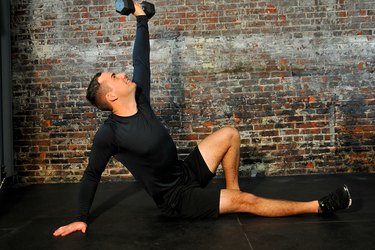
- Lie on your back and hold a dumbbell straight over your shoulder so it's reaching toward the ceiling. Extend your left leg, but keep your right knee bent.
- With your eyes focused on the weight, roll to the left side and press up onto your left hand. Keep the dumbbell overhead and eyes on it the whole time. Pause for a few counts.
- Use control as you reverse the movements to return to the starting position.
- Do 5 to 7 repetitions on one side, then switch.
Tip
This move is often done with a kettlebell, but a dumbbell works just as well. It's a full-body move that uses your core for stability, but also builds muscle in your shoulders, hips, arms and back.
2. Dumbbell Trunk Rotation
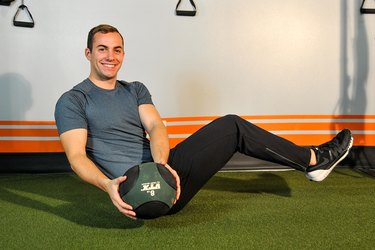
- Sit on the floor with your legs extended in front of you. Grab a dumbbell on its end with both hands. Hold the dumbbell in the center of your chest.
- Bend your knees slightly and keep your heels planted. Lean back until you feel your abdominal muscles engage. Your body will resemble the letter V. This is the starting position.
- Maintain a straight back as you twist your torso to the right. Keep the dumbbell directly centered between your navel and upper chest.
- Return to center and then rotate left.
- Continue to alternate sides until your work interval is finished.
Tip
To increase the challenge, lift your feet off the floor and balance on the back of your sits bones. Eventually, you may be able to lift both legs off the floor with bent knees or straighten them out at a 45-degree angle.
3. Archer Row
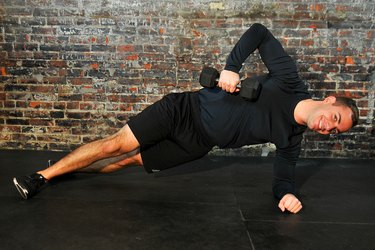
- With a dumbbell on your right side, assume a high plank with hands under shoulders.
- Lift your right arm and shift into a side plank, with your feet staggered. Your straight body is supported on your left palm and the sides of your feet.
- Grab the dumbbell with your right hand and row it up past your rib cage, your elbow pointing behind you.
- Complete 8 to 12 repetitions on one side, then repeat with the right hand as the base and the left hand rowing.
Creating a Fat-Burning Dumbbell Workout
1. Pick a Work:Rest Ratio
To create effective dumbbell circuit workouts, you'll need to get your timing right. High-intensity interval training (HIIT) typically involves 15 to 45 seconds of maximum-effort work followed by 30 to 60 seconds of rest or active recovery, per the ACE. This creates a work to rest ratio of 1:2 or 1:3 that's ideal for reaching EPOC.
Related Reading
2. Establish a Duration
These workouts should be reasonably short due to their intensity — 15 to 20 minutes is all you need. Be sure to add 5 to 10 minutes to warm up beforehand and 5 to 10 minutes to cool down after your workout.
3. Choose Your Exercises
Pick four to eight exercises (see above for some options). You can choose how many rounds you'll do based on how much time you have or want to spend working out.
For example, a 30-minute workout could consist of a 5 to 10 minute warm-up, followed by high-intensity dumbbell exercises using a 1:3 work to rest ratio (15 seconds of work and 45 seconds of rest). Run through five separate dumbbell exercises in a circuit four times over, with a one-minute recovery time between circuit rounds and a 5- to 10-minute cool down.
4. Monitor Your Intensity
To gauge your intensity, use a rating of perceived exertion (RPE) scale. A 7 to 8 is usually a challenging anaerobic work interval. And your rest intervals should be equivalent to pacing back and forth, allowing your rate to slow down somewhat before entering another high-intensity interval. Use the following scale provided by the Cleveland Clinic:
- 0 – no effort
- 1 – very easy
- 2 – somewhat easy
- 3 – moderate effort
- 4 – slightly hard
- 5 – hard
- 6
- 7 – very hard
- 8
- 9
- 10 – very, very hard
Related Reading
Understanding Causes of Belly Fat
Abdominal obesity can be caused by many factors. A March 2015 article published in the American Journal of Clinical Nutrition says that anything from endocrine disruptors — hormone-mimicking chemicals in our food, drugs and water — to daily stress can contribute.
And of course, consuming more calories than you burn and remaining sedentary is a huge factor contributing to an increase in belly fat and overall weight gain. Genetics also plays a role in the amount of stomach fat you have, determining where you tend to carry excess fat and how that fat comes off as you lose weight.
No matter the cause, having too much stomach fat can be unhealthy. Excess subcutaneous and visceral fat contributes to many health problems, according to Harvard Health Publishing. Visceral fat produces a protein that triggers inflammation, which in turn increases the risk of chronic conditions like heart disease.
Subcutaneous fat is a less risky type of fat that — in the right amount and ratio to other fat — can even help in the fight against diabetes. That's due to its role in the production of a hormone called adiponectin, which helps regulate the processing of sugars and fats, creating an anti-inflammatory effect.
Even so, having too much subcutaneous fat is unhealthy, and a 35-inch waist or larger correlates to a higher risk of breast cancer, colorectal cancer, dementia, cardiovascular disease and asthma, according to the National Heart, Lung and Blood Institute.
- American Journal of Clinical Nutrition: "Are the Recent Secular Increases in the Waist Circumference of Adults Independent of Changes in BMI?"
- Harvard Health Publishing: "Taking Aim at Belly Fat"
- National Heart, Lung and Blood Institute: "Assessing Your Weight and Health Risk"
- CDC: "Physical Activity for a Healthy Weight"
- British Journal of Sports Medicine: "Concurrent aerobic plus resistance exercise versus aerobic exercise alone to improve health outcomes in paediatric obesity: a systematic review and meta-analysis"
- ACE: "4 Effective Exercises for Fat Loss"
- ACE: "How to Create an Effective Circuit Workout"
- Cleveland Clinic: "Rated Perceived Exertion (RPE) Scale"
Was this article helpful?
150 Characters Max
0/150
Thank you for sharing!
Thank you for your feedback!