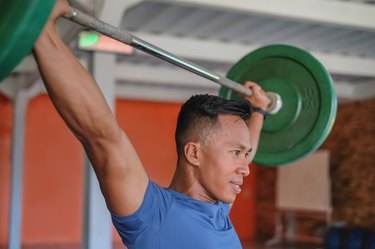
Whether you choose dumbbells, resistance bands, weight machines or body-weight exercises, resistance training will strengthen your bones and muscles, keep your metabolism humming and help make everyday activities easier.
And although lifting weights doesn't burn as many calories as cardio does in a single session, the perks last well beyond the end of your workout.
Video of the Day
Tip
The calories burned weight lifting for 30 minutes can range from 90 to 252, depending on your weight and the intensity of your workout.
How Many Calories Does Weight Lifting Burn?
Calories burned while lifting weights largely depends on how much you weigh. In general, the more you weigh, the more calories you'll burn compared to someone who weighs less, though only if you're both lifting at similar intensity levels.
Based off Harvard Health Publishing's calories burned chart for activity and weight, for 30 minutes of general weight training:
- A 125-pound person will burn 90 calories.
- A 155-pound person will burn 112 calories.
- A 185-pound person will burn 133 calories.
On the surface, it looks like people who weigh more have an advantage when it comes to burning calories during strength training. However, while people who weigh more generally burn more calories than their lighter counterparts, they also need more calories.
The reason? It takes more energy to power bigger, heavier things. Think about it: A laptop will typically need more juice than a smartphone.
In addition, how many calories you burn during a strength workout will depend on the intensity of the exercise. You can increase the amount of calories you burn by:
- Lifting heavy weights (weights you can lift for no more than 6 reps)
- Lifting weights in a fast, circuit-style fashion with little to no rest
- Performing bigger compound exercises (e.g., squat, bench press, deadlift)
To see the difference that intensity can have on caloric expenditure, consider some numbers from Harvard Health Publishing:
- A 125-pound person will burn 180 calories during an intense 30-minute strength workout.
- A 155-pound person will burn 216 calories.
- A 185-pound person will burn 252 calories.
The extra calories burned adds up over time, making higher-intensity forms of strength exercise well worth the effort.
Can You Lose Fat Lifting Weights?
Some forms of exercise get all the weight-loss credit, but the reality is that any form of exercise can help you lose fat, including strength training. Of all the factors that determine how many calories you burn on any given day, physical activity is the most variable.
So, you may not be able to change many factors that contribute to your resting metabolic rate (the number of calories your body needs to function at rest), but you can easily manipulate how much and what types of exercise you do every single day.
Adding regular exercise to your weekly routine can have a huge effect on the total number of calories you'll burn, which can ultimately help you shed more fat over time.
That said, no amount of exercise — strength training or otherwise — can undo the effects of a poor diet. If you're eating more calories than you're burning, you will gain weight over time.
Related Reading
Cardio vs. Weight Training
At the end of the day, it's important to do cardio and strength training, both for weight loss and for general health. Each form of exercise offers unique benefits that can keep you healthier and fitter for the long haul. In general, you can expect to burn more calories during a 30-minute cardio session than strength training.
For example, a 155-pound person will burn roughly 372 calories during a 30-minute run at a pace of 6 miles per hour but only 223 calories during a high-intensity resistance-training session, according to Harvard Health Publishing. However, strength training leads to greater muscle growth, and the more muscle you have, the more calories you burn at rest, according to the American Council on Exercise.
So, while you might not burn as many calories during a strength workout as you would during a cardio session, resistance training can help you burn more calories in the long term.
In addition, strength training causes more muscle damage than cardio, which will lead to an increased calorie burn post-workout. Why? Because your body uses up energy (read: calories) to repair damaged tissues and build new tissues. As a result, you'll continue burning calories after your strength session for longer than you will after a cardio workout.
How Much Weight Lifting Do You Need?
At a minimum, you should aim to meet the physical activity guidelines established by the Physical Activity Guidelines for Americans. Adults should get 150 to 300 minutes (two-and-a-half to five hours) of moderate-intensity cardio exercise, 75 to 150 minutes of high-intensity cardio exercise, or an equivalent combination of the two every week.
The Physical Activity Guidelines also recommends that all adults perform two full-body strength training sessions every week. If you want to maximize muscle growth, stick to moderately heavy weights that you can lift for six to 12 reps and keep rest periods short (one to two minutes max).
Benefits of Both Strength and Cardio
As far as the health benefits, cardio exercise (e.g., running, cycling, walking, swimming) is a great way to lower blood pressure and bad cholesterol, keep blood sugar under control, and reduce your risk of certain conditions, including heart disease, type 2 diabetes and stroke, according to the Mayo Clinic.
Meanwhile, lifting weights is one of the best ways to keep your bones strong, according to the American Heart Association. Strength training will also prevent sarcopenia or loss of muscle mass as you age.
A combination of age, inactivity and inadequate nutrition decreases bone mass at the rate of 1 percent per year after the age of 40. According to Harvard Health Publishing, by stressing your bones, strength training can play a role in increasing bone density and reducing the risk of osteoporosis.
If you don't do anything to replace the lean muscle you lose over time, you'll increase the percentage of fat in your body. By incorporating strength training into your fitness routine, you can burn calories in just 30 minutes, increase your metabolism and even reduce signs and symptoms of chronic conditions like arthritis and back pain.
Strength Exercises to Burn Calories and Build Muscle
Whether you want to focus on your upper body, lower body or total body, circuit training is a great way to get in multiple exercises at once. You'll be sure to burn calories if you keep up the intensity, focus on using heavy weights and move quickly from exercise to exercise.
Move 1: Dumbbell Thruster
- Start standing with your feet just wider than hip-distance apart, core engaged, with a dumbbell in each hand at your shoulders, palms facing in.
- Keeping your chest tall and core tight, hinge your hips back and down to sink into a squat. Lower until your thighs are parallel with the ground — or as low as you can comfortably squat while maintaining good form.
- Press through all four corners of your feet to return to standing.
- As you straighten your legs, press the dumbbells up over your head. Your upper arms should stay close to your ears.
- Slowly bend your elbows to lower the dumbbells back down to your shoulders with control.
Move 2: Push-Up
- Begin in a high plank with your core and glutes engaged. Your shoulders should be stacked over your wrists and your hips should be in line with your head and heels.
- Bend at the elbows at about a 45-degree angle from your torso and lower your body toward the ground.
- On the way down, squeeze your shoulder blades together.
- When your chest hovers just above the ground (or however far down you can go), press into the ground and push your shoulder blades apart to return to the starting position.
Move 3: Burpee
- Stand with your feet shoulder-width apart and your arms by your sides.
- Bend your knees, keeping your back straight and letting your butt drop down into a squat.
- Reach your hands forward, placing them on the floor shoulder-width apart.
- Kick your feet back to come into a high plank.
- Lower your chest and belly down to the floor.
- Press through your hands to quickly push your body back up.
- Jump your feet back in, making sure they land wider than your hands.
- Lift your hands, and press through your heels to stand.
- Jump straight up, reaching your arms overhead.
- Land gently and immediately lower into your next rep.
Move 4: Kettlebell Swing
- Start standing with your feet at shoulder-width apart, knees bent slightly, gripping a kettlebell on the ground between your feet.
- Keeping your back flat, shoot your hips back and pull the weight between your legs and under your hips.
- On an exhale, push your hips forward and straighten your legs, swinging the bell up to chest height with control.
- Using the bell's momentum, swing the weight back between your legs and under your hips as you simultaneously sink into your hips and bend your knees.
- Push your hips forward again to go right back into the next swing.
- Harvard Health Publishing: “Calories Burned in 30 Minutes for People of Three Different Weights”
- Health.gov: “Physical Activity Guidelines for Americans”
- ACE Fitness: "Weight Lifting for Weight Loss"
- Mayo Clinic: "Exercise: A Drug-Free Approach to Lowering High Blood Pressure"
- American Heart Association: "Strength and Resistance Training Exercise"
Was this article helpful?
150 Characters Max
0/150
Thank you for sharing!
Thank you for your feedback!