
Olympic Volleyball Rules
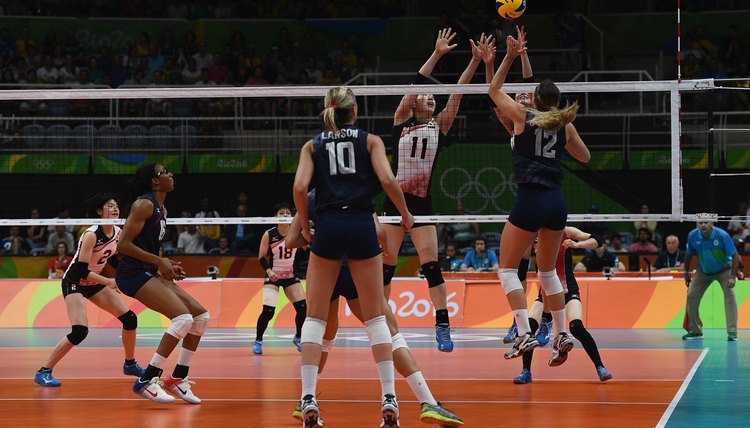
There's no doubt volleyball has gained popularity in recent years, in large part thanks to Olympic beach volleyball. However, indoor volleyball has been played as an Olympic sport since 1964. The International Olympic Committee awards medals in volleyball to men and women for both indoor and outdoor volleyball. The game features two teams playing at a time, and each team tries to win a match by winning three of five sets for indoor volleyball and two of three sets in beach volleyball. Olympic volleyball uses the same rules as the International Volleyball Federation.
Size of Court and Set Up
In the Olympics, the indoor volleyball court is 18 by 9 meters (59 by 29 feet). The court is divided by a net in the center of the court, where the top is 2.43 meters (about 8 feet) high in the men's game and 2.24 meters (about 7 feet) high in the women's game.
For indoor volleyball, there are six players on a team and three players in two rows. The player in the rear right position serves when his team has the ball, and a team regains the serve by winning a point after the opponent has served. The team rotates in a clockwise manner. The player in the rear right moves to rear center. The player in the rear center moves to rear left. The player in the rear left moves to front left and the rest of the team moves in a similar manner.
In beach volleyball, there are only two players per team. They switch off serving every time the ball returns to them for a new rally.
Scoring System
In Olympic volleyball, indoor volleyball is played under the rally system of scoring. This means that both the serving and defending team has a chance to score a point on the play. Whichever team wins the point also wins the serve. The first team to get to 25 points and lead by at least two points wins the set. Whoever wins three sets first, wins the match. However, if there's a 2-2 tie going into the fifth set, they only play to 15 points (with a lead of at least two).
In beach volleyball, teams only play to 21 points, but they must still be leading by 2 points. Just like indoor volleyball, if a tie-breaking match is needed, they will only play to 15 points.
Game Play
Each rally is started by the player in the rear right portion of the court who serves the ball (called putting the ball in service). He or she must toss the ball overhead and hit it directly over the net. The opponent has three hits to return the ball to the opponent, and the rally continues in this manner until the ball hits the floor or a team cannot make it over the net in three hits.
A player may go out of bounds to hit the ball, but the ball must cross the net and land in bounds for it to be considered a legal return. A ball that does not travel over the net counts as a point for the opponent. After each set ends, indoor teams switch sides of the court.
For beach volleyball, team switch sides of the net after every 7 points in set 1 and 2 and every 5 points in set 3.
References
Writer Bio
Steve Silverman is an award-winning writer, covering sports since 1980. Silverman authored The Minnesota Vikings: The Good, The Bad and The Ugly and Who's Better, Who's Best in Football -- The Top 60 Players of All-Time, among others, and placed in the Pro Football Writers of America awards three times. Silverman holds a Master of Science in journalism from the Medill School of Journalism.