
Shoulder Isolation Exercises
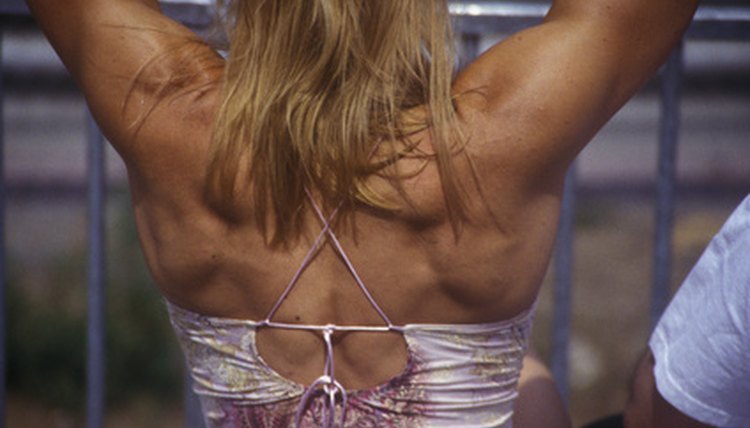
Your shoulders are involved in almost every upper body exercise you perform, from cable rows to bench press. They're so important, in fact, that exercising your deltoids (delts) and trapezius (traps) in isolation can improve most of your other lifts. Of course, there's also the side benefit of adding width to your upper body, creating that attractive v-shaped taper that indicates athleticism in both men and women. The shoulder press and upright row are compound exercises, because they work not only the shoulders, but the triceps and biceps respectively. Laterals are the primary shoulder isolation exercise.
Dumbbell Laterals
This exercise will target your anterior and middle deltoid heads, increasing your shoulder width. Stand with your feet approximately shoulder-width apart, and hold the dumbbells with your palms facing in towards each other. Lean ever-so-slightly forward to allow the dumbbells to touch in front of your thighs, as starting with the dumbbells resting on the outside of your thighs causes too much strain in your rotator cuffs as you progress to higher weights. Lift your arms until they are parallel to the ground, feeling the contraction in your delts and your traps. Pause for a moment, then lower the weights back down in front of your thighs.
Front Laterals
This exercise will target your anterior deltoid heads, increasing your strength for exercises such as bench press and shoulder press. Stand with your feet shoulder-width apart. Hold a pair of dumbbells at your sides, palms facing back. Starting with your weak arm, raise the dumbbell in front of you until your arm is parallel to the ground. Hold momentarily, then lower the arm back to your side. Repeat the motion with your strong arm. Always do an equal number of reps per arm.
The reason you alternate arms is that your natural tendency will be to hoist the weight up with your lower back. This tendency is greatly increased by lifting both arms at the same time.
Rear Laterals
This exercise will target your posterior deltoid heads, the ones that will assist you in back exercises such as back and cable rows and even pull-ups. For this lateral raise, you will need to sit on the end of a bench. Lean forward until your stomach touches your thighs. Move your feet far enough forward that you can bring the dumbbells together underneath your legs. Raise them out to the sides, maintaining your leaning posture. Hold momentarily, then lower them to beneath your thighs.
Shrugs
Shrugs target your trapezius muscles. In "The New Encyclopedia of Modern Bodybuilding," Arnold Schwarzenegger calls them "the visual center of the upper back." The top portion helps lift the shoulders in exercises such as laterals and shoulder presses. The rear portion helps retract the shoulder blades, pinching them together in exercises such as back rows.
Shrugs are the best way to target the upper trapezius, the portion that acts as a shoulder muscle. To shrug, grab a barbell or a set of dumbbells, and perform a shrugging motion. Do not rotate your shoulders as you'll see some people do. This adds absolutely nothing to the exercise, only increasing the risk of damaging your rotator cuff as you begin to use heavy weight. Hold the shrug at the top of the movement, then slowly release.
References
- "Inner Body": Human Muscular System Picture (Back View)
- "The New Encyclopedia of Modern Bodybuilding"; Arnold Schwarzenegger; 1998
Writer Bio
Jeffrey Rice became an ACE-accredited personal trainer in 2007, and began writing about fitness to support his business. Soon, however, he found himself writing more than training, and has since written health, fitness and supplement articles for numerous websites. He holds a M.F.A. in creative writing from Cleveland State University.