What does fact checked mean?
At Healthfully, we strive to deliver objective content that is accurate and up-to-date. Our team periodically reviews articles in order to ensure content quality. The sources cited below consist of evidence from peer-reviewed journals, prominent medical organizations, academic associations, and government data.
The information contained on this site is for informational purposes only, and should not be used as a substitute for the advice of a professional health care provider. Please check with the appropriate physician regarding health questions and concerns. Although we strive to deliver accurate and up-to-date information, no guarantee to that effect is made.
Causes of Dark Spots Developing on the Chest & Torso
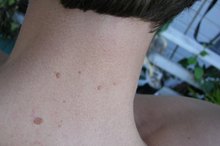
According to the American Osteopathic College of Dermatology, age spots, also known as liver spots, hyperpigmentation or lentigines, may appear on the chest, face, back of the hands or torso, and are considered a harmless skin condition 1. These darkened skin patches are mainly due to excess melanin, a condition also known as hyperpigmentation.
Sun Damage
According to MayoClinic.com, age spots or solar lentigines, are flat, black, brown or gray spots that usually appear on areas of the skin most exposed to the sun 3. Age spots are common for adults over 40 years of age, but may also affect younger people. The sun emits invisible rays of ultraviolet light or UVB rays. The UVB radiation attacks the skins pigment cells which react by overproducing melanin. The melanin darkens the skin to act as a filter from the harmful rays. Freckles and brown spots are examples of skin damage that occur as a direct result of exposure to UVB rays. People with fair skin who spend a lot of time in the sun are more likely to develop age spots.
- According to MayoClinic.com, age spots or solar lentigines, are flat, black, brown or gray spots that usually appear on areas of the skin most exposed to the sun 3.
- Freckles and brown spots are examples of skin damage that occur as a direct result of exposure to UVB rays.
Hormonal Changes
Why Do Skin Moles Increase?
Learn More
Dark spots that appear on the face, chest or other areas due to hormonal changes in the body look very similar to age spots but are usually larger in size. Often referred to as the "mask of pregnancy" when they occur on the face, melasma or chloasma spots occur as a result of fluctuating hormones in the body that stimulate an overproduction of melanin. In addition to pregnancy, woman taking birth control pills may also experience hormone related hyperpigmentation.
Other Causes
The AOCD states that other causes for dark pigmentation are related to skin diseases such as acne. Once the condition clears, dark spots may be left on the skin. In addition to acne, hyperpigmentation may occur after surgery or after an injury to the skin. When exposed to the sun, these spots or patches may become darker as the melanin works to absorb the UVB rays and protect the skin from further damage.
- The AOCD states that other causes for dark pigmentation are related to skin diseases such as acne.
- When exposed to the sun, these spots or patches may become darker as the melanin works to absorb the UVB rays and protect the skin from further damage.
Prevention
What Is the Difference Between Cellulitis & Mrsa?
Learn More
The American Skin Association recommends you protect your skin by following a few rules 2. Avoid the sun between the hours of 10 a.m. and 4 p.m. If you have to be in the sun, wear protective clothing. Use a sunscreen with an SPF of 15 or higher no matter what your skin type, and avoid indoor tanning.
- The American Skin Association recommends you protect your skin by following a few rules 2.
- Use a sunscreen with an SPF of 15 or higher no matter what your skin type, and avoid indoor tanning.
Related Articles
Why Do Skin Moles Increase?
Learn More

What Is the Difference Between Cellulitis & Mrsa?
Learn More

Hyperpigmentation While on Birth Control
Learn More

Symptoms of Low Blood Pressure After Exercise
Learn More
What Are Raised Bumps on the Skin?
Learn More

Tobacco's Effect on the Excretory System of the Human Body
Learn More
How to Stop the Itch of Folliculitis
Learn More
How to Get Rid of Psoriasis & Eczema
Learn More

Dark Pigmentation in the Elbows, Ankles and Inner Thigh
Learn More
How to Remove Moles With Glycolic Acid
Learn More
References
- American Academy of Dermatology: Mature Skin
- American Skin Association: Sun Safety
- MayoClinic.com: Age spots (liver spots): Symptoms
- Vashi NA, de Castro Maymone MB, Kundu RV. Aging differences in ethnic skin. J Clin Aesthet Dermatol. 2016;9(1):31-38.
- American Osteopathic College of Dermatology. Hyperpigmentation.
- Bandyopadhyay D. Topical treatment of melasma. Indian J Dermatol. 2009;54(4):303-309. doi:10.4103/0019-5154.57602
- Kang SJ, Choi BR, Lee EK, et al. Inhibitory effect of dried pomegranate concentration powder on melanogenesis in B16F10 melanoma cells; involvement of p38 and PKA signaling pathways. Int J Mol Sci. 2015;16(10):24219-42. doi:10.3390/ijms161024219
- Parveen R, Akhtar N, Mahmood T. Topical microemulsion containing Punica granatum extract: its control over skin erythema and melanin in healthy Asian subjects. Postepy Dermatol Alergol. 2014;31(6):351-5. doi:10.5114/pdia.2014.47117
- Kim E, Hwang K, Lee J, et al. Skin protective effect of epigallocatechin gallate. Int J Mol Sci. 2018;19(1). doi:10.3390/ijms19010173
- Kim YC, Choi SY, Park EY. Anti-melanogenic effects of black, green, and white tea extracts on immortalized melanocytes. J Vet Sci. 2015;16(2):135-43. doi:10.4142/jvs.2015.16.2.135
- Zhou BR, Ma LW, Liu J, et al. Corrigendum to "protective effects of soy oligopeptides in ultraviolet B-induced acute photodamage of human skin". Oxid Med Cell Longev. 2018;2018:3871280. doi:10.1155/2016/5846865
- Adhikari D, Panthi VK, Pangeni R, Kim HJ, Park JW. Preparation, characterization, and biological activities of topical anti-aging ingredients in a Citrus junos callus extract. Molecules. 2017;22(12). doi:10.3390/molecules22122198
Writer Bio
Alison Stellner, owner of Body Tune Personal Training, is a fitness instructor and freelance writer with more than 25 years in the health and fitness industry. Her first professional article was published in "Idea Today Fitness Magazine" in 1993. She majored in music and business administration at the University of Oklahoma.