
Stretches for Hip Pointers
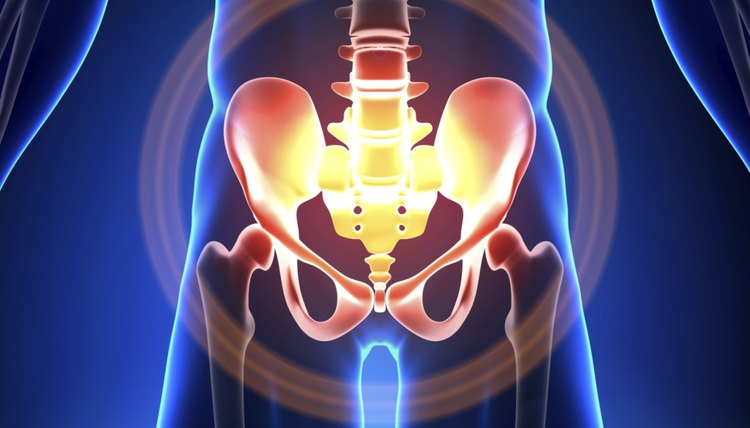
A hip pointer is an extremely painful injury that occurs when you receive a direct blow to the anterior superior iliac spine, the “point” on the front of your hip where your pelvic bone sticks out, according to the hip injury page of the Indian Health Service website. Hip pointers can cause bone fractures, extreme pain and deep bruising. Treatment of hip pointers calls for rest, ice, compression and elevation but often requires rehabilitative stretching to return your full range of motion. See your doctor before undertaking any of these stretches.
Standing Hip Pointer Stretch
Stand facing away from a hip-high table, and bend the leg of the injured hip until you can place the top of the foot on the table. Keep both knees under your hips and your stomach tight, then bend the knee of the leg you are standing on. This will stretch the bruised hip flexor muscles associated with the hip pointer injury, according to physical therapist Neil Chassan at the Sports Reaction Center. Increase the efficiency of this stretch by standing farther from the table, according to Chassan.
Wall Hip Pointer Stretch
This exercise is performed by standing perpendicular to a wall with your injured hip farthest from the wall. Place the hand of your uninjured side on the wall and raise the foot of your uninjured hip. Place your elevated foot in front of your injured leg and gently bend your hip away from the wall, stretching the muscles along the top of your hip. Your body should be in the position of a “C” when performing this stretch. Physical therapists at the Abshire Chiropractic Sports Center suggest that you hold this stretch for at least 30 seconds and up to one minute. It should be performed on both sides five times daily, they say.
Kneeling Hip Pointer Stretch
Begin this stretch in a kneeling position with the knee of your injured hip on the ground and your other leg in front of you with your foot flat on the ground. Tighten your stomach muscles to flatten your lumbar spine and slowly move your upper body until your body weight is supported by your front foot. Continue to move forward until you feel a pull in your groin and hip area, according to Chassan. Simultaneously reach over your head with the arm of your uninjured side and gently pull your upper body away from your injured side. Hold this stretch for at least 30 seconds, according to Chassan.
Writer Bio
Keith Strange spent more than a decade as a staff writer for newspapers in the southeastern United States, winning numerous awards for his work. He has a B.S. in wellness/sports medicine from Averett University and completed graduate work in exercise physiology. Strange is a former competitive martial artist and holds a third-degree black belt in tae kwon do.