
How to Get on a High School Swim Team
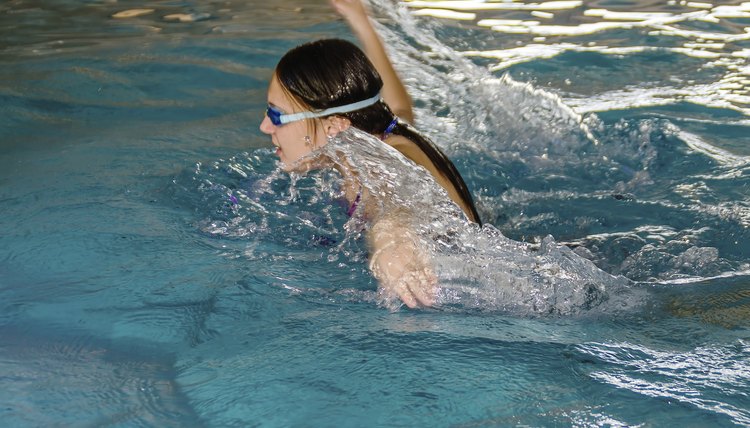
High school swim teams typically select its members with a swim tryout. Standards vary widely from school to school. Some may have a select varsity team, a "B" or junior varsity team and a freshman team to develop swimmers for the varsity program. In many states, elite high school swimmers have Olympic Trials qualifying times. Lesser school programs may welcome swimmers of varying skill and operate more as an activity, with the less-experienced swimmers getting opportunities to compete in the "B" heats. Whatever the case, you should prepare for tryouts by swimming on a team.
Join a Swimming Program
Competing as a high school swimmer is difficult unless you have some competitive swimming experience. Swimming programs range from recreational summer teams at neighborhood pools local youth clubs to more intensive year-round programs. The top national swimming organizations offer training for novices as well as intermediate competitors and potential Olympians. These programs can help you build swimming strength, refine your stroke mechanics and improve your breathing techniques -- allowing you to add speed and endurance.
Master the Competitive Basics
Through team experience you can learn how to swim efficiently for different race lengths while mastering the fundamentals of competition. Smooth starts, proper body alignment, steady pace, consistent mechanics, regulation stroke form, lane awareness, powerful flip turns and strong finishes will go a long way toward impressing a high school coach. Once you know the mechanics, practice these basics regularly to improve your chances of making the team after tryouts.
Build Endurance
High school teams don't have a lot of time to prepare for the season, so practices can be intense. Teams swim a lot of laps, day after day after day. It is not unusual for a coach dealing with an overflow of students during tryouts to simply swim the group down to a more workable number. Aspiring high school swim team members must build endurance before the tryout process begins while being careful not to overtrain. Many swim clubs offer training programs specifically designed to prepare for high school tryouts and swimming.
Learn All Four Strokes
High school teams need backstroke, breaststroke and butterfly swimmers along with freestyle swimmers. Coaches divide their team into sprinters and distance swimmers, identifying candidates for each of the individual and relay events. The most versatile swimmers may get an opportunity to swim the individual medley events. Mastering all the strokes gives you a better opportunity to make the team and earn an important role.
References
Writer Bio
Jeff Gordon has been reporting and writing since 1977. His most recent work has appeared on websites such as eHow, GolfLink, Ask Men, Open Sports, Fox Sports and MSN. He has previously written for publications such as "The Sporting News" and "The Hockey News." He graduated from the University of Missouri-Columbia School of Journalism in 1979 with a bachelor's degree.