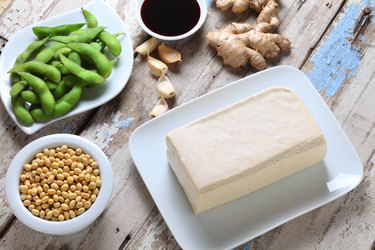
The discussion around soy is just as controversial as the egg debate. Some people think soy is linked to breast cancer and feminizing effects in men while others peg soy as the best plant-based protein.
Spoiler alert: Soy isn't bad for you. With the explosion of plant-based diets, soy can be a high-quality protein for those trying to cut back on animal foods.
Video of the Day
Video of the Day
We recognize sex and gender are not binary; however, studies on this topic categorize females and males as women and men, which is why we use this language in this article.
Why the Soy Controversy?
Soy is rich in nutritional compounds called isoflavones. These isoflavones are at the root of the soy controversy.
Isoflavones in soy are called phytoestrogens, which have a similar structure to human estrogen and allow them to bind to estrogen receptors in the body. This fact alone had mistakenly led some to believe that soy is linked to breast cancer, can interfere with fertility and should be classified as an endocrine disruptor, according to March 2021 research in Critical Reviews in Food Science and Nutrition.
But these claims haven't been proven, and research has actually shown the opposite effect.
While phytoestrogens act like estrogens, the way they behave at a molecular level is quite different, showing affinity to one estrogen receptor (beta) over another (alpha) — while human estrogen does not show this preference, according to March 2021 research in Reproductive Toxicology. This changes the way soy acts physiologically and may actually help explain the benefits of soy.
Soy Nutrition
Soy is a legume but has a nutrient profile that outshines any of its cousins (such as the peanut or the chickpea). Soy is a unique plant because it contains all nine essential amino acids, which makes it comparable to animal protein in terms of nutrient quality.
Soy comes in many different forms, and the way it's processed can affect its nutritional profile. For products using soy protein concentrate or soy protein isolate (both used in energy bars, shakes and cereals), the processing matters.
Soy protein concentrate processed in water has a higher isoflavone amount than processing in alcohol, although both are rich in protein.
The most recent 2020-2025 Dietary Guidelines for Americans give the nod to fortified soy milk and soy yogurts as the most nutritious alternatives to dairy milk.
Soy Milk | Edamame | Tempeh (cooked) | Soybeans (roasted) | Tofu (soft) | |
|---|---|---|---|---|---|
Serving Size | 1 cup | 1/2 cup | 3 oz. | 1 oz. | 3 oz. |
Calories | 100 | 94 | 166 | 126 | 52 |
Protein | 7 g | 9 g | 17 g | 12 g | 6 g |
Carbs | 8 g | 7 g | 7 g | 8 g | 1 g |
Fat | 4 g | 4 g | 10 g | 6 g | 3 g |
Isoflavones | 6 mg | 16 mg | 30 mg | 42 mg | 19 mg |
Soy and Breast Cancer Risk
Early animal studies showed that eating soy was linked to an increased risk of breast cancer, mainly due to the isoflavones in soy. But this topic has been studied multiple times over, and the consensus is that eating soy protein does not increase the risk of developing breast cancer, according to a July 2021 systematic review in Nutrients.
There is some evidence to suggest that soy intake has a protective effect against developing breast cancer, but more evidence is pointing to the idea that this might only be true if the soy is eaten in early adolescence when breast tissue development happens, according to the Soy Nutrition Institute.
Not all is lost for those who didn't grow up with a lot of soy in their diet. A March 2021 study in Cancer Treatment and Research Communications looked at Chinese people with breast cancer who ate more soy early after their diagnosis and found that higher soy intakes were linked to a reduced risk of death from breast cancer. The lowered risk was more pronounced in premenopausal people, those on tamoxifen (a drug used to treat breast cancer) and those with triple-negative cancer.
Current research also suggests that one of the protective effects of soy post-diagnosis in cancer may be due to the ability of the phytoestrogens in soy to make the cancer cells more sensitive to cancer treatment, per October 2020 research in Biology. This may be why the results in the March 2021 Cancer Treatment and Research Communications study found a more pronounced effect in those taking tamoxifen.
Soy and Thyroid Health
For those who have hypothyroidism, the effects of isoflavones on thyroid function may be a cause for concern. The research has gone back and forth on the effects of soy on thyroid hormones.
In a March 2021 review in Critical Reviews in Food Science and Nutrition, the authors note that the research is too inconclusive to even make a speculation about the role of soy isoflavones on those who already have hypothyroid dysfunction.
But, soy doesn't seem to affect those with normal thyroid function.
Soy and Men
For men, hearing that soy contains a compound that could mimic estrogen might keep their intake at bay. But eating soy has not been found to increase estrogen levels in men, nor has it been found to decrease testosterone, according to the March 2021 meta-analysis in Reproductive Toxicology.
The debate on soy-producing gynecomastia (what some call "man boobs") can also be put to rest. An early case study came to light from one man who developed gynecomastia after drinking about 13 cups of soy milk every day, but multiple subsequent studies looking to find an association have not found one, according to the March 2021 review in Critical Reviews in Food Science and Nutrition.
There are many reasons why testosterone levels may shift, and some studies have shown small decreases in testosterone following soy supplementation, but it's not clear that it was the isoflavones causing the reduction. Illness, alcohol use and aging can all decrease testosterone levels, per the Cleveland Clinic.
Soy and Fertility
Some older research showed that soy could lengthen the time of the menstrual cycle — by about one day, which could affect ovulation. But this hasn't been proven to have an effect on fertility.
In a more recent study, researchers from the Harvard T. H. Chan School of Public Health looked at the link between BPA and infertility. BPA is connected to reproductive disorders, and it was found that BPA did not have an effect on the women who were actively going through fertility treatment who had one serving of soy two to three times a week.
But BPA did have an effect on fertility in the women who did not eat soy, per the March 2016 research in the Journal of Clinical Endocrinology and Metabolism. This suggests a possible protective effect of soy in people exposed to BPA.
Soy and Hot Flashes
One of the most recent and impressive study findings is the effect of soy on hot flashes in postmenopausal people. Those with menopause symptoms, including hot flashes, were separated into two groups: one that ate a low-fat, vegan diet with 1/2 cup of soybeans each day and a control group without any diet modifications.
The soybean group reported 84 percent fewer severe hot flashes, in addition to improved symptoms relating to mood and sexual function, according to October 2021 research in Menopause.
The amount of isoflavones given in the study was around 55 to 60 milligrams per day. This is a similar amount of isoflavones for most studies involving soy and a practical amount for most to get each day through a variety of soy foods.
Soy and Muscle Health
In the workout world, whey protein is the gold standard for building and maintaining muscle. For those who follow a vegan diet, whey isn't an option, but soy protein should be.
One study put looked at young men on an omnivorous diet with whey protein and another group of young men on a vegan diet with soy supplementation and measured changes in muscle mass and strength with resistance training. Both groups showed increases in muscle mass and strength, which suggests that soy is equal to whey protein in its ability to spur muscle gains, according to a February 2021 study in Sports Medicine.
Another study looked at supplementation of whey, soy or whey-soy blend — amounting to 16 grams of extra protein per day — in older men with low muscle mass. Over six months, all protein types helped maintain muscle mass equally, even without increased training, according to a February 2021 study in the Journal of the Academy of Nutrition and Dietetics.
In both of these studies, the total daily protein from foods and supplementation was not super high (it was around 1.5 to 1.6 grams per kilogram of body weight). FYI, getting more protein than the recommended daily allowance (which is 0.8 grams per kilogram of body weight) is necessary for those who do resistance training and for older adults to prevent sarcopenia (age-related muscle loss).
Soy and Osteoporosis
There is no consensus on the effects of soy and bone health, according to a January 2016 review in the Journal of Medicinal Food.
Many of the studies in this area have been on animals, and while these types of studies are important and point to areas of future research, it's difficult to make inferences about the human population.
Plus, the authors of the above review say that there are more factors involved that make this inconclusive, such as race differences, genetic differences, exercise programs and soy isoflavone intake.
Soy and Heart Health
The debate on the benefits of soy for heart health is as strong as the soy controversy itself. There is no conclusive evidence to suggest that soy is largely beneficial to heart health.
But a recent review of three long-term studies, the first starting back in 1984 and ending in 2013, saw an association between tofu — not other soy products — and heart health. People who ate tofu had a lower risk for developing coronary heart disease, according to an April 2020 review in Circulation.
The authors note some reasons why they found this to be true: the special binding of estrogen receptors, the effect of isoflavones on cholesterol and gut health benefits. Plus, it's possible that those who choose to eat tofu also make other nutritious plant-based diet choices, which is great for heart health overall.
Can You Eat Soy Every Day?
Yes, you can eat soy every day.
The typical daily isoflavone intake for those living in Japan is 30 to 50 milligrams per day, but people in the U.S. typically only get around 2.4 milligrams per day, per the Soy Nutrition Institute. Three servings of soy foods would give you about 75 milligrams of isoflavones per day, depending on the type of soy.
Whole and minimally processed soy foods, such as soybeans, tofu and tempeh provide the most isoflavones. Foods such as soy milk, soy yogurt and edamame provide a modest amount; and processed soy foods, such as meat substitutes, provide the least. Sadly, soy sauce does not provide isoflavones but it's a lower sodium option measure-for-measure than salt.
You can feel confident eating soy every day, but if you're concerned or you have been diagnosed with hyperthyroidism, have a conversation with your doctor about soy to see if it has a place in your diet.
Related Reading
- Nutrients: "Effect of the Intake of Isoflavones on Risk Factors of Breast Cancer—A Systematic Review of Randomized Controlled Intervention Studies"
- The Soy Nutrition Institute: "Systematic Review Supports the Safety of Soy for Women with Breast Cancer"
- Biology: "Phytoestrogens for Cancer Prevention and Treatment"
- Reproductive Toxicology: "Neither Soy Nor Isoflavone Intake Affects Male Reproductive Hormones: An Expanded and Updated Meta-Analysis of Clinical Studies"
- Cleveland Clinic: "Low Testosterone"
- Menopause: "The Women's Study for the Alleviation of Vasomotor Symptoms (WAVS): a randomized, controlled trial of a plant-based diet and whole soybeans for postmenopausal women"
- Sports Medicine: "High-Protein Plant-Based Diet Versus a Protein-Matched Omnivorous Diet to Support Resistance Training Adaptations: A Comparison Between Habitual Vegans and Omnivores"
- Journal of the Academy of Nutrition and Dietetics: "Daily Supplementation With Whey, Soy, or Whey-Soy Blended Protein for 6 Months Maintained Lean Muscle Mass and Physical Performance in Older Adults With Low Lean Mass"
- Circulation: "Isoflavone Intake and the Risk of Coronary Heart Disease in US Men and Women: Results From 3 Prospective Cohort Studies"
- Soy Nutrition Institute: "How Much Hidden Soy is in the American Food Supply?"