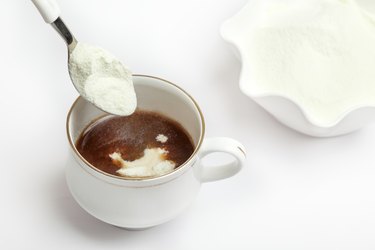
Dry instant milk is naturally rich in carbohydrates, protein and numerous vitamins and minerals that can help you meet many of your daily nutrient needs. While regular milk is a moderate source of dietary fat, dry milk is derived from skim milk and contains little of this nutrient. Some brands fortify dry milk with vitamins A and D, and the USDA provides nutrient values for both fortified and non-fortified dry instant milk.
Carbohydrates
Both non-fortified and fortified dry instant milk contain about 35.5 g of carbohydrates. The average adult needs about 225 to 325 g of carbohydrates each day, so a 1-cup serving of dry instant milk contributes about 16 percent of the typical adult's minimal daily carbohydrate needs. All of dry milk's carbohydrate content comes from sugar, specifically the natural milk sugar lactose. While sugar can help you meet your daily carbohydrate needs, the Institute of Medicine advises consuming less than 25 percent of your total calories from sugars and consuming most of your carbohydrates from starch and fiber.
Protein
Dry instant milk contains nearly 24 g of protein per 1-cup serving. The average adult generally needs between 50 and 175 g of protein each day, so a 1-cup serving of dry milk provides almost half the typical adult's minimal daily protein needs. Protein molecules are composed of amino acids. The body can produce some amino acids on its own, but many of them it cannot. It is therefore essential to consume these additional amino acids through dietary sources. Dry instant milk contains all essential amino acids, making it a biologically complete protein.
Fat
While dry instant milk is not a sufficient source of dietary fat, it does contains a trace of this macronutrient. Each 1-cup serving of dry instant milk contains about 0.5 g of fat, while the typical adult generally needs between 44 and 78 g of fat each day. The majority of the fat in milk is saturated, an unhealthy type of fat that can increase blood cholesterol levels and raise your cardiovascular disease risk.
Vitamins
Dry milk's greatest vitamin contribution is its B-vitamin content. A 1-cup serving contains a high dose of riboflavin, pantothenic acid, choline and vitamin B-12, with 1.2 mg, 2.2 mg, 114 mg and 2.7 mcg, respectively. Non-fortified dry instant milk also contains small to moderate amounts of vitamins C, A and E. Fortified dry instant milk contains a high dose vitamins A and D with 1,608 IUs and 299 IUs, respectively.
Minerals
Dry instant milk is naturally high, relative to typical percent daily values, in calcium, magnesium, phosphorous, potassium, zinc and selenium, with 837 mg, 80 mg, 670 mg, 1,159 mg, 3 mg and 19 mcg, respectively. It contains small to moderate amounts of iron, sodium, copper and manganese with 0.2 mg, 373 mg, 0.03 mg and 0.01 mg, respectively.
References
- USDA: National Nutrient Database for Standard Reference: Milk, Dry... Without Added Vitamin A and Vitamin D
- USDA: National Nutrient Database for Standard Reference: Milk, Dry... With Added Vitamin A and Vitamin D
- MayoClinic.com: Healthy Diet; End the Guesswork With These Nutrition Guidelines; February 2011
- Institute of Medicine: Dietary Reference Intakes; Macronutrients; 2005
- Institute of Medicine: Dietary Reference Intakes; Vitamins and Minerals; 2005


Member Comments