
How to Know If You've Hyperextended Your Shoulder
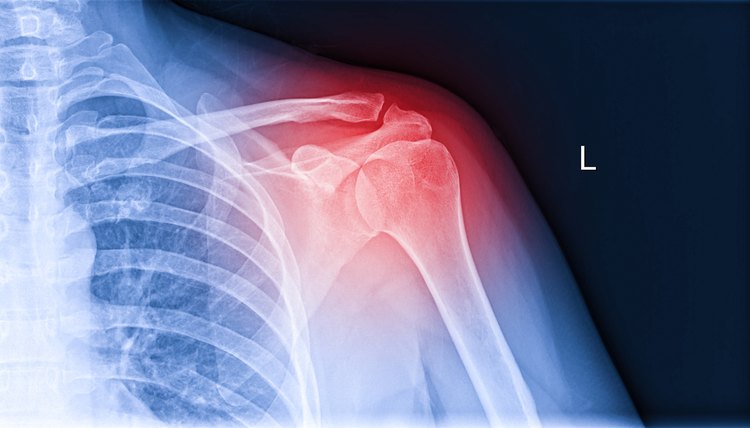
Feeling pain in your shoulder ligaments or rotator cuff? Has your range of motion been decreased? Well it's possible that you could be suffering a shoulder injury known as a shoulder hyperextension. This injury is a lot worse than a shoulder blade sprain or a bruised clavicle, which means you may have to ditch the over-the-counter ibuprofen and go straight to physical therapy. Here’s how you can tell if you have hyperextended your shoulder and how you can avoid risk factors.
What is shoulder hyperextension?

A shoulder hyperextension is also known as a shoulder dislocation. When you hyperextend your shoulder, the upper arm bone -- or humerus -- has become dislocated from the ball-and-socket joint of the shoulder known as the glenoid. This happens when a joint has moved too far past its normal capacity which can lead to the tearing of ligaments around the acromion and collar bone. This condition causes a lot of shoulder pain and requires immediate medical attention. This can be acute or chronic, as for some a dislocated shoulder can happen often as opposed to a one time thing.
What can cause shoulder hypertension?
Common causes of shoulder hypertension is overuse of the shoulder muscles due to daily activities or sports motions like throwing, rowing and more. It is also a common sports injury in contact sports as hypertension can be caused by trauma via a fall or hard tackle. Many sports medicine clinics are well equipped to handle this condition due to the frequency.
How to tell if you've hyper extended your shoulder?
Check for symptoms. You are likely to experience pain, inflammatory swelling, bruising and numbness if you have dislocated your shoulder. You may also experience muscle spasms.
Look in the mirror. Examine your shoulder for signs of a visual deformity. Your affected arm may appear to be longer than the other arm, or your shoulder joint may appear to be loose. This is caused by shoulder instability.
Visit a doctor or emergency room as soon as possible. A healthcare professional will take a medical history, inquire about how you injured yourself and examine you. A physical examination and an arthroscopy or x-rays will likely occur. At this point, your doctor will determine the appropriate treatment plan for you. A doctor will normally reduce -- or put back into place -- your shoulder joint. Severe pain will decrease shortly thereafter.
Sometimes orthopaedic surgeons may get involved to repair the shoulder or you may have to see a physical therapist. Often some sort of nonsteroidal anti-inflammatory drugs or anti-inflammatory medications will be prescribed as well.
Warning
Left untreated, shoulder hyperextension can cause permanent damage to the tendons and nerves of your shoulder and upper arm.
Expert Video from Mount Sinai Health System
References
Warnings
- Left untreated, shoulder hyperextension can cause permanent damage to the tendons and nerves of your shoulder and upper arm.
Writer Bio
Michelle Zehr started writing professionally in 2009. She has written on health, fitness, fashion, interior design, home decorating,sports and finance for several websites. Zehr possesses a Bachelor of Arts in communication from the University of Pittsburgh, a Master of Arts in professional writing from Chatham University and a graduate certificate in health promotion from California University of Pennsylvania.