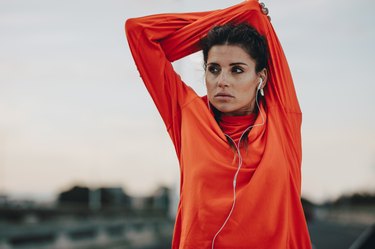
Most people's muscles feel tight a few hours after an intense workout. Such muscle tightness is part of a muscle injury known as delayed-onset muscle soreness, or DOMS. The exact causes of DOMS remain unknown, but scientists have recently started to understand its underlying mechanisms. This new information can help you prevent post-workout tightness and lower your injury risk.
Tip
It's easy to treat muscle tightness, but it's even easier to prevent it from happening. For example, isometric exercises like yoga don't cause tightness.
Video of the Day
Understand the Symptoms of DOMS
In addition to muscle tightness, people with DOMS notice several other symptoms. These changes include a decrease in muscle strength and a smaller range of motion. Your muscles will also feel swollen and thick. Combined, these effects decrease your athletic ability and life quality.
Video of the Day
A 2017 report in the Journal of Clinical Nursing noted that you may also experience muscle pain. People with muscle stiffness often have difficulty communicating about and managing this pain. You should make an extra effort to do so. Health care misunderstandings can have many negative consequences.
Read more: What Causes Leg Aches After Exercise?
Understand What Exercises Trigger DOMS
Doing certain types of exercise will trigger DOMS, according to a 2016 review in the Journal of Applied Physiology. Muscle-lengthening contractions where the force applied and result are in the opposite direction — negative work — reliably causes muscle tightness. In contrast, muscle-shortening contractions where the force applied and result are in the same direction — positive work — won't affect tightness.
For example, doing negative work like the downward stroke of a bench press, biceps curl or leg squat with enough weight will make you tight. Doing positive work such as the upward stroke of these exercises will not change the tightness of your muscles. You usually do both movements, so you'll end up feeling tight after most workouts.
Understand What Doesn't Cause DOMS
You damage your muscles during most workouts. The exact nature of this damage remains unknown. Many people think that microtears occur and that these tears explain the muscle tightness and other symptoms of DOMS. Yet these symptoms can happen without muscle damage or swelling.
Another common theory involves lactic acid. Most forms of stress trigger the release of lactic acid, and this chemical may play a role in muscle fatigue. Recent evidence, however, disputes the idea that exercise-induced changes in lactic acid cause DOMS. In fact, researchers now consider lactic acid a positive stress response.
A similar change of thinking may occur for creatine kinase. This marker allegedly correlates well with symptoms of DOMS. More creatine kinase usually means more DOMS. Yet a 2017 report in Antioxidants showed that DOMS continues after creatine kinase returns to baseline — at least in women.
Understand What Does Cause DOMS
Inflammation in the space between muscle fibers underlies exercise-related tightness and DOMS, according to a 2016 paper in the International Journal of Sports Medicine. This swelling comes with inflammatory chemicals released by satellite cells or muscle fibers.
Muscle inflammation, muscle tightness, muscle damage, creatine kinase and lactic acid don't mediate DOMS. Yet the authors of the 2016 paper have recognized these variables as important markers. They also suggest that exercise-induced decreases in muscle strength remain the best predictor of DOMS.
Understand the Timeline of DOMS
You damage your muscles during your workout. A few hours later, inflammatory chemicals invade your muscles, causing you to experience muscle sickness. This sickness challenges your immune system, which releases healing chemicals. Within a week, the process ends with rejuvenated muscle fibers.
This process will change depending on the type of exercise you do, according to a 2015 report in the Journal of Strength and Conditioning Research. It takes you longer to recover from single-joint exercises like curls than multiple-joint exercises like squats.
Thus, distributing the load across many muscles appears to diminish muscle tightness.
Understand the Consequences of DOMS
The muscle tightness and the other symptoms of DOMS you experience after exercise ultimately lead to your muscles becoming stronger. But there's a price to pay for these improvements. Your performance degrades during the healing process, according to a 2017 report in Research in Sports Medicine. You are also more vulnerable to injury during the healing process — unless you're an elite athlete.
Understand the Treatments for DOMS
You can choose among many readily available treatments for muscle tightness and DOMS. However, some methods make you feel worse, and some methods put you at risk. However, natural methods can improve your health. Be sure to speak with a doctor before pursuing any method, because all treatments can produce side effects.
Take BCAA Supplements for DOMS
Branched-chain amino acids, BCAAs, have an immediate effect on the healing process triggered by exercise, according to a 2017 paper in Applied Physiology, Nutrition, and Metabolism. Thus, taking these essential amino acids or their metabolites should help your muscles recover after extended periods of exercise. A study described in Nutrition and Enhanced Sports Performance tested this hypothesis in soccer players.
Participants received daily supplements of leucic acid — a metabolite of the essential amino acid leucine — for four weeks. Compared to the placebo group, players in the supplement group had milder DOMS. They also had greater muscle mass by the end of the study. The researchers didn't notice any major side effects, and the U.S. Food and Drug Administration considers leucine safe. However, you should check with your doctor before taking any supplement.
Read more: What Are BCAA Supplements?
Try Vibration Therapy for DOMS
A 2018 review in the Journal of International Medical Research looked at another safe treatment for muscle health. Vibration therapy can provide many health and treatment benefits. In their review, the authors found that vibration therapy decreased symptoms of DOMS and levels of creatine kinase. A study in the Yonsei Medical Journal looked at the effects of a similar treatment on muscle tightness.
Healthy adults with tight hamstrings received extracorporeal shock-wave therapy, ESWT, three times a week for a month. Compared to controls, subjects given ESWT showed an increased range of motion. Amazingly, combining ESWT and stretching led to long-lasting changes in the participants' flexibility. That is, the subjects kept their enhanced flexibility for at least a month after the interventions.
Use Heat Treatment for DOMS
Applying heat may produce similar effects as vibration therapy. In both cases, an increase in blood flow may underlie the positive effects on sore muscles. A 2016 report in the Journal of Clinical Sciences explored this possibility in healthy adults.
The researchers intentionally caused DOMS by making the participants do repeated biceps curls. Subjects then received either 20 minutes of infrared radiation therapy or no treatment. Compared to controls, participants given irradiation showed less DOMS for the next three days. Thus, irradiation had an immediate effect on muscle tightness.
The authors of the 2016 report found a similar effect on DOMS by having the subjects do a few minutes of warmup exercises. However, the symptoms of DOMS persisted until the second day of the healing process. Warmup exercises, thus, take longer to prevent DOMS than irradiation. Nonetheless, this positive finding is consistent with the common-sense advice of using a warmup routine to prevent DOMS.
Wear Compressive Clothing for DOMS
Wearing the right clothing may give you another easy way to prevent post-exercise muscle tightness. Compressive garments give athletes many advantages, including enhanced jump height and foot speed. A study in the Journal of Strength and Conditioning Research looked for other benefits of compressive clothing in marathon runners.
The scientists tested the participants two weeks before and two weeks after a marathon. Subjects in the treatment group wore compression socks immediately after the race. Compared to no treatment, runners in the treatment group showed greater recovery. Endurance increased 2.6 percent in the treatment group. It decreased 3.4 percent in the control group.
Compression tights have a similar effect on athletic recovery, according to a 2019 report in the journal Evidence-Based Complementary and Alternative Medicine. These researchers found that compressive garments decreased levels of creatine kinase.
Scientists must do more research on such treatments in the future, but you can benefit from their hard work today.
- Journal of Clinical Nursing: Understanding Symptom Experiences of Muscle Tightness From Patients’ and Clinicians’ Perspectives
- Journal of Applied Physiology: Muscle Damage and Inflammation During Recovery From Exercise
- Antioxidants: Effect of Gender and Menstrual Phase on Serum Creatine Kinase Activity and Muscle Soreness Following Downhill Running
- International Journal of Sports Medicine: Susceptibility to Exercise-Induced Muscle Damage
- Journal of Strength and Conditioning Research: Dissociated Time Course of Muscle Damage Recovery Between Single- and Multi-Joint Exercises in Highly Resistance-Trained Men
- Research in Sports Medicine: Impact of Stretching on the Performance and Injury Risk of Long-Distance Runners
- Nutrition and Enhanced Sports Performance: Alfa-Hydroxy-Isocaproic Acid—Effects on Body Composition, Muscle Soreness, and Athletic Performance
- Journal of International Medical Research: Does Vibration Benefit Delayed-Onset Muscle Soreness?
- Yonsei Medical Journal: Effect of Extracorporeal Shock Wave Therapy on Hamstring Tightness in Healthy Subjects
- Journal of Clinical Sciences: Comparative Study of the Effects of Infrared Radiation and Warm-Up Exercises in the Management of DOMS
- Journal of Strength and Conditioning Research: Compression Socks and Functional Recovery Following Marathon Running
- Evidence-Based Complementary and Alternative Medicine: Effects of Compression Tights on Recovery Parameters After Exercise Induced Muscle Damage
Is this an emergency? If you are experiencing serious medical symptoms, please see the National Library of Medicine’s list of signs you need emergency medical attention or call 911.