
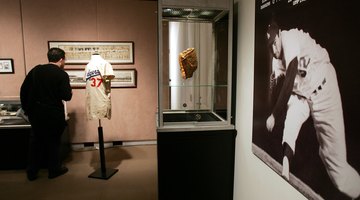


Baseball was fully ingrained in the American cultural experience by the start of the 1930s. Much of this was due to the home run slugging of Babe Ruth, who drew fans to the game because of his ability to hit the long ball and because of his outsized personality. Baseball's grip on the American public would grow dramatically during the next 20 years.
Baseball Integration
For the first half of the 20th century, major league baseball had been a sport for white players only. African-Americans played baseball in the Negro Leagues, and many were brilliant athletes. But baseball history changed when the Brooklyn Dodgers signed Jackie Robinson. In 1947, Robinson integrated major league baseball. He endured racist behavior and attitudes from fans, opponents and teammates. Nevertheless, Robinson endured and thrived. He hit .297 and won the Rookie of the Year Award in 1947. His 10-year career earned him a spot in baseball's Hall of Fame. More importantly, Robinson paved the way for African-Americans and other minorities to enter the major league. He also played a key role in the civil rights movement, serving as a role model for anyone who wanted to break down social barriers.
Yankee Domination
The Yankees had established themselves as one of baseball's better teams in the 1920s when they won three World Series championships. However, they became baseball's best overall team in the 1930s and 1940s. They won the 1932 World Series by sweeping the Chicago Cubs in four straight games. That victory featured Babe Ruth famously calling his shot when he pointed to the center field bleachers at Wrigley Field before bashing a long home run and then laughing at the beleaguered Cubs as he circled the bases. The Yankees won four straight World Series titles between 1936 and 1939 and added four more World Series titles in the 1940s.
All-Star Game
The All-Star game was first played in 1933 and was so successful that the annual game between the best players in the American and National Leagues has become known as the "Midsummer Classic." The first All-Star game was played in Chicago's Comiskey Park. The American League won 4-2 in a game that featured a Babe Ruth home run. The All-Star game would serve as the only meeting between players in both leagues besides the World Series until baseball began interleague play in 1997.
Star Players
Baseball saw a generation of stars play in the 1930s and 1940s. Perhaps the two best of the era were Joe DiMaggio of the New York Yankees and Ted Williams of the Boston Red Sox. DiMaggio was a brilliant center fielder who was the game's best all-around player until Willie Mays started playing in the 1950s. Many historians regard Williams as the best hitter in baseball history. The National League featured stars such as Stan Musial of the St. Louis Cardinals, Mel Ott of the New York Giants and Gabby Hartnett of the Chicago Cubs.
Related Articles








References
Writer Bio
Steve Silverman is an award-winning writer, covering sports since 1980. Silverman authored The Minnesota Vikings: The Good, The Bad and The Ugly and Who's Better, Who's Best in Football -- The Top 60 Players of All-Time, among others, and placed in the Pro Football Writers of America awards three times. Silverman holds a Master of Science in journalism from the Medill School of Journalism.