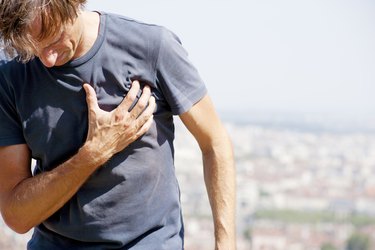
In many respects, heart disease is an equal opportunity killer, taking deadly aim at men and women alike. In fact, according to the U.S. Centers for Disease Control and Prevention (CDC), cardiovascular illness ranks as the number one cause of death for both sexes.
Every year, roughly 610,000 American men and women succumb to the disease — a figure that, according to the CDC, accounts for about a quarter of all American fatalities. But heart disease is not entirely gender neutral, especially when it comes one of the main causes of cardiovascular death: heart attacks.
Video of the Day
Video of the Day
Heart Attacks & Men’s Heart Disease
Every year about 735,000 people experience a heart attack, states the CDC, with about 525,000 being first-time heart attacks. Men are much more prone to heart attacks across their lifespan than are women, according to the American Heart Association (AHA). What's more, the Norwegian Tromsø Study, published in the November 2016 issue of JAMA Internal Medicine, found that men are about twice as likely as women to experience a heart attack at some point in their life.
Exactly why that's the case remains somewhat of a mystery. Tromsø investigators tracked nearly 34,000 men and women, including about 2,800 who experienced a heart attack sometime between 1979 and 2012. After analyzing gender differences in terms of cholesterol levels, high blood pressure, diabetes, high body mass index and physical activity habits, the team found that none of these traditional risk factors for heart disease could explain the huge gender gap in heart attack risk.
Read more: The 14 Best Foods for Your Heart
Estrogen May Protect Women
We also know that women tend to have heart attacks later in life than men. "Men experience an increased risk of heart attack about 10 years earlier than women," notes Michael Joseph Blaha, MD, director of clinical research at the Johns Hopkins Ciccarone Center for the Prevention of Heart Disease. Specifically, a man's heart attack risk starts to rise at age 45, while a woman's risk rises at age 55, according to the Mayo Clinic.
Why are men more prone to heart attacks than women? "Women appear to be more protected from atherosclerosis prior to menopause, after which they start catching up to men in terms of heart disease risk," Dr. Blaha explains. Atherosclerosis, when arteries get clogged by plaque deposits, sets the stage for a heart attack.
So what changes with menopause? The most clear-cut shift is that levels of the female hormone estrogen start to fall. That's what has led many experts to believe that high pre-menopausal estrogen levels are the secret weapon shielding younger women from heart attacks, according to the Cleveland Clinic.
The Tromsø study failed to find any evidence in support of the estrogen theory, despite concluding that women do face an increasing risk for heart attacks as they age. And the AHA notes that, even after a woman reaches menopause, her risk for a heart attack still remains somewhat less than that of a similarly aged man.
Look for the Warning Signs
Even if the reasons for higher risk among men are not entirely clear, what are clear are the signs that men should be aware of.
Erectile dysfunction is one such early-warning sign of heart trouble, according to Johns Hopkins Medicine. The penis is a vascular organ much like the heart, but its arteries are smaller. The arterial narrowing that can lead to sexual dysfunction might also indicate heart trouble developing in arteries closer to the heart.
Of course, know all the warning signs of an imminent heart attack. "Men should be on the lookout for chest pain and increasing shortness of breath with exertion," says Dr. Blaha. But don't rely on only obvious signs. It's possible to experience a heart attack even in the absence of classic chest pain. "Typically, these men felt increasing shortness of breath, fatigue or low energy in the days to weeks before a heart attack," he points out.
What should a man do if he thinks a heart attack is actually underway? Dr. Blaha's advice is simple: "Chew an aspirin and seek emergency care right away." That means call 911 — don't attempt to drive yourself to the hospital. EMTs can start treatment as soon as they reach you.
- CDC: "Heart Disease Facts"
- U.S. Centers for Disease Control and Prevention: “Men and Heart Disease”
- American Heart Association: “Understand Your Risks to Prevent a Heart Attack”
- American Heart Association: “Heart Attack or Sudden Cardiac Arrest”
- Mayo Clinic: “Heart Attack”
- JAMA Internal Medicine: “Lifelong Gender Gap in Risk of Incident Myocardial Infarction: The Tromsø Study.”
- Cleveland Clinic: “Estrogen and Hormones”
- Johns Hopkins Medicine: “Special Heart Risks for Men”
Was this article helpful?
150 Characters Max
0/150
Thank you for sharing!
Thank you for your feedback!
Is this an emergency? If you are experiencing serious medical symptoms, please see the National Library of Medicine’s list of signs you need emergency medical attention or call 911.