
What does fact checked mean?
At SportsRec, we strive to deliver objective content that is accurate and up-to-date. Our team periodically reviews articles in order to ensure content quality. The sources cited below consist of evidence from peer-reviewed journals, prominent medical organizations, academic associations, and government data.
- American Council on Exercise: Strength Training 101
- American Council on Exercise: Energizing Your Life With Strength Training
- American Council on Exercise: Strongman Training for Your Clients
The information contained on this site is for informational purposes only, and should not be used as a substitute for the advice of a professional health care provider. Please check with the appropriate physician regarding health questions and concerns. Although we strive to deliver accurate and up-to-date information, no guarantee to that effect is made.
What Types of Weightlifting Training Do Prison Inmates Do?
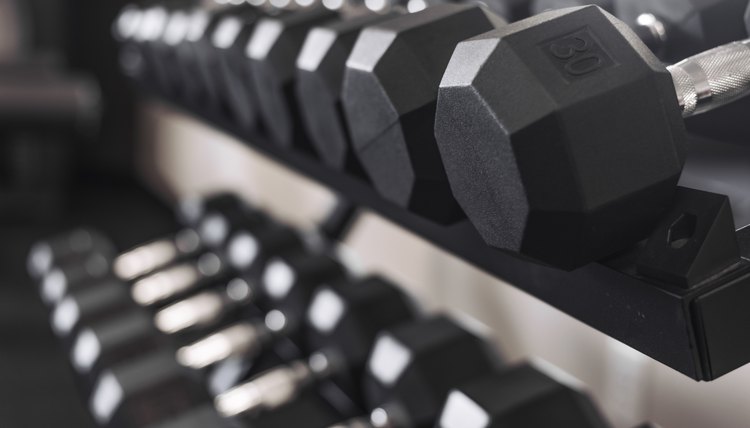
Inmates manage to get fit despite not having full fitness gyms in prison. Whether it's in the rec yard or within a cell, inmates lift weights. Depending on the facility, there is weightlifting equipment for inmates such as dumbbells, barbells and a bench. Inmates also get creative and fill 2-liter bottles with water or use a bucket of wet towels for curls. Inmates' weightlifting training consists of powerlifting and strength training.
Going to the Yard
One-hour rec isn't just an opportunity for inmates to go outside and get a breath of fresh air; it's also a chance to lift weights. The yard has dip-bars, pullup bars, dumbbells, barbells and benches. Inmates often do pushups, dips or pullups in their cell. When they go to the yard, it's often to use dumbbells, barbells and the bench to weights for strength and muscle mass.
The Importance of Size
In prison, size matters. It's a violent environment, and size can often be a matter of life and death. Bullying goes on, fights happen, rapes take place and inmates murder inmates. The smaller an inmate is, the more vulnerable that inmate is to violence. Inmates' survival is associated with lifting weights, getting big and getting strong.
The Strength of Powerlifting
Prisoners often powerlift, which involves exercises like the deadlift, the squat and the bench press. Powerlifting works the ability to administer muscular force against an external resistance, notes the American Council on Exercise. This form of training is ideal for inmates because powerlifting focuses on strength, pulling and pushing. An inmate may have to exert muscular force in pushing away another inmate in self-defense; powerlifting provides that physical power.
Building Muscle With Strength-training
Strength-training exercises involve body weight, weight machines, resistance bands and free weights. Strength-training is ideal for inmates because it strengthens bones and muscles, and it builds muscle mass. In prison, size often projects fear. Inmates tend to lift heavy weights and do push ups for an intimidating, hulking image -- big arms and a massive chest. Since powerlifting involves lifting the most amount of weight, the reps aren't as high as strength-training exercises, which use at least eight reps
References
- The New York Times: Sidewalk Is His Prison Yard
- The New York Times: Inmate Was Considered 'Property' of Gang, Witness Tells Jury in Rape Lawsuit
- American Council on Exercise: Strength Training 101
- American Council on Exercise: Energizing Your Life With Strength Training
- American Council on Exercise: Strongman Training for Your Clients
Writer Bio
andRe Christos Helios began writing and editing for college students in 2009, covering criminal justice, theology and English. In 2013, Helios became a sports writer for Rant Sports. He also authors two blogs. Helios is certified in complementary and alternative medicine and majored in biology at IONA college.