
Can You Butter With a Stiff Snowboard?
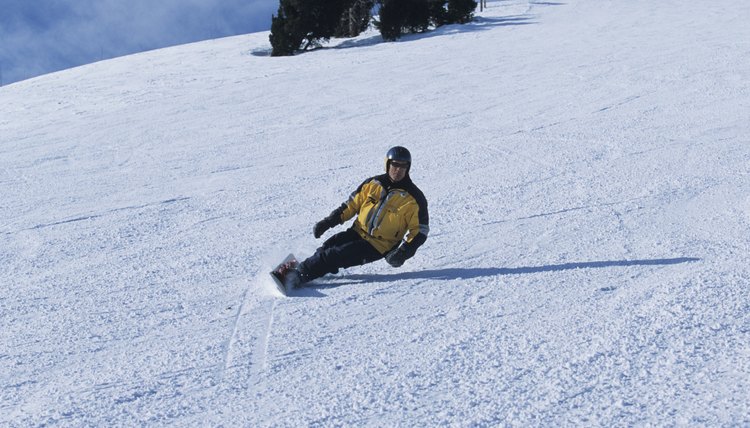
Unlike more advanced slope-style tricks, the butter maneuver will allow you to keep your board on the snow. According to ABC-of-Snowboarding, buttering involves rotating 360 degrees while balancing on the nose or tail of the snowboard. While buttering on a stiff snowboard is possible, it can be quite difficult without the proper setup and technique.
Stiff Decks
While a stiff snowboard will help to increase your speed capabilities, it will make the buttering technique more difficult. The lack of flex will make it harder to transfer your body weight between the opposing ends of the board. The length of the deck also will affect your overall success in the butter maneuver. If you prefer to ride a stiff snowboard, choose one that features a more compact design. This will allow you to easily lift the nose or tail off the riding terrain while buttering.
Binding Position
When attempting the buttering technique on a stiff snowboard, you'll need to make sure the bindings have been placed on the centermost mounting holes. Bindings that have been set farther back toward the tail will make it virtually impossible to balance on the nose of the snowboard. The width of your snowboard stance also will affect your ability to perform the butter maneuver. When riding a stiff snowboard, choose a stance that roughly corresponds to the width of your shoulders.
Nose Butter
The nose butter involves balancing on the front end of your stiff snowboard deck. Choose a mellow slope that features a finely groomed terrain, as this will help to prevent you from catching an edge during the learning process. Ride forward with your non-dominant foot in the lead position. Tru Snow recommends winding up your shoulders prior to the butter technique. Shift your body weight forward to balance on your front foot. Spin your shoulders in the direction of the spin to execute the nose butter. Lower your back foot onto the ground as you complete a 360 spin.
Tail Butter
Many novice riders feel more comfortable with the technique of the tail butter because it allows you to balance on your dominant foot. Choose a groomed terrain to avoid catching an edge during your flat ground spin. Shift your body weight onto your back foot as you reach a comfortable speed. Elevate your front foot slightly while swinging your shoulders in the direction of the spin. Lower your front foot onto the riding terrain as you complete the rotation.
Resources
Writer Bio
Philip Foster has been writing professionally since 2010. His work has been featured in the literary-arts magazine "The PEEL" and the weekly newspaper "The Mountain Xpress." Foster is an expert in various extreme sports. He cooked in a restaurant that offered organic and vegetarian cuisine for over three years. Foster received a Bachelor of Arts in creative writing from Appalachian State University.