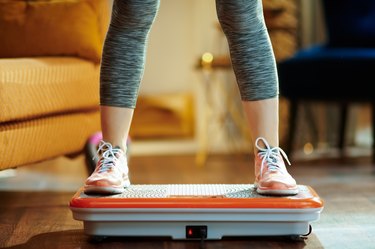
Vibrate your way to a slimmer, fitter you. Just strap yourself to a piece of equipment turn it on and watch your body be transformed. But, does it work? Considering vibration plate exercise machines can be costly, it's wise to find out before you buy whether or not they're a scam.
Tip
While use of a vibration plate won't melt fat off your body, it can lead to improved strength and power when used as part of a training program.
Video of the Day
Read more: Does a Vibrating Belt Reduce Belly Fat?
Video of the Day
The Equipment, the Claims
Vibration exercise is done on a piece of equipment that vibrates your whole body from your feet up. There is more than one brand on the market, but they all have similar designs. The vibration equipment resembles a treadmill without the long deck: it has an upright front piece with a display screen, controls and a hand rests.
Where the treadmill belt should be is where the vibrating plate is located. You stand on the plate while it vibrates 30 to 50 times per second. Vibration exercise is supposed to help you lose weight, increase power and flexibility, prevent muscle loss, improve bone density and even decrease cellulite and eliminate toxins from your body.
Effectiveness of a Vibration Plate
If you're looking for proof that vibration exercise will melt the pounds away, the comprehensive research to support that doesn't exist. However, according to a small January 2018 study published by PLOS One, total energy expenditure during 20 minutes of exercise was higher when performed on a vibrating platform, compared to a static surface.
Exercising on a vibration plate can have other health benefits. According to an August 2014 article published by the Journal of Musculoskeletal and Neuronal Interactions, use of a whole body vibration plate has been shown to improve jumping height and sprinting performance.
In addition, use of a vibration plate during isometric elbow flexion exercises increases co-contraction of muscles around the joint — in this case, the biceps and triceps.
Read more: Weight Loss Vs. Loss of Inches
Sample Vibration Plate Workout
People who are out of shape and considered sedentary can start their vibration exercise workouts by simply standing on the plate, knees flexed. This is supposed to stimulate natural muscle contractions and get blood flowing. People who are used to exercise can add actual exercise movements while on the equipment to enhance the effects of both the vibration plates and the exercise.
Some of the exercises you can do on vibration equipment include squats, calf raises, front and side lunges, pelvic thrusts done with your feet on the equipment while lying with your back on the floor, push-ups both with your hands on the vibrating deck and also with your feet on the deck, triceps dips done from the deck, and scissors exercise for your abs done while seated on the deck.
Resistance bands with handles can be attached to the sides of the equipment to add resistance for exercises such as bicep curls and upright rows, both done while standing on the vibrating deck.
- Journal of Musculoskeletal and Neuronal Interactions: "A comparison of different vibration exercise techniques on neuromuscular performance"
- PLOS One: "Metabolic effect of bodyweight whole-body vibration in a 20-min exercise session: A crossover study using verified vibration stimulus"
- Biodex: "LivMD Vibration Plate"