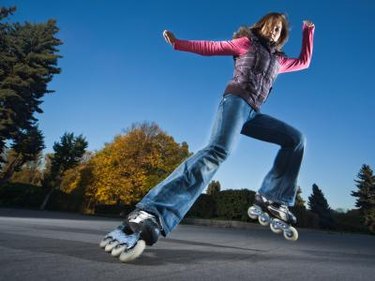
Whether for fitness or fun, rollerblading has serious benefits. You'll get a higher heart rate for cardio activity, spend time outside, and may just find a new hobby. Of course, there aren't training wheels for rollerblades. You'll need to start slow and practice your technique before you glide through the city park.
Gearing Up
Video of the Day
Your first area of concern is the rollerblades themselves. They should fit snugly and support your ankles according to the Texas A&M Agrilife Extension. If your ankles feel unsupported, try a smaller size or lace your rollerblades tighter. You'll also need a helmet and knee and elbow pads. Don't head out on blades before trying out the helmet for the right fit. A properly-fitted helmet sits squarely on the head, doesn't move back and forth or side to side, and won't have slack in the chip strap.
Video of the Day
Gaining Balance
The first rollerblading skill you'll need to master is the art of balancing. If you've ever been ice skating, you know balancing on such a thin strip is difficult. To get your bearings, try walking with your blades on a patch of grass first. Grass provides enough traction that you won't begin to roll. It's the best way to practice your balance before you get started. If there's no grass around, practice on gravel.
Getting Started
Once you feel comfortable balancing, look for a smooth, flat piece of ground where you can practice gliding. When you start rollerblading, your movements should be smooth and long. As you put one foot forward, push it back to glide before placing your other blade on the ground, alternating from foot to foot. Go slowly at first to test your abilities then pick up speed.
Quick Stop
While it's fine to hop on a patch of grass to stop, most roller blade sets come with a rubber stopper brake on the back of one blade. As you're ready to stop, shift your weight to the foot without the stopper. Bring your brake foot around so it's behind and perpendicular to your non-stopper, then gently apply pressure to the stopper to apply the brake. The t-shape of your feet should give you extra stability as you slow to a stop. Practice stopping skills on a flat surface before you try stopping on other terrain. If you don't have a heel brake, apply pressure across the full length of the blade and drag your back foot until you come to a stop.
Learn to Turn
Turning to switch directions or avoid obstacles requires the parallel technique. Once you have some forward momentum, scissor the leg opposite to the direction of the turn forward. If you're turning left, for instance, scissor your right foot over and in front of the left. Bend the corresponding leg into the turn as your right leg swings out and back to its starting position as it stabilizes the change in direction. Once you have the hang of it, you can speed up a turn by rotating your torso as your scissor legs swings around.