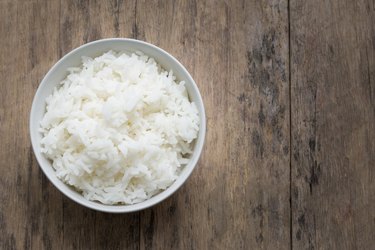
There are a few vitamins in rice, including vitamins E, K and B. Long grain brown rice contains higher amounts of these vitamins than white rice.
Tip
Rice contains vitamin B1, B2, B3, B6, B9, K and E.
Video of the Day
White and Brown Rice
The best way to understand the distinction between white rice and brown rice is to understand the distinction between whole grains and refined grains. Whole grains are mainly composed of 3 parts, according to Toby Smithson, a registered and licensed dietitian and national spokesperson for the Academy of Nutrition and Dietetics on ShareCare.
Video of the Day
The bran is the hard outer layer on the seed, the part that protects it. Note that the bran isn't the same as the husk. The husk is the actual outer covering of the grain, and is removed for both whole grains and refined grains. However, the bran is the layer just beneath the husk ,and isn't removed in whole grains. It is a rich source of minerals, antioxidants, and fiber.
The germ is the core of the grain, and is often rich in many different nutrients, such as fat, protein, carbohydrates, antioxidants, and many other different beneficial compounds, including most of the vitamins in rice.
The endosperm is the largest part of the cereal grain by size. However, it consists almost entirely of starchy carbohydrates, with only a small quantity of protein. In fact, the high starch content of rice is often considered one of the disadvantages of rice.
The main difference between brown rice and white rice is that brown rice is a whole grain that has been left intact. It has both the germ and the bran. It, therefore, has more nutritional content than white rice and contains plenty of antioxidants and fiber.
White rice, on the other hand, has been stripped of the bran on the outside and the germ on the inside. It, therefore, has lost its most nutritious component. This is done is so that white rice can have a longer shelf life, better taste, and a nicer cooking quality. However, the trade-off is that cooked white rice nutrition consists almost entirely of starchy carbohydrates, including amylose and amylopectin. This contributes to the disadvantages of rices that have been refined.
Different types of rice will have different amounts of each of these starches, which will affect their digestibility and texture. Rice that is high in amylopectin tends to be sticky, while rice that is high in amylose usually is not.
Vitamin B
According to Harvard P.H. Chan, there are eight B vitamins: B12 (cobalamin), B9 (folate), B7 (biotin), B6 (pyridoxine), B5 (pantothenic acid), B3 (niacin), B2 (riboflavin) and B1 (thiamin).
According to the USDA Food Composition Databases, 1 cup of wild rice contains 0.626 milligrams of vitamin B6 (pyridoxine), 1 cup of long-grain, enriched white rice contains 0.147 milligrams of vitamin B6 and 1 cup of long-grain brown rice contains 0.882 milligrams of vitamin B6.
One cup of wild rice has 152 micrograms of B9 (folate), 1 cup of long-grain enriched white rice contains 153 micrograms of vitamin B9 and 1 cup of long-grain brown rice has 43 micrograms of vitamin B9.
One cup of wild rice has 0.184 milligrams of vitamin B1 (thiamin), 1 cup of long-grain enriched white rice contains 0.528 milligrams of vitamin B1 and 1 cup of long-grain brown rice contains 1.001 milligrams of vitamin B1.
One cup of wild rice has 0.419 milligrams of vitamin B2 (riboflavin), 1 cup of long-grain enriched white rice has 0.021 milligrams of vitamin B2 and 1 cup of long-grain brown rice has 0.176 milligrams of vitamin B2.
One cup of wild rice contains 10.773 milligrams of vitamin B3 (niacin), 1 cup of long-grain enriched white rice has 2.332 milligrams of vitamin B3 and long-grain brown rice has 12.014 milligrams of vitamin B3.
While long-grain brown rice and long-grain, enriched white rice contain no vitamin A, 1 cup of wild rice has 2 micrograms of vitamin A.
Vitamin E
Vitamin E is found in white, brown and wild rices. Wild rice contains the most vitamin E of the three, with more than 6 times the vitamin E content of white and brown rice. This is according to a March 2015 study published in the Journal of the Science of Food and Agriculture on the vitamin E content of different rice varieties.
According to the USDA Food Composition Databases, 1 cup of wild rice contains 1.31 milligrams of vitamin E, 1 cup of long-grain enriched white rice contains 0.06 milligrams of vitamin E and 1 cup of long-grain brown rice contains 1.11 milligrams of vitamin E.
Vitamin E acts as an antioxidant, protecting the body from damage caused by free radicals. Free radicals are unstable molecules that have been linked to a host of diseases, including cancer. Vitamin E is also active in protecting cell membranes and the various fat-soluble tissues of the body from destruction.
Vitamin K
According to INRTracker.com, Vitamin K is very important in blood clotting and bone growth. This is because it is crucial in the transportation of calcium around the body. In fact, the ability of vitamin K to help blood clot has caused it to be utilized in treating warfarin overdoses. Warfarin is a blood-thinning medication.
According to the USDA Food Composition Databases, the highest amounts of vitamin K are found in wild rice, which contains 3 micrograms of vitamin K per cup. One cup of long-grain brown rice has 1.1 micrograms of vitamin K. Unfortunately, long-grain, enriched white rice doesn't contain any vitamin K.
- Harvard P.H. Chan: "B Vitamins"
- USDA Food Composition Databases: "Long-Grain Brown Rice"
- USDA Food Composition Databases: "Long Grain Enriched White Rice"
- NCBI: "Tocopherol and Tocotrienol Contents of Different Varieties of Rice in Malaysia"
- INRTracker: "Vitamin K in Rice, White, Long Grain, Precooked or Instant, Enriched, Dry"
- ShareCare: "What Are the Different Parts of a Grain?"
- USDA Food Composition Databases: "Wild Rice"