With passing time, your face's appearance shifts: Wrinkles form, jowls sag, double chins form and your neck and chin lose tautness. If you're waging battle against these changes, there are dermatological procedures — like fillers and other injections — that can help.
But what about non-medical remedies? If you're accustomed to buoying your health and wellness with regular workouts and a thoughtful diet, you might wonder if there's merit to facial exercises, which are often on view as you scroll social media.
Video of the Day
Video of the Day
We spoke to experts — and dug into the limited research available — to determine if facial exercise can help sharpen your jawline, firm jowls, eliminate so-called "turkey neck" or wattle or generally change your appearance.
Why Does Your Jawline and Chin Change as You Get Older, Anyway?
There's not just one reason why your face changes as you mature. There are several, such as:
- Loss of volume: It's one of the "main factors responsible for facial aging," says double board-certified facial plastic surgeon Konstantin Vasyukevich, MD of New York Facial Plastic Surgery. Collagen and elastin — two proteins — diminish with age, causing a loss of youthful plumpness.
- Loss of bone mass: With age, you'll lose bone mass and density, which changes the skeletal shape of your face, says board-certified dermatologist Elaine F. Kung, MD, a clinical assistant professor at Weill-Cornell Medical College and founder of Future Bright Dermatology. That can change the appearance of your face, making it less chiseled. Even changes to the gum tissue — which tends to recede with age, per the National Library of Medicine — and adjustments to your teeth placement can change how you look, Dr. Kung says.
- Gravity: "Part of the aging process is that our fat pads tend to descend," says Azza Halim, MD, of Azza MD, who focuses on aesthetic medicine, anti-aging treatments and regenerative medicine. When you're young, there's a fat pad in your cheek, under your eyes, per the Cleveland Clinic. But gravity pulls it down. "That's what causes a lot of drooping and sagging," Dr. Halim says.
- Genetics: This is a "huge factor," Dr. Kung says. It determines if your skin is oily or dry and other characteristics. For instance, if you have more melanin, you're more resistant to sun damage, which can lead to a more youthful appearance, Dr. Kung says.
- Weight fluctuations: "Repeated cycles of weight gain followed by weight loss would be a significant factor that accelerates sagging of the facial tissue around the jowls," Dr. Vasyukevich says.
- Lifestyle factors: If you're in Florida, like Dr. Halim, you're faced with constant sun. Other states may have less sunshine and a colder, dryer climate, which causes dehydrated skin, Dr. Halim notes. And it's not just the weather: diet, alcohol, smoking, sleep and other lifestyle choices can all have an effect on overall skin health, Dr. Kung says.
As you can see, you do have some control over certain factors that influence how skin changes with each passing year. You can opt to be diligent with sunscreen and stay hydrated, for instance. But of course, you can't overpower gravity or genetics with force of will, nor can you change your skin type.
Can Jawline Exercises Help?
Our three experts — Drs. Halim, Kung and Vasyukevich — were united in their response: No, doing facial exercises won't improve the appearance of your jawline and chin.
"I would not recommend facial exercises," Dr. Vasyukevich says. He notes the strength of your facial muscles doesn't affect the "rate of facial aging" or the firmness (or laxness) of your skin.
When it comes to facial and jawline exercises, Dr. Halim says they're "social media hype" and "not going to improve or enhance the face."
That is, if you're looking to tighten your neck, improve sagging jowls or sharpen your jawline, exercises are unlikely to further your efforts, according to the experts we consulted.
In fact, there's potential for facial workouts to lead to results you don't desire. Think of workouts as being the "anti-Botox," Dr. Vasyukevich says, with the potential to create more wrinkles and deep lines in your face, he says.
From a dermatologist's point of view, repeated movements with facial muscles — such as smiling, squinting or lifting your eyebrows — are a pathway to wrinkles, Dr. Kung points out.
5 Jawline Exercises to Try
So-called face yoga isn't likely to transform your neck, chin or cheeks. But if you're curious about giving your jawline a workout, Alejandra (Ali) Martinez CPT, a certified personal trainer at WRKOUT, shares five jawline exercises you can try at home.
1. Sound Out Vowels
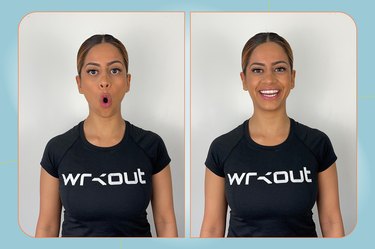
- Open your mouth wide.
- Say the letter “O” followed by the letter “E.”
- Hold each position for 1 second.
Tip
Exaggerate the sounds and movements, while not showing or touching your teeth, Martinez says.
2. Kiss the Sky

- Lift your chin, then nod your head back.
- Swallow while simultaneously pushing the tip of your tongue against the roof of your mouth.
3. Stretch Your Tongue

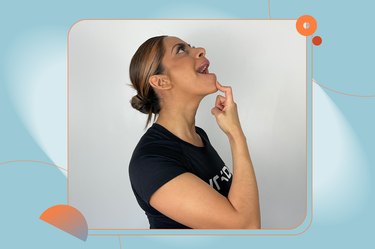
- Sit up straight. Slowly raise your chin so you're looking at the ceiling.
- Keep your shoulders relaxed to avoid neck strain.
- Stick your tongue out and down, trying to get the tip to touch your chin.
- Hold this position for 10 seconds, then relax.
- Repeat for a total of 3 sets.
Tip
“Tongue exercises are particularly good for flexing the jaw muscles,” Martinez says.
4. Smile Smoother
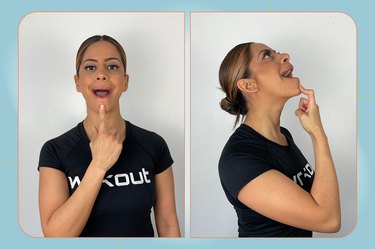
- Place your index finger onto the chin area. Make a smile shape with your mouth wrapping your lips around your teeth.
- Start to scoop your jaw backwards, opening and closing your mouth.
- Apply subtle pressure with your index finger as you start to tilt your chin up towards the ceiling without over-straining the neck, continue to open and close your mouth as you slowly tilt your head back down to starting position.
5. Chin Press
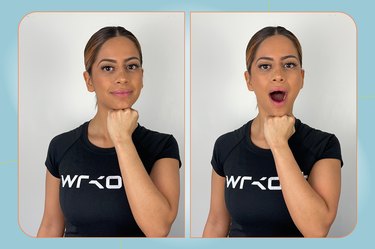
- Place your fist under your chin and begin opening and closing your mouth.
- Push your fist into your chin, applying resistance from your hand.
- Do not rush through the movement. Repeat for 1 minute.
- Rest before starting your next set.
How Effective are Jawline Exercises?
There are, however, some studies that point to a potential positive outcome with facial exercises. For example:
- In one small study, 16 adults learned facial exercises and did them at home for 20 weeks, for 30 minutes each session. To assess the effectiveness of the exercises, two physicians rated the fullness of the participants' cheeks and estimated their age. Per the March 2018 JAMA Dermatology results, cheek fullness improved and estimated age decreased. These are, of course, somewhat subjective ways to assess improvements.
- A December 2021 systematic review in the Journal of Korean Physical Therapy found while facial exercises improved cheek fullness and skin elasticity, the "level of evidence was low."
So, there is some limited evidence facial exercises may have benefits. Plus, if you have the time, to Dr. Kung, many of the facial exercises she sees online tend to promote relaxed muscles. That has potential benefits: Clenched and contracted muscles can emphasize signs of aging, she says.
Spending time on facial exercises may also have a bit of a halo effect, Dr. Kung says. That is, if you're spending time on these workouts, you may also be more likely to follow other skin-related best practices, such as wearing sunscreen, eating a balanced diet and so on.
Other Ways to Keep Your Skin and Face Looking Great
As highlighted earlier, many factors influence the appearance of your skin and face. Some strategies to improve the appearance of your skin include:
- Put on sunscreen: Use it regularly to prevent sun damage, Dr. Vasyukevich says. Try one of our picks for the safest sunscreens.
- Moisturize and wash your face: Use gentle cleansers, avoid products that sting and moisturize your face daily, per the American Academy of Dermatology Association (AAD).
- Follow a health-promoting diet and lifestyle: Eating a nutritious diet, getting enough sleep, abstaining from cigarettes and other healthy habits can all help your skin.
- Maintain a stable weight: Fluctuations in your weight can affect the appearance of your face.
- National Library of Medicine: "Aging changes in teeth and gums"
- Cleveland Clinic: "Minimally Invasive CheekLift"
- JAMA Dermatology: "Association of Facial Exercise With the Appearance of Aging"
- Journal of Korean Physical Therapy: "Effects of Facial Exercise for Facial Muscle Strengthening and Rejuvenation: Systematic Review"
- American Academy of Dermatology Association: "11 WAYS TO REDUCE PREMATURE SKIN AGING"