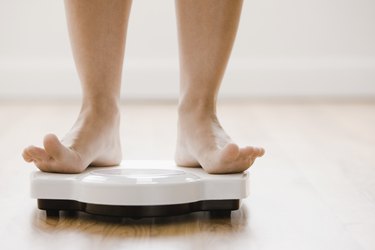
You've been working out and eating right, but the scale won't budge. For weeks, or even months, the same number flashes on the screen and you're getting discouraged. You're in the middle of a weight-loss plateau.
A stall in weight loss is totally normal, but it can be incredibly frustrating. With a few modifications to your diet and exercise habits, though, you should be able to get the scale moving again.
So, What Is a Plateau?
Plateaus are an inevitable part of any weight-loss journey, according to the Mayo Clinic, because as your weight changes, your body adapts. Think about it like this: When you are overweight, you burn through a lot of calories just going about your day-to-day activities, so weight tends to comes off quickly initially. As your weight drops, however, it takes less energy to move your body, you burn fewer calories and your weight loss grinds to a halt — unless you tweak your approach.
Keep in mind that many factors affect your ability to drop pounds. Before you determine that you're indeed experiencing a plateau, ask yourself whether some outside factor may be to blame: Have you made any significant lifestyle changes? Are you taking any new medications that might be influencing your weight? Is it possible that you've gotten lax about adhering to all aspects of your weight-loss program?
If the answer is no to all of those, keep this in mind: The scale isn't always the best marker of your progress because it can't differentiate between water, fat or muscle. Fluid regulation in the body is a, well, fluid process — it's constantly changing, so one pound up or two pounds down on any given day doesn't reflect any real changes in body composition.
To get the full picture, Joe Dowdell, a New York City-based personal trainer and strength coach, suggests tracking your chest, waist and arm circumference with a tape measure. You can also track your body-fat percentage if you have access to skinfold calipers or another method, but this should be done with the help of a trainer. "We never use a scale by itself to measure and monitor a client's progress," he says.
How Can You Push Past a Plateau?
First, don't get discouraged. Hitting a weight-loss plateau might tempt you to throw in the towel, but think about all the progress you've made so far and remember that you're still on track to better health. Instead of reverting to bad habits, try these tips to help get those numbers moving in the right direction again.
1. Keep a Food Journal
Write down everything you eat. Every bite — even those french fries you snuck off your friend's plate or the four bites you "tasted" of your kid's macaroni and cheese.
You may be surprised at what and how much you're actually eating. This kind of "loosening of the rules" is a big contributor to plateaus, according to the Mayo Clinic.
2. Get More Sleep
"Recent research is showing that adequate sleep is important for managing a healthy body weight," says Penny Kris-Etherton, PhD, RDN, LDN, a distinguished professor of nutrition at Penn State University.
In addition to focusing on diet and physical activity as important components to a weight-management program, research suggests that getting the recommended seven to nine hours of shut-eye each night can help with weight loss, and might prevent weight gain.
3. Cut More Calories
As your body mass goes down, your calorie needs do, too. So you may need to adjust your daily calorie goal in order to continue losing weight.
Just make sure you don't go to extremes. The Mayo Clinic recommends getting at least 1,200 calories per day — less than that can leave you hungry, which can lead to overeating.
4. Change Up Your Workout
If you've been doing the same exercises, it might be time to switch things up in order to increase your calorie burn.
Keep in mind that the current Physical Activity Guidelines for Americans, compiled by the Office of Disease Prevention and Health Promotion, encourage 30 minutes of daily exercise on most days to help maintain weight and fend off disease. Those who are trying to lose weight, though, should be aiming higher.
If you've mostly done cardio, like walking or jogging, up until this point, try adding weight-lifting into your routine. Adding lean muscle mass can help you burn more calories, according to the Mayo Clinic.
Prefer a group atmosphere? Try a HIIT class. HIIT stands for high-intensity interval training, which delivers a higher-calorie burn and keeps your metabolism revving long after the workout is done.
5. Watch Out for Sneaky Sources of Sugar and Starches
Read food labels carefully: Sauces, beverages and packaged foods all may contain more calories than you've bargained for.
Not confident when it comes to breaking down nutrition facts? Get up to speed with LIVESTRONG.com's guide.
6. Tame Your Stress
When you're stressed out, your body overproduces a hormone called cortisol, which may lead to increased fat storage, according to The American Institute of Stress. Stress may also lead you to reach for packaged and processed comfort foods (hello, emotional eating).
Try to decrease your stress by getting up and going for a walk, treating yourself to a massage, reading a book, meditating or spending time with a friend.