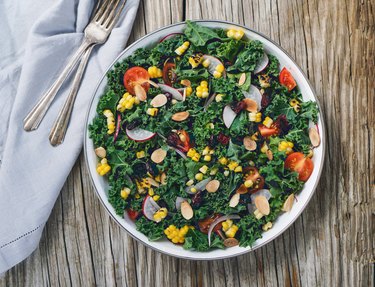
To lose weight, you need to reduce your calorie intake. But limiting your intake to 1,000 calories a day may make a diet difficult to follow over the long term and could potentially lead to nutritional deficiencies. If you're considering a 1,000-calorie diet to help you lose the weight, consult your doctor for ongoing support and guidance.
Read more: Small Diet Changes that Yield Big Results
Video of the Day
Video of the Day
Risks and Benefits of a 1,000-Calorie Diet
At a basic level, weight loss requires a calorie deficit, meaning you eat fewer calories than you burn, according to the Mayo Clinic. It's often said that one pound of fat equals 3,500 calories and so, cutting about 500 to 1,000 calories per day would theoretically spur one to two pounds of weight loss per week. But weight loss is a little more complicated than that. For example, lowering your caloric intake too far can make your body burn fat-free mass (aka lean muscle) rather than just fat, according to a December 2018 study published in Nutrients.
In fact, loss of fat-free mass is among the major drawbacks of a 1,000-calorie diet. According to the American Academy of Family Physicians, calorie restriction usually results mostly in the loss of water weight or lean muscle, not body fat. So while you could be losing pounds on the scale, the results may not be reflected in the mirror — and they might not last.
The lack of variety in a 1000-calorie diet can lead to malnutrition, sluggishness and a slower metabolism, according to the Academy of Nutrition and Dietetics. Severely cutting calories tricks your body into thinking it is in a famine condition, causing your metabolism to drop.
A 1,000-calorie diet is most likely to result in weight loss for individuals at a high starting weight. According to UCLA Health, a diet of 1,000 calories per day or less affects your body in the same way as total starvation. When individuals with obesity in particular are restricted to a very low-calorie diet, they can lose between three to five pounds per week. However, considering the dramatic shift this regimen spurs, it should be monitored by a medical professional.
Healthy Foods for a 1,000-Calorie Diet
To maximize every bite, you need to make very smart choices on your 1,000-calorie diet plan. For health and balance, you should consider the caloric density of your foods and choose wisely.
Fill your meals with leafy vegetables and fruits. Fruits and vegetables are both low in calories and high in fiber, which can help curb your hunger. For instance, while one-quarter cup of raisins contains around 100 calories, you can eat an entire cup of grapes for the same amount of calories. A small order of french fries has more than 200 calories, while a large salad might have the same caloric density.
Although a 1,000-calorie diet is certainly low, there is still room for snacks in your daily plan. Instead of choosing potato chips, opt for air-popped popcorn or fruits and veggies. Also consider the high-calorie beverages you may be sipping throughout the day. Trade your latte for a black coffee and turn your soda into a sparkling water.
Read more: 10 Surprising Foods That Will Fill You Up, Not Out
Example 1,000-Calorie Meal Plan
Breakfast
- 2-egg omelet
- 1 cup blueberries
- 1 cup black coffee
Total (according to the USDA): about 275 calories
Morning Snack
- 3 cups plain air-popped popcorn
Total: approximately 90 calories
Lunch
- 1/2 chicken breast
- 2 cups shredded lettuce
- 1 handful cherry tomatoes
- 1 small baked sweet potato
Total: roughly 260 calories
Dinner
- 3 oz. (1 serving) salmon filet
- 1 cup boiled or steamed broccoli
- 1/2 cup brown rice
Total: 300 calories
Dessert
- 1 1/2 cup strawberries
- 1 cup chamomile tea
Total: 70 calories
- Counting calories: Get back to weight-loss basics
- Nutrients: "Body Composition Changes in Weight Loss: Strategies and Supplementation for Maintaining Lean Body Mass, a Brief Review"
- American Academy of Family Physicians: "Nutrition for Weight Loss: What You Need to Know About Fad Diets"
- American Academy of Nutrition and Dietetics: "4 Metabolism Myths and Facts"
- UCLA Health: "Very Low Calorie Diet (VLCD)"
- Mayo Clinic: "Foods for weight control"
- USDA: "Egg, whole, cooked, omelet"
- USDA: "Blueberries, raw"
- USDA: "Popcorn, air-popped (no butter or oil added)"
- USDA: "Chicken, broilers or fryers, breast, meat only, cooked, roasted"
- USDA: "Cherry tomatoes"
- USDA: "Lettuce, cos or romaine, raw"
- USDA: "Sweet potato"
- USDA: "Fish, salmon, Atlantic, wild, raw"
- USDA: "Broccoli, cooked, boiled, drained, without salt"
- USDA: "Rice, brown, long-grain, cooked"
- USDA: "Strawberries, raw"